From the start of the 2020s, American businesses have been formidable in maintaining and growing their profits. Despite a gantlet of challenges — a pandemic, tariffs, high inflation and wars in key commodity hubs — profits have leaped ahead.
Corporate profits have reached a record share of the U.S. economy, data show. And a measure of margins that tracks the difference between input costs for businesses and the final selling price of goods and services to customers is also near a record high.
“It’s completely shocking,” said Josh Brown, the chief executive of Ritholtz Wealth Management. “Companies have become really, really good at managing risk. They are practically ninjas at this point.”
As the U.S.-Israeli war with Iran continues, causing energy prices to surge, the question is whether corporate America can pull it off again — dodging another economic shock by raising prices, finding efficiencies and new supply lines, or cutting back on hiring.
Johnson & Johnson, the drug and medical-device maker, reported strong earnings on Tuesday and increased its full-year earnings forecast. Executives acknowledged “macro uncertainty,” but said they did not see damage to their business yet. On Wednesday, Bank of America reported a jump in quarterly profit from a year earlier, partly because of strong consumer spending that indicated a resilient economy, said Brian Moynihan, the bank’s chief executive.
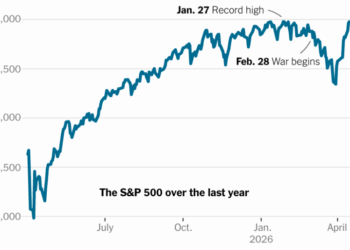
The S&P 500 index inched toward a record high at the start of trading on Wednesday.
Some economists are worried that this newest geopolitical hurdle may be the one that finally trips up U.S. businesses. They are lifting their recession probabilities, fearing that higher operating costs and falling revenues may freeze hiring and investment. Other analysts remain more bullish, expecting economic growth, and profit margins, to hold steady.
Sonu Varghese, the global macro strategist at the Carson Group, a financial firm, said many of the companies he tracked viewed inflation pressures from “outside shocks,” such as this war, “as an opportunity to raise prices and boosts margins,” which can, in turn, raise profits.
“I think we’re actually going to get some margin expansion,” Mr. Varghese added.
In early 2022, geopolitical volatility after the Russian invasion of Ukraine caused a surge in commodity prices, from wheat to crude oil. It exacerbated inflation and the chaos already riling supply chains because of the Covid-19 pandemic. But corporate profits rose alongside inflation from 2021 to 2022, reaching new highs.
Data from the U.S. Producer Price Index, which tracks the inflation that businesses experience, showed that wholesalers and retailers generally expanded the margin between their sales prices and their cost of acquiring goods.
Four years later, another test similar to 2022 is emerging.
Iran’s effective closure of the Strait of Hormuz, a crucial channel for fuel and commodities for the global economy, has caused oil prices to jump more than 60 percent this year. Diesel, jet fuel and gas prices have all soared. The costs of transportation, fertilizers, packaging and petrochemical products are all expected to march higher.
Airlines are raising prices and fees. Amazon has announced a 3.5 percent “fuel and logistics‑related surcharge” for third-party sellers that use its fulfillment services. All this after tariffs imposed by the U.S. government are already adding to price pressures for both households and businesses.
Many economists note that the United States is more vulnerable in this moment because the economy was in much stronger shape in 2022. Total employment is still growing, but barely. Hiring rates are anemic.
Lower-income consumers are exhausted after years of elevated costs. Broad barometers of commercial activity, such as “nominal gross domestic product,” which measures all expenditures in the economy, have slowed since 2022.
Even with that knowledge in hand, the consensus estimate among Wall Street analysts is that earnings among companies in the benchmark S&P 500 index will grow by well over 10 percent across the next several quarters, despite the considerable geopolitical risks. Vincent Reinhart, the chief economist and macro strategist at BNY Investments, is cautioning clients to not bet on a substantial hit to corporate profit growth.
“The lesson ever since the Great Financial Crisis is that, almost no matter what, American corporate management figures out what to do when there is a big shock,” Mr. Reinhart said. “So why don’t you think they’ll be able to do it again?”
Tariff Lessons
Underneath the turmoil of current events, and market reactions to them, there are only three ways for corporate profits to go: up, down or sideways.
Samuel Rines, a macroeconomic strategist at Wisdom Tree, a financial firm, said the combination of a softer economy and corporate cost-saving measures would cause most companies’ earnings to go sideways. The U.S. economy is in the early innings of adjusting to the war, but wholesaler and retailer margins did ease last month.
“Whether it’s productivity from A.I., whether it’s some excuse to have work force reductions, you’re going to have X, Y, Z reasons to buckle up, and it’s going to lead to margins largely being the same regardless of where energy costs go,” Mr. Rines said.
If war in the Middle East is severe and long enough to cause a global downturn, every corner of the U.S. economy would be affected. For now, however, countless health care providers, tech companies and barbershops are operating in a service economy where it’s business as usual.
“It’s kind of weird, but, in many cases, it’s not really that big of a deal,” Mr. Rines said.
Much of this confidence from investors stems from the demonstrated ability of companies, small and large, to adapt to the tariffs President Trump adopted last year.
Last April, Mr. Trump raised tariffs to their highest levels since the 1930s. Predictions of a slowdown and a broad hit to corporate margins proliferated among forecasters, even after the White House created carve-outs and exemptions.
Still, most analyses have found companies managed to largely pass tariff costs along to consumers. For most households and businesses, tariffs ended up more of a nuisance than a disaster. Margins and inflation ticked up in 2025. But they did not spiral.
Consumer watchdogs, however, remain worried that price spikes resulting from the war in Iran could end up just as bad as those at the start of the Russian-Ukrainian war.
Lindsay Owens, the executive director of Groundwork Collaborative, a progressive nonprofit, is especially worried, she said, “because there’s really this cottage industry now of A.I. pricing tech that helps companies figure things out quickly.”
Those “things” include information on their competitors’ price changes in real time, or estimates of how high a firm can lift a price tag based on recent demand.
Sometimes, mere talk of impending inflation can become self-fulfilling. Ms. Owens pointed to comments last year from Jerome H. Powell, the Federal Reserve chair, that “some companies will certainly be taking advantage of the fact of the tariffs, and all of the discussion of how they’re going to raise prices.”
Ample Uncertainty
In any event, a large share of price increases in coming weeks won’t be just a clever excuse. Meat processors, for example, which are highly exposed to the cost of diesel and energy-intensive livestock, expect to see their input costs soar and their margins compress as a result of the war.
Bernhard Dalheimer, a professor at Purdue University, and Ken Foster, a professor of agricultural economics and director of Purdue’s Farm Policy Study Group, published a paper modeling the Middle East war’s potential effects on food inflation.
They conclude that extending the war through the spring and summer planting and growing season could push “food-at-home” grocery inflation toward 5 to 7 percent, and that prices would most likely not come back down even if energy prices retreated, with retailers “preferring instead to restore margins that were compressed” during the initial shock.
David Cervantes, the founder of Pinebrook Capital Management, an asset management firm, is among investors hedging for a grimmer scenario: a blockage of the Strait of Hormuz that lasts several more weeks and the seizing up of physical oil markets with shortages.
That could cause crude oil to soar as high as $170 a barrel by the end of May, he said. And that would be likely to tear into margins.
Whatever happens, most economists believe some irreversible supply impacts are already in motion, with ripple effects well beyond price swings in financial markets.
Elevated profits have contributed to the financial strain on households struggling with a higher cost of living. Yet those same robust profits have been a quiet anchor for the labor market, helping to keep layoffs low even as growth slowed: When businesses are maintaining or increasing their profitability, there is generally little reason for employers to initiate large-scale layoffs.
An energy crisis that shrinks margins could upset the delicate equilibrium, after years of low unemployment.
Mr. Varghese of the Carson Group said price shock periods like this were a good reminder of the occasions in markets when dynamics are largely zero-sum.
Whether at the grocery store or the gas pump, “one person’s inflation,” he said, “is often just someone else’s margin expansion.”
Talmon Joseph Smith is a Times economics reporter, based in New York.
The post Corporate America Aims to Preserve Profit Streak During War in Iran appeared first on New York Times.