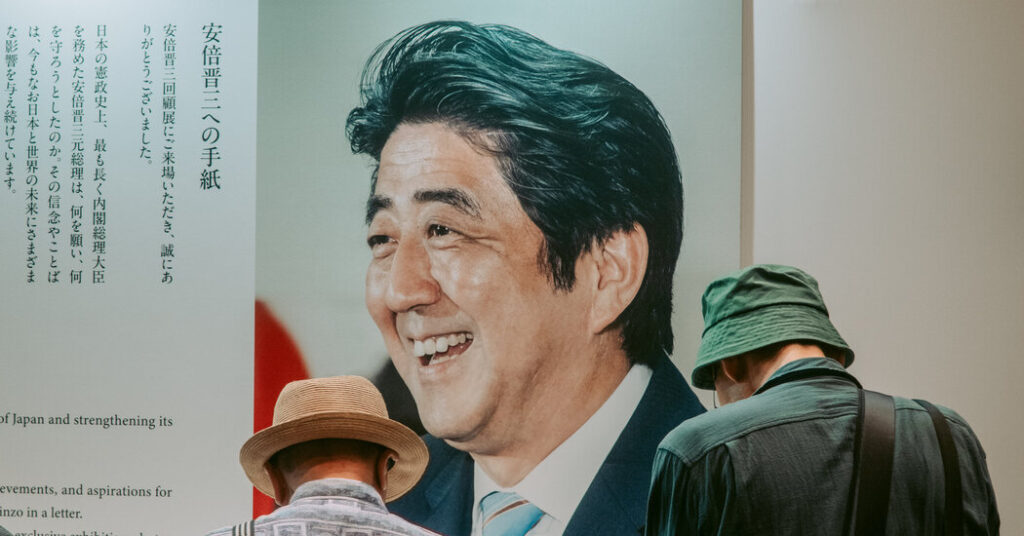
Inside a hushed hall in Tokyo on a recent afternoon, Prime Minister Sanae Takaichi of Japan stood before a giant portrait of her mentor, Shinzo Abe, the slain Japanese leader, and bowed.
It had been four years since Mr. Abe, a giant in Japanese politics and the country’s longest-serving prime minister, was shot and killed while giving a speech outside a train station. Ms. Takaichi, his protégé, had come to pay her respects — and to vow to carry on his vision. She told the crowd of right-wing politicians, activists, journalists and business leaders that she sometimes still imagined him sitting on the couch of the prime minister’s office.
“I could never fill Prime Minister Abe’s shoes; my days are filled with nothing but criticism when compared to him,” she said. “Even so, I want to be a fighter politician like him. I tell myself that I must be.”
Since winning election nine months ago, Ms. Takaichi, Japan’s first female prime minister, has frequently leveraged her ties to Mr. Abe to rally support for her nationalist agenda, often referring to him and his policies in major speeches.
She has hailed his vision of a more muscular Japan that is a driving force for strength and stability across Asia. She has invoked his legacy to call for greater military spending and the establishment of Japan’s first intelligence agency since World War II. She has dropped his name while wooing foreign leaders such as President Trump and Prime Minister Narendra Modi of India.
Yet Mr. Abe remains a divisive figure in Japan because of his break with decades of postwar pacifism; his support for changing how the country’s World War II-era history is taught in schools; and a rise in economic inequality during his tenure. His killing, by a 41-year-old man who was protesting the ruling Liberal Democratic Party’s ties to the Unification Church, a fringe religious group, prompted a range of reactions. While many people were outraged, some sympathized with the assassin, noting his difficult childhood. Others said that a state funeral for Mr. Abe was a waste of money. (His assassin, Tetsuya Yamagami, was sentenced to life in prison earlier this year.)
Despite Mr. Abe’s complicated legacy, Ms. Takaichi has emerged as one of his chief defenders, hailing him as a transformative leader who elevated Japan’s stature on the global stage.
This triumphant account of Mr. Abe’s tenure has been on display recently across Japan, including at a sold-out exhibition by the Shinzo Abe Digital Museum, an organization founded by Mr. Abe’s allies in business and government. The exhibition featured more than 100 objects from his life, including the microphone he was holding when he was shot on July 8, 2022, in the ancient city of Nara, Ms. Takaichi’s hometown.
Mr. Abe’s widow, Akie Abe, said during a visit to the exhibition in Nara on Sunday that her husband’s message “has been entrusted to” Ms. Takaichi.
Same Playbook, New Challenges
Ms. Takaichi, who met Mr. Abe in the 1990s when they were both rising politicians and later served in his cabinet, has sought to portray herself as the inheritor of his legacy, at a time when Japan is facing rising tensions with China, Russia and North Korea.
“She’s embracing what Abe did and running with it,” said Sheila A. Smith, a senior fellow at the Council on Foreign Relations.
The question now, analysts say, is whether Ms. Takaichi can adapt Mr. Abe’s vision to new challenges. Among them:
-
Beijing is rapidly expanding its military and economic influence in Asia, and has led a monthslong campaign against Ms. Takaichi to punish her for a comment she made in support of Taiwan, which China claims as its territory.
-
Japan’s economic outlook has grown more complicated as the country grapples with inflation for the first time in decades and a stubbornly weak yen.
-
The country’s demographic decline is also accelerating, hurting the economy, causing labor shortages and undermining defense priorities like military recruitment.
Mieko Nakabayashi, a political science professor at Waseda University in Tokyo, said Ms. Takaichi was clinging to Mr. Abe’s playbook while ignoring new realities. She pointed to Ms. Takaichi’s support for expansionary fiscal policies, which some analysts say could exacerbate inflation.
“Her popularity depends on Mr. Abe’s legacy,” Ms. Nakabayashi said. “Her biggest selling point is that she is trying to realize everything that Mr. Abe wanted to do, at whatever cost.”
Ms. Takaichi worked for Mr. Abe during his first stint as prime minister in 2006, and during his second term, which began in 2012. She rose to the powerful position of minister for internal affairs and communications.
During that time she became a fierce defender of his policies, including efforts to revise Japan’s Constitution to unfetter its military, and his economic program, which emphasized cheap cash and government stimulus efforts.
“I was deeply drawn not only to his qualities as a politician but also to his character as a human being,” Ms. Takaichi said of her work with Mr. Abe, in a letter on display at the new exhibition.
Tobias Harris, the founder of the advisory firm Japan Foresight and the author of a book on Mr. Abe, said that it remained to be seen whether Ms. Takaichi had fully grasped the lessons of his tenure. He said it was notable that she identified with Mr. Abe’s fighting spirit, given that Mr. Abe’s success in his second term came in part from tempering those impulses.
“We have seen her willingness to bulldoze her opponents over and over again,” Mr. Harris said. “But as Abe learned, there is a cost to pay for that.”
The Shinzo Abe Digital Museum raised more than $338,000 from individual donors for the exhibition. On a recent day, visitors left notes on a wall with messages such as “You were our hope!” and “We will carry forward your mission.” A shop sold Abe-themed calendars and playing cards that included scenes of him golfing with President Trump.
The exhibition became a gathering spot for his supporters, drawing nearly 7,000 visitors in Tokyo and Nara, including more than a half dozen of Ms. Takaichi’s cabinet officials.
Mr. Abe’s supporters are hopeful about Ms. Takaichi, though they said she would face different challenges than Mr. Abe, including disruptions to the energy supply, foreign wars and political volatility in the United States.
Fumiyo Kato, 48, who runs a weather data company in Tokyo, cried during a recent visit to the exhibition as she viewed Mr. Abe’s personal artifacts: a childhood notebook, a portrait of his father, a wedding photo. She said that Ms. Takaichi appeared to be carrying on his legacy, but it was too early to say whether she would succeed.
“Abe was a great man,” she said. “He can’t be easily replaced.”
Hisako Ueno contributed reporting.
The post Japan’s Leader Invokes Her Hero, Shinzo Abe, to Drive Nationalist Agenda appeared first on New York Times.