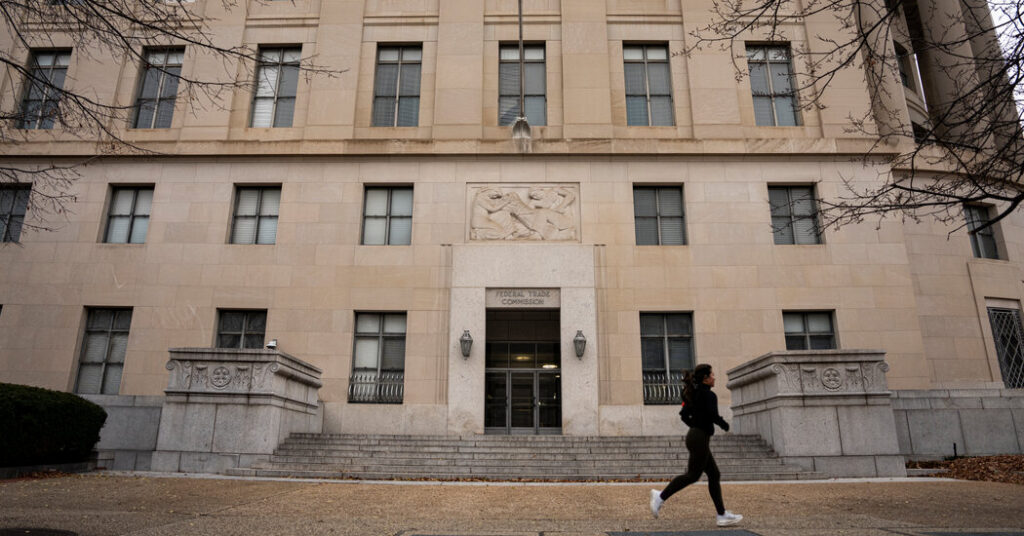
Three major ad companies settled with the Federal Trade Commission on Wednesday over claims that they colluded on policies to combat misinformation that denied ad revenue to conservative publishers, a concession to the Trump administration’s claims of unfair treatment of conservatives online and in the media.
The agency said in a complaint filed Wednesday in the U.S. District Court for the Northern District of Texas that WPP, Dentsu and Publicis had policies that limited the number of ads that ran on sites with content the industry defined as misinformation. That resulted in fewer ads running on conservative websites, including the right-wing media site Breitbart, and made it harder to make money from “lawful but disfavored content,” the government said in the legal filing.
Under the terms of the accompanying settlement, which must be approved by the court, the companies agreed not to work together to restrict ad buying services for any publisher “with respect to its news and political or social commentary content.” The companies, which all own multiple ad agencies, did not admit to wrongdoing as part of the settlement.
A spokesman for WPP said in a statement that the agreement “reflects our existing and ongoing commitment to provide our clients with unbiased advice as they decide where to place their media.” A spokesman for Dentsu said the company was “fully committed to operating transparently, with integrity, and in strict compliance with all applicable laws.” Publicis did not respond to a request for comment.
The settlement “restores competition to the digital news ecosystem,” the F.T.C.’s chairman, Andrew N. Ferguson, said in a statement.
Under the Trump administration, the F.T.C. has targeted companies and organizations that conservatives claim have made it harder for right-leaning publishers to make money from ads. Mr. Ferguson last year opened an inquiry into social media’s censorship of political speech, following years of complaints by Mr. Trump and other conservatives about being hindered by online platforms’ content moderation.
Mr. Ferguson said last year that tech companies, like social media sites, “should not be bullying their users” and that the agency wanted to understand “how these firms may have violated the law by silencing and intimidating Americans for speaking their minds.” More recently, he has expressed concerns about potential anti-conservative bias on Apple News.
The F.T.C. last year approved a merger between the ad giants Omnicom Group and Interpublic Group on the condition that they not engage in politically motivated boycotts.
The agency also began an investigation last year into whether Media Matters, a nonprofit group active in liberal politics, illegally colluded with advertisers. Elon Musk had earlier accused the group of trying to hurt relationships between advertisers and his social media site X.
Media Matters in turn sued the F.T.C., arguing the agency’s investigation overstepped its legal authority and violated the First Amendment. A judge blocked the investigation.
David McCabe is a Times reporter who covers the complex legal and policy issues created by the digital economy and new technologies.
The post Ad Companies Settle With F.T.C. Over Claims of Harm to Conservative Sites appeared first on New York Times.