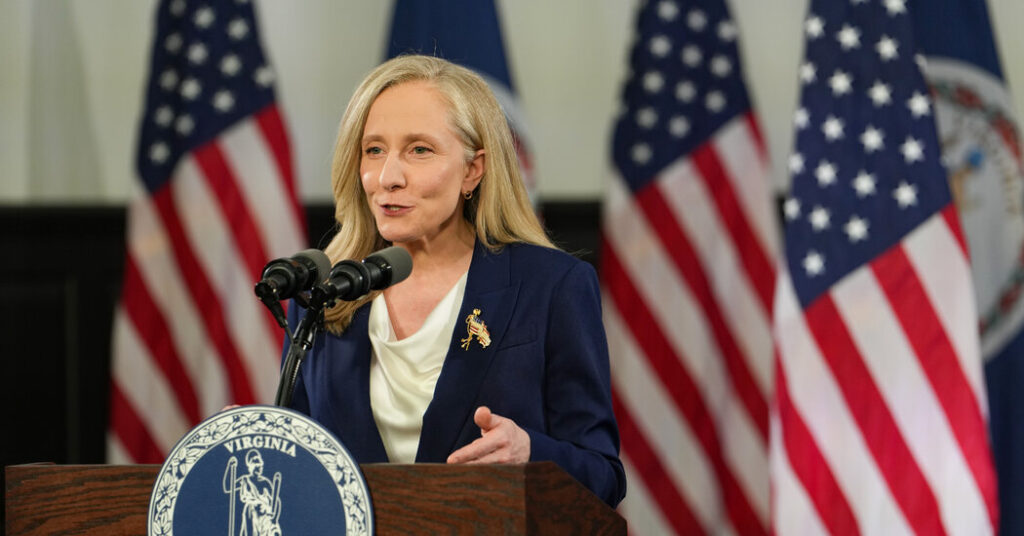
Gov. Abigail Spanberger of Virginia has signed into law a bill to end tax exemptions for a slate of Confederacy-related organizations in the state.
The signing by Ms. Spanberger on Monday is the culmination of a yearslong Democrat-led push to shake off the state’s legacy as the capital of the 11 Southern, slaveholding states that seceded from the country in the 1860s.
The new law’s most significant target is the United Daughters of the Confederacy, founded in 1894 for descendants of Confederates. The organization’s stated purpose is to honor the members’ ancestors. Throughout its history, the group built hundreds of Confederate memorials around the country, which have become flash points for protests over historical memory and racial injustices in the last decade.
In the past, the organization has said that losing the decades-old tax breaks could hinder its ability to maintain its headquarters in Richmond and carry out its operations.
Governor Spanberger, a Democrat, was elected in November by a wide margin and took office in January. She has described her victory as a referendum on the Trump administration, which has been aggressively moving to restore some Confederate symbols that were taken down in recent years.
In the General Assembly, where Democrats control both chambers, the House voted 62 to 35, and the Senate 21 to 17, to pass the legislation. This is the third consecutive year that Delegate Alex Askew has sponsored a version of the bill, which he said was an important step toward making state law align with modern values.
“Governor Spanberger’s signing of this bill is a proud moment and an important step forward for Virginia,” he said in a statement on Monday.
Representatives for the United Daughters of the Confederacy did not respond to requests for comment. In a statement in February, Julie Hardaway, the president of the national organization, said the bill “reeks of discrimination, based on misguided and biased opinions of our great philanthropic organization.”
Of particular concern to the group is its marble-walled headquarters in Richmond. It sits on property that the state deeded the group in 1950, but the terms stipulate that if the organization can no longer maintain the site, it will revert to the state.
The total property is valued at about $4.7 million, which according to the city’s rate would make the annual property tax over $57,000. The organization had about $2.1 million in revenue and about $1.1 million in expenses in 2025, according to a tax filing.
In 2020, the building sustained millions of dollars in damage when demonstrators set it ablaze during violence after George Floyd’s murder.
Two other Democrat-led bills targeting the Confederacy’s legacy also made it to Governor Spanberger’s desk. One, which she sent back to the Assembly with recommendations, would establish a task force at the Virginia Military Institute. The panel would be expected to, among other things, recommend ways the college could distance itself from the “Lost Cause,” a sanitized narrative about the Confederacy that has been propagated as fact throughout much of Southern history. The other bill discontinues specialty license plates that feature Robert E. Lee and the Sons of Confederate Veterans. It was signed into law by the governor last week.
Frank Earnest, a spokesman for the Virginia division of the Sons of Confederate Veterans, said it was “terrible” that the Lee plate would be discontinued and that it was an issue of free speech.
“I could go down to the D.M.V. right now and point out some fact about every plate there that I didn’t like,” he said. “So if we’re going to cancel every plate because somebody out there doesn’t like it, we might as well just cancel the whole program.”
Virginia’s place at the center of Confederate history has stirred tension and anger for years. Efforts to remove Confederate memorials intensified after the deadly Unite the Right rally in Charlottesville in 2017 and accelerated in 2020, when Gov. Ralph Northam, a Democrat, signed a bill that gave local governments the authority to alter their Confederate symbols. His Republican successor, Glenn Youngkin, however, twice vetoed versions of the tax bill and said targeting specific groups by revoking exemptions would set “an inappropriate precedent.”
The issue continues to play out in other ways across the state. For example, Shenandoah County is awaiting a judge’s decision over whether Black students’ rights were violated when the school board restored the names of Confederate generals to two schools, after they were dropped in 2020.
And at the federal level, the Trump administration announced that a Confederate memorial that was removed in 2023 would be returned to Arlington National Cemetery, a restoration that will reportedly cost $10 million.
The post Virginia Governor Ends Tax Breaks for Confederate Groups appeared first on New York Times.