Evelin and Gustavo Quebedo, have filed U.S. tax returns every year for more than a decade.
That they are undocumented immigrants did not deter them.
“Our thinking has been, if one day there’s immigration reform and the chance to legalize our status, we can show that we file our taxes, are not a burden — that we do the right thing,” said Mr. Quebedo, a car mechanic, who lives with his family in Los Angeles.
But as April 15 approached this year, the couple, who came to the United States from Central America, agonized over whether to file.
Their fears, shared by many of the millions of undocumented people who file tax returns, are rooted in the decision last year by the Internal Revenue Service to give immigration officials the addresses of people subject to deportation — a break with the tax agency’s longstanding practices.
The shift sent shock waves through the I.R.S., where taxpayer privacy has been an article of faith, and through immigrant communities, where filing tax returns was seen as a way for people in the country illegally to show that they were complying with tax laws.
The federal treasury could take a hit. Many undocumented immigrants have taxes withheld in every paycheck, but experts worry some could shift into under-the-table jobs. Others with less formal earnings may now skip filing a tax return — and therefore not pay federal taxes at all. The Yale Budget Lab, a nonpartisan research center, projected lost tax revenue of about $300 billion over a decade.
The fallout from the I.R.S. agreement with Immigration and Customs Enforcement is becoming clearer as the annual tax deadline nears, according to several organizations that assist immigrants with filing their tax returns.
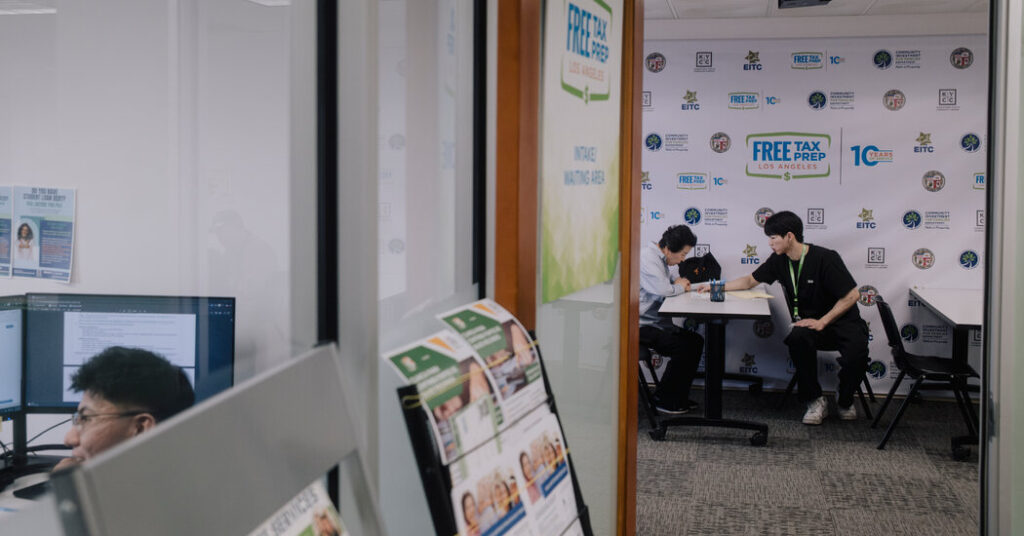
At the Koreatown Youth and Community Center in Los Angeles, certified volunteers help low-income residents prepare returns through a partnership with the I.R.S. Undocumented immigrants file using an Individual Taxpayer Identification Number, or ITIN, a nine-digit identifier issued by the I.R.S. for people who don’t have Social Security numbers.
This year, only 10 percent of clients at the Koreatown center’s free tax clinics have been ITIN holders, compared with about a third in previous years, said Audrey Casillas, a director.
A week before the April 15 tax deadline, the Quebedos were among the immigrants who came by the clinic seeking help but were stricken by anxiety.
“I don’t know if we can trust this government not to come after us,” Ms. Quebedo said, glancing at their daughter, born in the United States, and their son, brought to the country as a little boy.
For decades, the I.R.S. implicitly encouraged undocumented taxpayers to file a return as part of its broader mission to promote tax compliance. Before the agreement between the I.R.S. and ICE, unauthorized immigrants paid roughly $60 billion annually in federal taxes, according to an estimate by the Institute on Taxation and Economic Policy, a progressive think tank. Much of it went to Social Security and Medicare, which are programs that undocumented immigrants cannot benefit from.
With few exceptions, taxpayer information was kept walled off from other government agencies, and that won a measure of trust among many undocumented immigrants. But under President Trump, the effort to find as many immigrants to deport as possible led the administration to try to exploit that trust.
The Department of Homeland Security, which includes ICE, first sought the help of the I.R.S. in early 2025, soon after President Trump returned to the White House and launched his mass deportation campaign. The I.R.S. initially balked at the request, which sought information on about 700,000 immigrants. Several top I.R.S. officials resigned because they feared working with ICE to detain immigrants could be illegal.
ICE didn’t relent, though, and by the spring, the agency had secured an agreement to get information from the I.R.S., which had cycled through a series of leaders and had seen an exodus of career employees.
Over the summer, ICE sought the addresses of about 1.3 million immigrants, and the I.R.S. handed over information on about 47,000 of them before federal judges ordered a stop to the practice.
“It’s sending the message to undocumented immigrants and mixed-status families that being in the shadows is safer,” said Louis DeSipio, a political scientist at the University of California, Irvine.
The I.R.S. did not respond to a request for comment.
John Koskinen, who was the I.R.S. commissioner from 2013 to 2017, said the potential consequences of sharing tax data with D.H.S. were evident.
“Our job was to collect taxes owed, not enforce immigration laws,” said Mr. Koskinen. “That was the job of D.H.S. And it was clear to me that, if immigrants thought their information was going to be shared, many of them would quit filing their tax returns.”
Brian Pastori, who helps undocumented immigrants file tax returns in New Bedford, Mass., said he first noticed a drop in filings last year, after news broke that ICE was seeking information from the I.R.S. “We got a significant drop-off last year, and we haven’t recovered,” said Mr. Pastori, who is deputy director of the Community Economic Development Center of Southeastern Massachusetts.
“The damage is already done,” he said.
About 14 million undocumented immigrants lived in the United States in 2023, the latest available estimate, and about 70 percent of them were in the labor force, according to the Pew Research Center, a nonpartisan think tank.
Since creating the ITIN in 1996, the I.R.S. has issued 31 million of them; about five million were active as of October 2025. In 2022, about 3.8 million tax returns included at least one ITIN, and those returns accounted for about $17 billion in federal income taxes that year, according to I.R.S. data.
Not all ITIN holders are undocumented immigrants. Some are foreign students or other noncitizens who have tax-reporting obligations because they earn income in the United States.
Many of the undocumented immigrants work in jobs in which taxes are withheld on every paycheck. They may have used a fake, expired or stolen Social Security number to obtain that job, but they use the separate nine-digit code provided by the I.R.S. to document their tax payments.
For those workers, filing a return presents an opportunity to receive a refund if they paid too much in taxes, and that can provide a boost to household budgets.
Now, some of those families are going to miss out, said Luz Arevalo, a lawyer who sued to block the sharing of taxpayer information on behalf of the Community Economic Development Center of Southeastern Massachusetts and other groups.
“People are forgoing refunds, and often it’s money they paid in,” Ms. Arevalo said.
Other undocumented immigrants may be paid in cash, off the books, or work as independent contractors, so they won’t have had taxes deducted over the course of the year. If they decide not to file a return, they would not be paying any taxes.
Undocumented immigrants were already cut off from most federal tax benefits, such as the earned-income tax credit. But last year’s Republican tax law cut off the child tax credit, which had been available to families if a child was a U.S. citizen.
In Huntington Park, a predominantly Latino city in Los Angeles County, banners recently advertised tax preparation offices hemmed between quinceañera dress shops and taquerias.
The area was the target of big immigration raids last year, including one that Kristi Noem, the homeland security secretary at the time, showed up to observe.
Javier Oviedo owns Ov Professional Services, one of several tax preparers who reported a steep decline in business. “We have clients who have self-deported,” he said.
Nonprofits like the United Ways of California, which connects low-income workers with tax prep sites like the Koreatown center, and groups like the National Immigration Law Center have been inundated with questions about what immigrants should do this tax season.
“We had never received as many questions and seen this level of concern and confusion,” said Ben D’Avanzo, a senior strategist at the immigration law center.
On its website, the nonprofit offers some guidance: “If ICE already has your address, filing does not add to your risk. “
“You don’t have to file a tax return unless your income is over the filing minimum, or you owe self-employment taxes,” it says, “but filing tax returns may help if you plan to apply for a green card or citizenship.”
The last time a bipartisan immigration bill was introduced in Congress, it required proof of “good moral character” to qualify for permanent residency. And the last immigration amnesty, in 1986, required applicants to prove they had lived and worked in the United States for several years.
Maria Garcia, who sells cosmetics and clothes at a downtown Los Angeles stall, is among those who have decided not to file.
“In all my years in this country, I had never experienced what is happening now,” said Ms. Garcia, who has lived in the United States for more than 30 years. Earlier this year, she narrowly avoided arrest during a raid that targeted street vendors.
“My whole life is here. My elderly mother is here. My two children are here. I don’t want to be separated from them,” Ms. Garcia said.
At the Koreatown tax clinic, many immigrants said they felt a duty to comply with the law.
“I want to show I have integrity,” said Manuel Aranguiz, a computer technician from South America, after filing his taxes. “One of my sons will hopefully be able to sponsor me for a green card one day.”
The Quebedos completed their return at around 8 p.m., and tucked it inside Ms. Quebedo’s tan purse alongside years of past returns.
“We thought hard before coming here,” Mr. Quebedo said.
Their expected refund: less than $200.
Miriam Jordan reports from a grass roots perspective on immigrants and their impact on the demographics, society and economy of the United States.
The post To File or Not to File: Undocumented Immigrants Face a Tax Return Dilemma appeared first on New York Times.