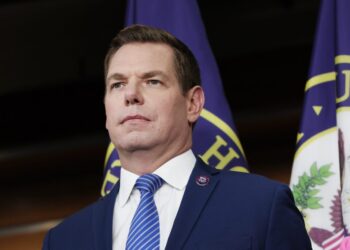
Addressing a tiny audience of just a few hundred people, Peter Magyar, a charismatic but largely unknown lawyer, swayed atop an unsteady flatbed truck two years ago and issued a preposterous command: “Take back our country, step by step, brick by brick.”
The childhood home of Hungary’s seemingly invincible prime minister, Viktor Orban, was just down the road, and the idea that Europe’s longest-serving head of government would allow a jumped-up attorney to tear down his laboriously constructed and very sturdy political movement — a vote-winning machine called Fidesz — seemed absurd.
Now, having demolished Mr. Orban’s governing party in a general election on Sunday, Mr. Magyar, 45, stands at the pinnacle of power in Hungary. He was hoisted there by a two-thirds majority of seats in Parliament and a share of the popular vote larger than a single party has received since the fall of Communism nearly four decades ago.
Mr. Magyar will not formally take over from Mr. Orban as prime minister until Parliament resumes for its first post-election session, which must happen before May 12. But given that nearly 80 percent of registered voters cast ballots, a record turnout, Mr. Magyar he has already assumed the role of Hungary’s undisputed leader.
But how is Mr. Magyar going to use his power and to what end?
A priority, Mr. Magyar told cheering supporters on Sunday night, is to pull down the “puppets and pillars” of Mr. Orban’s system: the Fidesz-aligned heads of the Supreme Court, of the prosecution service and of various nominally independent agencies overseeing the media, the judiciary, the state budget and the policing of anti-competition laws.
“They should leave of their own volition rather than wait for us to fire them because we will fire them,” he warned. “They occupied our country.” Dismissing them could prove difficult; some officials serve for fixed terms, and Parliament has limited ability to unilaterally force them out.
On Monday, at a three-hour news conference, he said he wanted Hungary’s president, Tamas Sulyok, gone, too. The presidency is a mostly ceremonial job, so getting rid of Mr. Sulyok would be less a power grab than a symbolic strike against Mr. Orban’s old order.
“The regime has fallen, and the Hungarian people have voted for a change of system,” Mr. Magyar said in Budapest, the Hungarian capital. “That is the crux of the matter, in my view. Let us start from there.”
Mr. Magyar said Hungary would rejoin the European Public Prosecutor’s Office, a wing of the European Union that investigates financial crimes, in a sharp break with Mr. Orban’s government, which often portrayed E.U. efforts to enforce rules that Hungary had agreed to abide by as an intolerable affront to Hungarian sovereignty. Rejoining the office would give European investigators the power to examine fraud cases involving the previous administration, including some that could touch Mr. Orban’s family, notably his son-in-law, Istvan Tiborcz, a wealthy tycoon.
Mr. Magyar makes for an unlikely scourge of the establishment. He was born into a conservative Budapest family and raised in a wealthy district on the eastern side of the Danube River. His relatives include lawyers and judges and a former president, Ferenc Madl, whose tenure in office from 2000 to 2005 overlapped with part of Mr. Orban’s first term as prime minister.
Mr. Magyar’s uniform for most of his appearances on the campaign trail — white shirt, slim-fit jeans or slacks — had a decidedly preppy look, not that of a rebel working to topple the government.
Sandor Laszlo Esik, a lawyer and conservative commentator who was a student with Mr. Magyar in the early 2000s at Pazmany Peter Catholic University in Budapest, remembers a different vibe. “The guy had a total disco-rat look back then, with spiky, gelled-back hair, that ’90s German techno hairstyle,” he recalled.
Back then, Mr. Magyar attended events organized by Fidesz, Mr. Esik said. The Catholic university, he added, served as a “seedbed of young Fidesz talent.” Its students at the time also included Gergely Gulyas, who later became Mr. Orban’s chief of staff, and Mate Kocsis, who became a prominent Fidesz lawmaker.
They were all studying law, like Mr. Orban, now 62, had done at another Budapest university more than a decade earlier.
For most of his career as a corporate lawyer, Mr. Magyar remained close to people in Mr. Orban’s circle.
Mr. Magyar worked in a senior position at a state-owned bank overseen by Fidesz loyalists and as a diplomat in Brussels. He married Judit Varga, who later became Mr. Orban’s justice minister, before they announced their divorce in 2023.
Mr. Magyar’s political transition began in 2024 after an independent media outlet, 444, revealed that Mr. Sulyok’s predecessor as president, Katalin Novak, had pardoned a man who had been convicted of helping to cover up sexual abuse in a state-run children’s home.
Mr. Magyar’s ex-wife, Ms. Varga, had countersigned the pardon order.
The news stirred outrage among Fidesz supporters who liked the party for its promises to protect children and family values. The president resigned, and Ms. Varga was forced to quit.
On the day of Ms. Varga’s resignation, Mr. Magyar announced in a Facebook post that he was breaking with Fidesz and leaving the state-owned company where he worked.
He said he did “not want to be part of a system” in which “the real responsible parties hide behind women’s skirts.”
The next day, he appeared on the opposition-inclined YouTube channel Partizán, accusing the government of deep corruption.
But Mr. Magyar scoffed when he was asked if he planned to go into politics: “I think that’s not even funny for a joke.”
A few months later he took over the leadership of an existing but inactive political party called Tisza, which in June 2024 stunned the Fidesz establishment by winning nearly 30 percent of the vote in elections for the European Parliament.
For some, Mr. Magyar seemed like a youthful version of Mr. Orban, who began his political life as a teenage Communist activist before his rise to prominence in the 1980s as a vocal critic of the regime.
“He is a young Viktor Orban — ambitious and full of energy,” said Botond Feledy, a Hungarian political analyst in Brussels who met Mr. Magyar during his stint at the Hungarian embassy in the Belgian capital. Comparing him to Mr. Orban “is not such a bad thing,” he added, noting that the prime minister as a young liberal activist was very different from what he became.
Throughout Mr. Magyar’s adult life, his values have remained constant, Mr. Feledy said — unlike Mr. Orban, who moved steadily to the right over the years.
Mr. Magyar “has remained the same conservative he always was,” Mr. Feledy said. “It was Fidesz that shifted its views to the radical populist right that has socialist elements and is also nationalist.”
Mr. Magyar addressed the perceived parallel with Mr. Orban at the news conference on Monday, saying that he was “different in many ways” and added that he had no desire to become “Viktor Orbán II or Fidesz Lite.”
One big difference between them involves religion. Mr. Magyar has long been a believer, unlike Mr. Orban, who was an atheist until he tilted to the right.
Marc Loustau, an American anthropologist in Budapest who has studied religion in Eastern Europe and who traveled with Mr. Magyar for part of the campaign, said that faith was an important part of his “enduring core.”
“He doesn’t talk about personal faith, but it is absolutely part of his profile,” Mr. Loustau said. Mr. Magyar went to Pope Francis’ funeral in Rome last year. Mr. Orban skipped it.
During the campaign Mr. Magyar wore a wrist band with a small wooden cross attached. His rallies in small towns often had the feel of religious revival meetings, with Mr. Magyar asking attendees to join and raise their hands in celebration. “God bless Hungary, God bless every Hungarian,” he said on election night. Mr. Magyar’s conservative side has led to some tensions with Mr. Orban’s most fervent foes — progressive activists and journalists in Budapest.
They were upset that he stayed silent last year when the government banned an annual Pride march in Budapest. The event had been held for years without incident. Then Mr. Orban’s party rushed legislation through Parliament to make it illegal to hold gatherings like Pride parades.
The ban put Mr. Magyar in a difficult position. Progressives in Budapest wanted him to take stand, but so did Fidesz, which was looking for ways to portray him as a closet liberal. Mr. Magyar avoided the trap by saying nothing.
Now able to speak more freely since his election victory, Mr. Magyar this week expressed his support of the freedom of assembly, gay rights and other liberties circumscribed by the previous government.
“In Hungary, everyone has the right to freedom of assembly. Period,” he said on Monday.
Still, Mr. Magyar’s years of proximity to Mr. Orban alarmed some longtime opposition leaders, like Klara Dobrev, a leftist leader who began battling Fidesz years before Mr. Magyar switched sides.
Ms. Dobrev tried to convince voters during the campaign that Mr. Magyar would not bring real change, only “the continuation of an Orban-like system in a slightly different package.”
Hungarians were unswayed. Ms. Dobrev’s party received just over 1 percent of the vote.
Mr. Magyar’s Tisza party earned more than 52 percent.
“Honestly, no one could have foreseen where this would lead,” said Andras Banko, an early supporter who was in Mr. Magyar’s audience two years ago in Mr. Orban’s hometown.
Andrew Higgins is the East and Central Europe bureau chief for The Times based in Warsaw.
The post The Man Who Defeated Viktor Orban appeared first on New York Times.