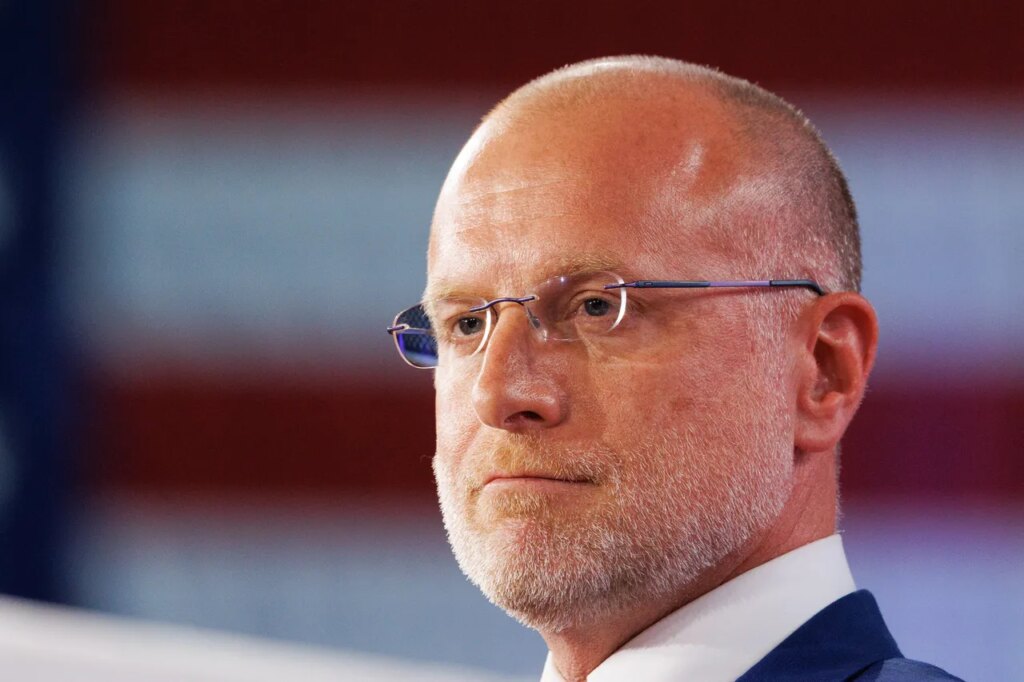
A small conservative legal group used direct access to the Federal Communications Commission chairman’s office last September to accelerate a complaint targeting Jimmy Kimmel and his employer, ABC, according to internal emails obtained by WIRED.
WIRED has made this article free for all to read because it is primarily based on reporting from Freedom of Information Act requests. Please consider subscribing to support our journalism.
The emails show the group routed its filing to Chairman Brendan Carr’s senior counsel, sidestepping career staff who typically review such complaints.
The correspondence offers a detailed look at how the Center for American Rights (CAR), whose filings often echo criticisms of the press by President Donald Trump, supplied legal arguments used in challenges against broadcast networks. Kimmel was briefly suspended in September following threats from the FCC, drawing condemnation from press freedom advocates and First Amendment scholars.
The backlash against Kimmel and ABC followed comments Carr made on a conservative podcast about a Kimmel monologue discussing the killing of Charlie Kirk. Carr suggested ABC affiliates could face regulatory scrutiny if they did not take action.
“We can do this the easy way or the hard way,” Carr said. “These companies can find ways to take action on Kimmel, or there is going to be additional work for the FCC ahead.”
The FCC did not immediately respond to a request for comment.
Records show that Daniel Suhr—president of CAR and former policy director to Wisconsin governor Scott Walker—had a direct line to Carr’s senior legal advisers and used it to route filings around consumer affairs staff. For months, emails show, CAR had fed the chairman’s office a steady supply of legal theories that could be used in attacks against major broadcast networks that drew the ire of the Trump administration.
Carr’s predecessor, Jessica Rosenworcel, had dismissed three earlier complaints from the group against ABC, CBS, and NBC stations, calling them “at odds with the First Amendment.” Carr reinstated those complaints shortly after taking office.
By September 2025, the group’s efforts had already influenced regulatory proceedings. CAR’s complaint against CBS over a 60 Minutes interview with Kamala Harris became leverage in the agency’s review of the Paramount-Skydance merger, which cleared in July after Skydance committed to installing a conservative ombudsman at CBS News.
Reached for comment, Suhr tells WIRED that CAR complies with all FCC rules on public comments and ex parte meetings and that its initial September complaint was filed through the agency’s consumer complaints portal with relevant staff copied. He says the supplemental filing came together quickly after Carr’s podcast appearance because the group had already done extensive prior research on news distortion, Kimmel, and late-night television and had no advance notice of the chairman’s remarks.
“In this instance, we filed our initial September complaint in the general FCC consumer complaints portal and, as you say, cc’d the relevant staff on it,” Suhr says.
Suhr also claims that the news distortion standard covers misleading viewers, not just literal falsehood. He also points to a 2018 letter from Senate Democrats urging the FCC to investigate Sinclair for news distortion and says CAR is asking for evenhanded enforcement of the public interest standard.
Suhr has argued in interviews that broadcasters are failing their public interest obligations under the Communications Act, pointing to Democratic-leaning late-night shows and a general lack of trust in national news. Asked in February whether the outcome he sought was conservative dominance over American broadcasting, Suhr agreed. “Yes, I’d be thrilled with that outcome,” he said.
Emails obtained by WIRED show Suhr sent his complaint against Kimmel directly to two senior aides in Carr’s office on September 4, shortly after submitting it through the FCC’s public complaint system. The email, which began “Dear Erin and Katie,” was addressed to Erin Boone, Carr’s senior counsel for media and enforcement, and Katie McAuliffe, the chairman’s policy adviser. Suhr also attached a 12-page filing and five exhibits of opposition research, giving Carr’s office his ticket number so they could “find it easily in the FCC consumer complaints system.”
Boone also served as the acting chief of the media bureau, the division with direct jurisdiction over broadcast television and radio licensing. Emails show that FCC staff had a standing instruction to route CAR’s complaints directly to her.
CAR’s complaint was framed as a case against Kimmel, but the largest of the five exhibits attached to Suhr’s email was a political profile of the show’s writers, producers, camera operators, and assistants. Time stamps show CAR spent the afternoon before the filing pulling Federal Election Commission records, including more than 60 pages of individual donation histories from Jimmy Kimmel Live! employees. A separate exhibit compiles 215 donations from Molly McNearney, the show’s executive producer and Kimmel’s wife. Two more exhibits document Kimmel’s personal giving history, pulled from OpenSecrets, which tracks campaign donations, and the Federal Election Commission.
Kirk was killed at Utah Valley University on Wednesday, September 10. Kimmel addressed the shooting in his opening monologue the following Monday, making remarks that critics interpreted as blaming the MAGA movement for Kirk’s murder. Outrage grew the next day with Fox News segments and backlash from MAGA influencers.
Carr appeared on The Benny Show, a YouTube program hosted by conservative commentator Benny Johnson. On it, he framed the monologue as a “very, very serious issue” for ABC parent company Disney and suggested that local station owners who carried Jimmy Kimmel Live! needed to “step up,” while warning broadcasters could either discipline Kimmel themselves or face regulatory action.
Hours later, emails show, Suhr filed a supplemental complaint with Carr’s office. The new filing adopted the theory that Carr had aired on the podcast—specifically “news distortion,” a rarely invoked doctrine that prohibits broadcasters from deliberately falsifying factual news reports.
Suhr addressed the filing directly to the chief of the FCC’s enforcement bureau. The supplemental urged the agency to force KABC, the ABC-owned Los Angeles station that carried Jimmy Kimmel Live!, off the air if necessary.
As WIRED previously reported, the FCC’s West Coast enforcement director—whose office holds direct authority over KABC—emailed Carr later that day, urging him not to let Disney off the hook and offering to help Carr in any way he could.
Later that evening, Nexstar announced it would preempt Jimmy Kimmel Live! across its ABC affiliates. Sinclair followed within hours, pulling the show and demanding Kimmel donate money to Kirk’s nonprofit, Turning Point USA. Both station groups had multibillion-dollar transactions pending before the FCC at the time: Nexstar was seeking approval for a $6.2 billion merger with Tegna, and Sinclair was pursuing station acquisitions that required the commission’s sign-off. Disney followed by suspending the program indefinitely.
Neither Disney nor Sinclair responded to requests for comment.
New emails show the FCC’s call center was overwhelmed the following day. Within 90 minutes, its consumer bureau had logged 170 calls, with more than half going unanswered. Overnight, the agency had also received roughly 700 complaints—a “very large call volume,” a consumer affairs deputy wrote, “all generally related to Kimmel going off air.”
Carr’s legal arguments were widely panned by First Amendment scholars, former FCC officials, and press freedom groups. In November, seven former FCC commissioners—five of them Republicans—petitioned the agency to rescind the news distortion policy, arguing that Carr had asserted powers that the Supreme Court and Congress have denied the commission.
Robert Corn-Revere, a former FCC chief counsel, told Deadline that Carr’s threats to Disney and ABC “sound like statements by a mob boss.”
The FCC has independent authority to open investigations into broadcasters it licenses and does not technically require an outside complaint to act. But content-based actions by the agency almost always proceed from third-party filings. An outside complaint gives the commission a named complainant, a specific set of allegations to point to, and a record that casts any resulting action as a response to public grievance.
In March, the FCC approved the Nexstar-Tegna merger, waiving a federal rule that bars a single company from owning TV stations reaching more than 39 percent of US households. In a press release, Nexstar said the merger would, in total, grant it access to 80 percent of homes with TVs.
That outcome—a handful of station groups reaching most of the country under commitments negotiated with the FCC—is close to the one Suhr has publicly described wanting. In a February interview on WNYC’s On the Media, Suhr offered the clearest picture yet of his agenda for the FCC and the future he wants for broadcast television.
“In that world,” he said, “I think it would look a lot more like the AM radio.”
The post The FCC Has a Fast Lane for Complaints About Trump’s Media Critics appeared first on Wired.