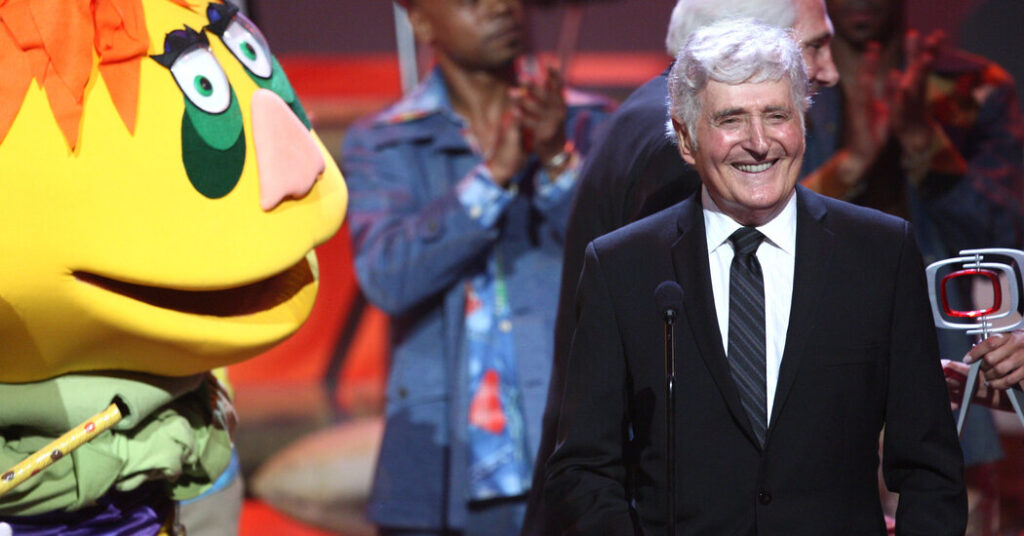
Sid Krofft, who with his brother Marty made some of the most zany children’s programming ever seen on television, like “H.R. Pufnstuf” and “Land of the Lost,” gaining a following among both the young and adult members of the counterculture with shows that lingered in viewers’ memories like acid flashbacks, died on Friday in Los Angeles. He was 96.
His death, at the home of his friend Kelly Killian, was confirmed by a publicist, Adam Fenton.
Mr. Krofft was an eccentric visionary, a kids’ show P.T. Barnum who sold children, and network executives, on exceedingly improbable programming with a combination of creativity and chutzpah.
The Krofft brothers were partners, with Marty, the younger one, largely handling the practical side of their enterprise, keeping them solvent and smoothing things over with the executives when Sid went too far.
As a result, the Kroffts had a string of television shows that often did not last long in their initial broadcast runs but remained in circulation for years as reruns.
A show about colossal talking hats?
A series on an affable clump of seaweed that flees its cruel relatives to befriend human children?
Or what about a program on a drawling dragon mayor that befriends a boy who has been spirited away to an island of talking objects and animals by a witch who covets the boy’s talking, golden flute?
“Just throw them all out there and hope one of them sticks to the wall,” Mr. Krofft was quoted as saying about developing new ideas in the book “Pufnstuf and Other Stuff: The Weird and Wonderful World of Sid and Marty Krofft” (1998), by the critic David Martindale.
What tied the shows together was a madcap yet wondrous feel, complete with fantastical creatures, elaborate costumes and puppets, psychedelic sets and slapstick humor — a mélange of the Three Stooges and “Alice in Wonderland.”
The shows could feel hallucinogenic, and many older viewers read drug references into them that the Kroffts maintained were not intentional. (Titles like “Pufnstuf” did not make that argument more believable.)
“If we did the drugs that we’ve been accused of doing all these years, we wouldn’t be here answering your questions,” Mr. Krofft said in an interview with The Washington Post in 2009.
His guiding philosophy was straightforward: “When you’re nuts, you’ve got to go nuts all the way,” he told The New York Times in 2006.
The Kroffts followed that credo in building a multifaceted business. They ran a special-effects and puppet-making studio; built attractions for amusement parks and created a park of their own; put on ice shows; and made a spate of TV programs, including prime-time variety shows like “Donny & Marie,” starring two of the singing Osmond siblings, as well as children’s fare.
The Krofft children’s shows featured young actors as well as entertainers more familiar to adult audiences, among them Richard Pryor, Ruth Buzzi, Jim Nabors and Bob Denver.
“H.R. Pufnstuf,” the first Krofft TV show, about the dragon mayor trying to help the boy escape the witch’s clutches, debuted in 1969 on NBC. It starred Jack Wild as the boy, Billie Hayes as Witchiepoo and Lennie Weinrib as the voice of Pufnstuf, and it offered more grown-up gags than most Saturday morning children’s shows of the era.
“The hardest thing to pull off was the budget,” Mr. Krofft said. “We went a million dollars over.”
But “Pufnstuf” found an audience, including adults. Its run of 17 episodes aired for two years on NBC, moved to ABC for a season and has since resurfaced on networks like Nickelodeon. It also inspired a feature film, an ice show and merchandise like lunchboxes and dolls.
With its relatively short initial run followed by years of reruns, “Pufnstuf” became a model for other Krofft programs.
The Kroffts went on to make “The Bugaloos,” about a rock band made up of bugs played by young actors; “Lidsville,” the hat show; and “Sigmund and the Sea Monsters,” about the personable seaweed.
All of these shows were comedies aimed at a Saturday morning audience. But “Land of the Lost,” the Kroffts’ next show, which they made with Allan Foshko, took a different tack. Premiering in 1974 on NBC, it revolved around a family that had plunged over a waterfall and become trapped in a world populated by dinosaurs and even stranger creatures.
The show, which was made with a combination of live action and stop-motion animation, relied on scripts by science fiction authors like Larry Niven, Norman Spinrad and David Gerrold. The Kroffts even enlisted a linguist to create a rudimentary language for the Pakuni, an apelike species.
“I wanted this show to be as smart as ‘Star Trek,’” Mr. Krofft said.
“Land of the Lost” aired until 1977. It was rebooted in the 1990s, and a film version, starring Will Ferrell, Anna Friel and Danny McBride, was released in 2009.
The brothers’ first prime-time offering was “Donny & Marie,” which began with a pilot on ABC in 1975 and became a hit, airing until 1979. The Osmonds had found fame earlier in the 1970s as part of a family musical group. Another, country-themed Krofft variety show, “Barbara Mandrell and the Mandrell Sisters,” lasted for two seasons on NBC.
Other Krofft shows for adults had far less staying power. One of them, “Pink Lady” (also known as “Pink Lady and Jeff”), which starred the comic Jeff Altman and the Japanese pop stars Keiko Masuda and Mitsuyo Nemoto, who hardly spoke English, barely lasted a month after it premiered in 1980.
Mr. Krofft later described the show as “a monument to bad television.”
Mr. Krofft was born on July 30, 1929, in Montreal, the third of four sons of Peter and Mary (Yolas) Krofft.
He began playing with marionettes as a boy and, encouraged by his father, started performing for audiences while still young. He told Mr. Martindale that he traveled with circuses and carnivals and held puppet shows for burlesque acts and in nightclubs. By the late 1950s, he was opening for Judy Garland in Las Vegas and on the road, and he and his puppets had appeared on “The Ed Sullivan Show.”
Sid and Marty teamed up to develop what became their early signature puppet show, “Les Poupées de Paris,” originally a risqué, adults-only extravaganza complete with chorus lines of puppet showgirls.
The show debuted in California in the early 1960s, and a version with less scantily clad puppets ran in a theater at the New York World’s Fair in 1964 and ’65 before traveling to Australia and Japan. It caught the eye of Angus Wynne, who owned the Six Flags amusement park chain, and he asked the Kroffts to develop a show for his parks.
The Kroffts became creative consultants for Six Flags, and soon acquired other clients, including Ringling Bros., the Ice Capades and even musical acts like the Jackson 5, Mr. Krofft said. They built costumes, sets and puppets in a former airplane hangar in the Los Angeles area.
Years later, during their run of television shows, the Kroffts briefly opened an indoor amusement park of their own, the World of Sid and Marty Krofft, at the Omni Hotel in Atlanta.
But television remained their main pursuit. Other Krofft programs included “Far Out Space Nuts,” which starred Mr. Denver and Chuck McCann as bumbling NASA employees who accidentally launch themselves into space; “The Lost Saucer,” with Ms. Buzzi and Mr. Nabors as androids on a flying saucer; and “Pryor’s Place,” a CBS series in which Mr. Pryor reminisced about his childhood with a group of neighborhood children.
The Kroffts returned to puppeteering in the late 1980s with “D.C. Follies,” a comedy about celebrities and politicians congregating in a Washington tavern. In 2018, they received lifetime achievement awards at the 45th Annual Daytime Emmy Awards.
Mr. Krofft never married — “I’m married to my art,” he told The Times in 2006 — and had no children. Marty Krofft died in 2023; another brother, Harry, died last year.
For many years, Mr. Krofft lived on an elaborate estate in California, a kind of Saturday morning Xanadu complete with a large treehouse and a stained-glass window of Pufnstuf’s face. At his death, he was living in another home in Los Angeles.
In his 90s, Mr. Krofft started posting videos on Instagram Live, from an account that now has more than 50,000 followers, reminiscing about his show business career and speaking with acquaintances like Paul Reubens (better known as the whimsical character Pee-wee Herman).
Revisiting his life was “the cherry on the cake for me,” Mr. Krofft told The Los Angeles Times in 2021.
He was proud of many of his shows, he said, especially “Pufnstuf,” but watching reruns of the worst Krofft programs could make him cringe.
“I have to turn away once in a while,” he said, “because I think, ‘Oh, my God, how did I ever allow that?’”
Ash Wu and Charlotte Dulany contributed reporting.
Daniel E. Slotnik proofreads Times articles to help ensure quality. He also writes, primarily for the Obituaries section.
The post Sid Krofft, 96, Dies; Created Zany TV Shows for Children of All Ages appeared first on New York Times.