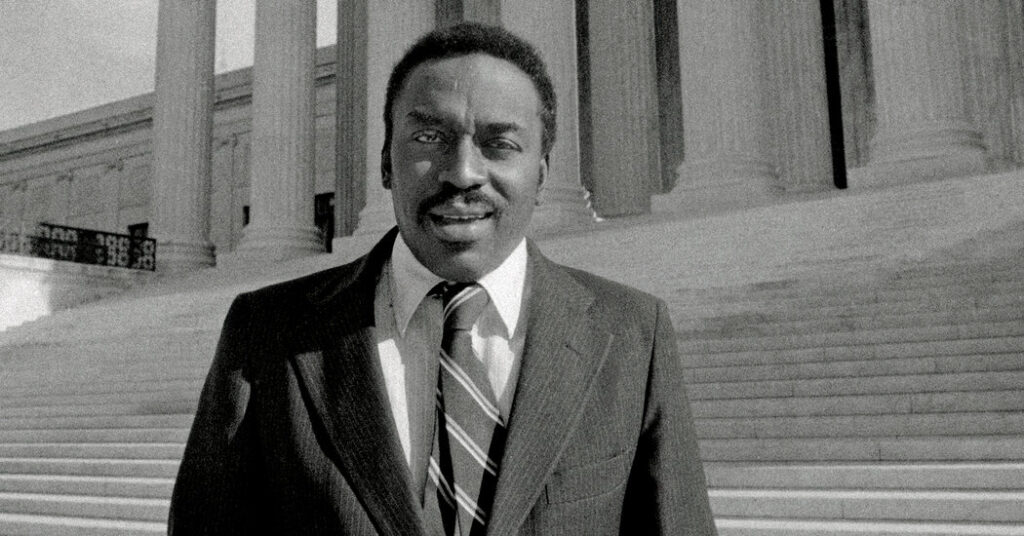
One afternoon in 1981, Ishmael Jaffree’s son came home from kindergarten and asked about God.
Mr. Jaffree, a lawyer in Mobile, Ala., was agnostic, and he recoiled when his son and his two older children, both second graders, told him that their teachers had been leading their classes in prayer. The Supreme Court had banned mandatory prayer in public schools in 1962, but a series of recent laws in Alabama had made it easier to bring religion into the classroom.
Mr. Jaffree complained to the teachers, then the principal, and then the district superintendent. His objection was about more than principle: When his kindergartner son refused to pray along, his classmates bullied him.
After Mr. Jaffrey failed to get any answers, he filed a federal lawsuit in 1982, charging that the Alabama laws violated the First Amendment’s Establishment Clause.
In 1985, the Supreme Court ruled 6-3 in his favor, restricting states from allowing anything more than a belief-neutral “moment of silence” in classrooms.
“Just as the right to speak and the right to refrain from speaking are complementary components of a broader concept of individual freedom of mind,” Justice John Paul Stevens wrote for the majority, “so also the individual’s freedom to choose his own creed is the counterpart of his right to refrain from accepting the creed established by the majority.”
The decision in the case, Wallace v. Jaffree, represented a high-water mark in the court’s defense of a strict separation between church and state. It made Mr. Jaffree a hero among civil libertarians, atheists and humanists: A few months after the court’s opinion was handed down, the Freedom From Religion Foundation gave him its inaugural Freethinker of the Year award.
Mr. Jaffree died on July 30, 2024, in Mobile. He was 80. His death, which was not widely reported at the time, was brought to the attention of The New York Times last week by the Freedom From Religion Foundation.
If the suit made Mr. Jaffree a hero to some, it earned him no small amount of enmity, especially in conservative Alabama. As the case proceeded through trial and appeals, he and his family found themselves the target of threatening phone calls, vandalism and ostracism.
They also became a political target. Soon after Mr. Jaffree filed his suit, Alabama’s governor signed a law explicitly allowing teachers to recite prayers with “willing students.” (If they did not have a prayer in mind, the bill helpfully suggested one, written by the governor’s son.)
“If this law is challenged, I hope it is taken all the way to the Supreme Court,” the governor, Fob James Jr., told reporters.
Unfazed, Mr. Jaffree added the new law to the suit.
In 1983 Justice Louis F. Powell Jr. issued an injunction that banned Alabama teachers from leading prayers in the classroom as Mr. Jaffrey’s suit was considered by a lower court. Then, in a brief order in 1984 and the 6-3 decision in 1985, the Supreme Court held that two of the three laws in question were unconstitutional, leaving in place only a law allowing neutral moments of silence.
That did not upset Mr. Jaffree, who did not insist that teachers should be barred from allowing prayer — only that they shouldn’t be able to encourage it.
“Teachers should be allowed to tell students to observe a moment of silence,” Mr. Jaffree told The Times in 1985. “It’s when a teacher says students should or ought to use their time for prayer that a teacher crosses the line of neutrality.”
Ishmael Jaffree was born Frederick Hobbs on March 28, 1944, in Cleveland. His mother, Roberta Hobbs, was a domestic worker; he never knew his father.
Ms. Hobbs was a strict Baptist, and when her son was young she would send him out to preach on street corners. He wasn’t wholly obedient, though: He was expelled from high school for violating the dress code.
He spent a few years working odd jobs before enrolling at Cuyahoga Community College, then transferred to Cleveland State University.
Arriving on that campus in 1968, he encountered ideas like Afrocentrism and existentialism that challenged his conservative upbringing. He was especially influenced by an atheist professor whose last name was Jaffree; in his honor, he changed his name to Ishmael Jaffree.
Mr. Jaffree received his bachelor’s degree in 1972 and his law degree in 1975, also from Cleveland State.
He married Mozelle Hurst in 1974. She survives him, as do their daughters, Makeba Lippitt, Nailah Jaffree, Talibah Jaffree and Layla Jaffree; their sons, Jamael and Chioke Jaffree; and six grandchildren.
The Jaffrees moved to Mobile in 1977, and Mr. Jaffree opened a law practice there. He later went to work for Legal Services of Alabama, a nonprofit law firm that provides free civil legal aid to low-income residents. He spent most of his career there.
Mrs. Jaffree was a practicing member of the Baha’i faith. Both parents agreed that neither would influence their children’s religious beliefs, or lack thereof — which was one reason he was so angered by prayer in his children’s classrooms.
He and his wife “made a pact,” he told The Baltimore Afro-American in 1984. “I certainly would not want a teacher to violate my right as a parent.”
Wallace v. Jaffree was among the last Supreme Court decisions to strengthen the separation of church and state. In his dissent, Justice William Rehnquist argued that the Constitution forbade only the creation of a state religion; it did not prevent the accommodation of religion in public life, he said.
As Justice Rehnquist rose to become chief justice the following year and the court tacked to the right, his position on religion became dominant, and has remained so. In the court’s 2022 decision in Kennedy v. Bremerton School District, for example, the justices ruled, 6-3, that the government could not prevent a coach from leading a prayer at a sporting event.
Despite the challenges of being the public face of a controversial position, Mr. Jaffree said after the Supreme Court’s ruling that he would go through with the suit again.
“I would do it because I’m absolutely committed to the idea of separation of church and state,” he said in a speech to the Freedom From Religion Foundation. “There’s no question that my religious view is a minority, and unless people like me are willing to challenge these cases, then we don’t have a chance.”
Clay Risen is a Times reporter on the Obituaries desk.
The post Ishmael Jaffree, Who Won Case Rejecting School Prayer, Dies at 80 appeared first on New York Times.