“The easiest method for the United States to reopen Hormuz,” I wrote last Tuesday, “is to start seizing tankers carrying Iranian crude once they reach the Arabian Sea.” I was reiterating a point I had made in this column a week earlier: “The principle would be ‘all or nothing’: Either energy flows freely from the strait, unimpeded by Tehran, or it doesn’t flow at all.”
On Sunday, Donald Trump described the point of his blockade of Iran to Fox News’s Maria Bartiromo: “It won’t be a friend of yours, like a country that’s your ally,” the president said, referring to Iran giving safe passage to tankers that had carried its oil or paid a toll. “It’s all or nothing.”
Since the president is taking good advice, let me offer a few more suggestions.
First, Trump should put Iran’s regime to a fundamental choice: It can have an economy. Or the regime can attempt to have a nuclear program while trying to control the Strait of Hormuz. But it can’t have both.
“Iran’s central bank has warned President Masoud Pezeshkian that rebuilding the country’s war-damaged economy could take more than a decade,” reports Iran International, an Iranian opposition news site based in London. The bank anticipates up to two million additional people left jobless by the war, along with inflation as high as 180 percent. An inflation rate of over 40 percent was what sparked January’s mass protests. As for the effects of the blockade, the site reports, it would wipe out “an estimated $435 million in daily economic activity,” and force “oil field shutdowns within weeks.”
Tehran will surely try to test the blockade by targeting Arab ports. The regime should be warned of the consequences, starting with the destruction of Iran’s most vital energy facilities, on Kharg Island. (So far, the U.S. has hit only military targets on the island.) Alternatively, Iran’s leaders can surrender their stockpile of highly enriched uranium, forswear enriching uranium and reopen the Strait of Hormuz as an international waterway. The choice should be theirs to make.
Second, Trump must bear in mind what precipitated the current crisis with Iran — not its nuclear programs, but the murder of thousands of Iranian protesters in January. What Iran’s leaders fear more than economic collapse is the wrath of their own people.
Administration policy should be geared to exploit that wrath. That begins by breaking the information blockade the regime has sought to impose through an internet blackout. Fully restoring funding to Radio Farda, the Persian-language service of Radio Free Europe that the Trump administration slashed last year during the tenure of the incompetent Kari Lake would be one place to start. Flooding Iran with additional Starlink terminals — too many for the regime to stop — would be the next. What would not help, by contrast, is to target civilian infrastructure, particularly power plants, whose destruction could only bring misery to ordinary Iranians.
The most important step Trump could take would be to warn the regime publicly — and in a way that gets communicated to Iran’s people — that it will intervene militarily if it again attempts a bloody crackdown on public protests. The United States cannot bring about regime change in Iran. But it can do what it can to tilt the scales in favor of the millions of disaffected Iranians who can.
Third, if the regime wants to link the current cease-fire with an end to Israel’s attacks on Hezbollah in Lebanon, then it must itself desist from arming and financing the terrorist group.
The principle is simple: Israel will get out of Lebanon the moment Iran gets out of Lebanon. Failing that, the United States should give Israel a green light to continue degrading Hezbollah’s capabilities until it can no longer initiate wars against Israel, as the group did in 2006, 2023 and again this year. If other states, particularly France as Lebanon’s former colonial power, object to this, they can always volunteer to send their own troops to enforce the U.N. Security Council resolution that Hezbollah has been violating for nearly 20 years.
Finally, Trump can offer the regime a grand bargain: what I’ve long called “normalization for normalization.”
Iran could get an end to both war and blockade, full relief from international sanctions, the resumption of diplomatic and commercial relations with the United States and every other benefit that Tehran used to enjoy before the Islamic revolution of 1979. In return, all that would be asked of Iran is to behave like a normal country: no efforts to support armed militias throughout the region, or harbor Qaeda leaders, or send hit squads to kill or kidnap enemies abroad, or declare “death to Israel” and “death to America” as foundational principles of the regime while trying to build nuclear weapons.
Does any of that sound outrageous? Of course not. The outrage is that the regime’s current leaders would almost certainly dismiss the proposal out of hand because ideological militancy, rather than fidelity to the interests of the Iranian people, is what has defined them for the past 47 years.
The moment an Iranian government, including the current one, accepts these terms, we’ll know that we are dealing with a fundamentally different regime. It would be statesmanlike of Trump to propose it — and wise of him to keep turning the screws on the regime’s leaders until they accept it.
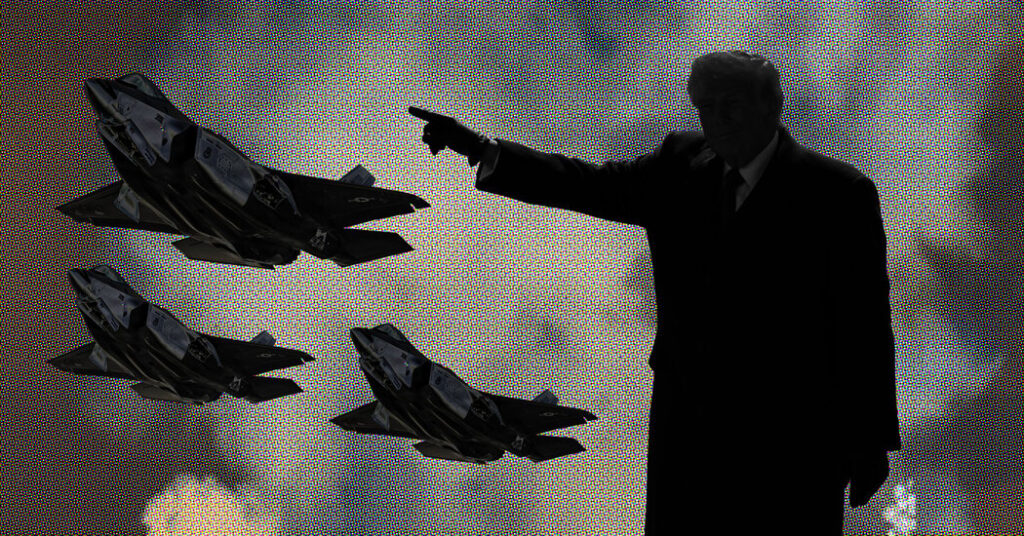
Source photographs by Tierney L. Cross, via The New York Times; Atta Kenare, via Agence France-Presse — Getty Images; and U.S. Air Force.
The Times is committed to publishing a diversity of letters to the editor. We’d like to hear what you think about this or any of our articles. Here are some tips. And here’s our email: [email protected].
Follow the New York Times Opinion section on Facebook, Instagram, TikTok, Bluesky, WhatsApp and Threads.
The post How Trump Can Wrap Up the War appeared first on New York Times.

![AEW’s Kenny Omega Gives Update on Kota Ibushi’s Recovery [Exclusive]](https://dnyuz.com/wp-content/uploads/2026/04/IMG_5301-350x250.jpeg)