Hundreds of watch brands and tens of thousands of visitors have poured into the Swiss watchmaking capital of Geneva this week for an extensive program of events that revolves around Watches and Wonders Geneva, where 65 watchmakers large and small will introduce new collections. Rolex, Patek Philippe and Cartier take center stage, with a supporting cast of big name players and independents targeting collectors. In an unpredictable world, industry players hope that the week brings some stability to a sector in flux. Here is a pick of what’s to come.
Heroes
Masters of the Universe
There’s no question that low-volume, high-value watches are all the rage, as watchmaking continues to reorganize according to a more exclusive formula (over the past decade, Switzerland has halved its output, while reporting record revenues). That’s given plenty of encouragement for both atelier-style independent makers and the giants of the traditional watchmaking establishment to go big on invention. The results? Otherworldly mechanical watches, astronomical prices and starry-eyed buyers.
Jaeger-LeCoultre Master Hybris Inventiva Gyrotourbillon à Stratosphère
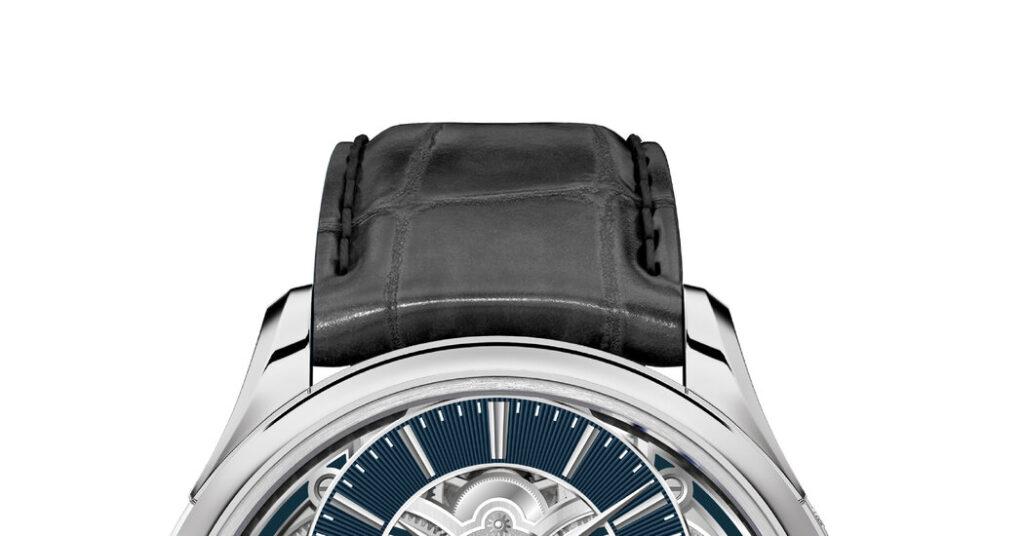
Just how much gravity impacts on the accuracy of a wristwatch remains up for debate. In theory, the action of it being worn compensates for most of the force that drags movement components out of position. But that hasn’t stopped Switzerland’s finest from looking for ways to mitigate it further. Jaeger-LeCoultre’s latest Gyrotourbillon, its sixth in 22 years, rotates the movement’s ticking escapement on three axes, which it says moves it into 98 percent of all possible positions, all but nullifying the negative effects of gravity on its accuracy. It’s a study in watchmaking mathematics and the possibilities of micromechanics: the Gyrotourbillon alone has 189 components and yet weighs a barely there 0.78 grams. The watch is 42 millimeters and platinum cased, and includes guillochage, enamel and lacquer decorations. Hybris Inventiva is a new term, said to be reserved for watches that will “change the course of the maison’s history.” Only 20 will be made.
Price on application
Vacheron Constantin Les Cabinotiers Minute Repeater Tourbillon Skeleton
Skeletonization may be commonplace, but historically it was a means for elite watchmakers to show off their workmanship. Simply put, it is a process of reduction, hollowing out a movement’s bridges and plates to reveal its moving parts. The challenges are legion. As well as ensuring the resulting assembly doesn’t become visual chaos, watchmakers must protect the movement’s rigidity and function. The process also adds to the burden of presentation: According to the codes of fine watchmaking, each component, now under the spotlight, must carry meticulous surface finishes and edge-bevelling, much of which has to be done by hand. Vacheron Constantin is a master of the art and makes a virtue of it in this made-to-order piece, which skeletonizes the Geneva company’s revered Calibre 2755. This brings a tourbillon and a minute repeater that chimes the time on demand. Vacheron says it took its crack Les Cabinotiers division a year to achieve — but it won’t say who the lucky first owner will be.
Price on application
Panerai Luminor 31 Giorni
One of the plainest advantages of the battery-powered quartz watches that were once thought to pose an existential threat to traditional watchmaking was that they didn’t stop when you took them off for a day or two. Mechanical watches run off energy stored in a tightly coiled “mainspring” that releases energy over a comparatively short period of time, typically around 40 hours, even in contemporary examples. As long ago as the 1950s, Panerai began working on extending the power reserve of a mechanical watch, a legacy it has continued, becoming well known for its three, eight and 10-day watches. Those now look quaint alongside the Italianate company’s latest, which offers 31 days of power. This monthlong reserve is delivered by four barrels arranged in sequence that house springs totaling 3.3 meters, or almost 11 feet, in length. The effort comes at the outset — the watch is hand-wound and it takes 128 crown turns to charge time, date and power reserve functions. The movement is skeletonized and framed in 44 millimeters of Panerai’s Goldtech, and the watch is limited to 200 pieces.
$107,000
A. Lange & Söhne Saxonia Annual Calendar
The German watchmaker A. Lange & Söhne, or Lange for short, makes around 5,000 watches a year, but it’s widely accepted it could sell most of that number again, such is demand. Buyers sign up for a charming contradiction of understated aesthetics and lavish finishing, as well as the brand’s unrepentantly Teutonic approach to fine watchmaking. Those qualities are front and center in this new annual calendar version of its classic Saxonia family, which makes time and date indications a visual priority (with irrefutable logic), gently relegating its day, month and moon phase displays so they have less prominence, without denting their legibility. If the dial is balanced, so too are the mechanics behind it. The handsome movement is new, designed to fit inside a very modest 36-millimeter case and to advance the oversize date at the end of 30 and 31-day months automatically without adjustment. The power reserve is 60 hours, but if left dormant for longer, indications can be skipped forward in unison using the pusher at 10 o’clock. Another Lange lesson in complex simplicity.
65,000 euros, or about $75,000
Shoot for the Moon
This year’s galaxy of lunar-themed watches happens once in a blue moon. (Perhaps it’s because life down here on Earth is such a muddle.) One is designed to be worn in space, another is scheduled to be left on the moon by the end of the year, while others have found poetic new ways of bringing the lunar phases to our wrists.
IWC Pilot’s Venturer Vertical Drive
Unlike Omega’s Speedmaster Moonwatch, IWC’s latest tool watch has been designed for spaceflight. Conceived and tested in partnership with Vast, the company that aims to produce a commercial space station, the white ceramic watch has no crown, instead using a rocker switch to activate its functions, each then operated via a rotating bezel.
$28,200
Van Cleef & Arpels Midnight Jour Nuit Phase de Lune
Another from the Poetic Complications collection from Van Cleef & Arpels, this time a decorous piece with an on-demand moon phase display. At the push of a button, the dial springs into life, rotating a golden sun out of sight to reveal the moon in its current phase in layers of mother-of-pearl and aventurine. Clever mechanics mean that even during animation the watch tracks the moon’s phases uninterrupted.
$153,000
Bremont Supernova Chronograph
Assuming everything goes to plan, when Astrolab’s solar-powered lunar rover FLIP takes up residence on the moon this summer, it will make its onboard Bremont Supernova the first British watch on the moon. The debut model in Bremont’s new Space collection, the 41-millimeter watch is made of 904L steel and has a black decahedral ceramic bezel.
$9,800
Gerald Charles Masterlink Perpetual Calendar
Gerald Charles’s asymmetrical sports watch gains a perpetual calendar this year. It’s fueled by a novel asymmetrical movement developed in-house that’s mechanically programmed to advance automatically the date at month’s end, even in leap years. Its moon phase features a large, domed, laser-engraved moon, textured to evoke the lunar surface. Beyond, it’s cased in 40 millimeters of titanium and weighs a floaty 97 grams.
$78,800
Lines in the sand
Anniversaries are often two a penny in an industry that can document its history going back five centuries. But not all anniversaries are born equal. These are four new watches that represent moments in time that shaped the fortunes of the brands that created them, and in some cases even watchmaking itself.
Patek Philippe Annual Calendar Reference 5396R-016
It’s a watchmaking anomaly that the perpetual calendar function predated the annual calendar in a wristwatch by more than 70 years. The former keeps track of the date, even in leap years, whereas the latter needs advancing manually at the end of February; both are Patek inventions. This year, the company celebrates the 30th anniversary of the more recent invention with this 38.5-millimeter rose gold update to its classic Reference 5396.
$67,517
Chopard L.U.C. 1860
Also marking a 30th anniversary is Chopard, which opened its Fleurier manufacture in 1996. This was pivotal for the family-owned company, becoming the source of all manner of complex movements that have since amplified Chopard’s reputation as a creator of fine watches. This time-only 36.5-millimeter steel automatic is a continuation piece, running on an upgraded version of the first movement delivered by the facility.
$29,700
Ulysse Nardin Super Freak
When the first Freak broke cover 25 years ago, it deserved its name. No hands, no dial and no crown, with some of its moving parts made of silicon. Its weirdness is recalled in this Super Freak, which has a double tourbillon, eight patents, 511 components and a movement that’s in almost complete constant motion, making it, according to Ulysse Nardin, “the most complicated time-only watch ever made.”
$361,600
Raymond Weil The Fifty
In the mid-1970s, when most Swiss watch companies were fighting for survival, Raymond Weil started his own. Half a century on, the unlikely story of the company that bears his name is remembered with a 50-piece limited-edition chronograph based on the Millesime, the neo-vintage design that’s given the family-owned watchmaker a recent boost. Each is powered by one of 50 restored Valjoux 26-3 movements made in 1976, Raymond Weil’s founding year.
$9,900
The post Geneva Watch Week Seeks to Brighten Watchmaking’s Future appeared first on New York Times.