Aaron Levinson wanted to go to a World Cup game this summer, but he didn’t want to take out a second mortgage to pay for that. So after winning a chance to spend $560 for individual tickets in a FIFA lottery last fall, Levinson backed out.
Then he backed in again this spring.
“Maybe the sticker shock kind of started wearing off,” he said Sunday. “I got caught up in the excitement.”
So Levinson decided to pluck down $850 for two Category 3 tickets — among the cheapest available — for he and his wife to go the final U.S. group-play game at SoFi Stadium in June. When his wife reminded him that his two sons would be visiting then, he bought two more tickets, bringing his investment to $1,700, more than double the price of a seven-day cruise.
And that doesn’t include the nearly $250 it will cost to park near the stadium.
“That’s really steep,” said Levinson, a Galaxy season-ticket holder for more than a decade. “But when are we going to go to another World Cup? This was special.”
Until it wasn’t.
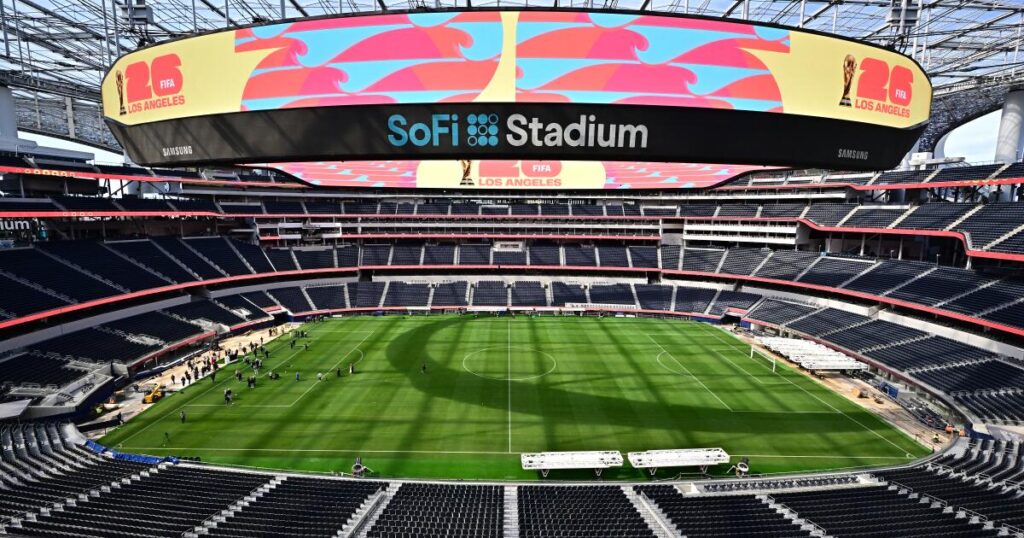
Levinson bought the tickets without knowing where the seats would be, but when he saw a color-coded seat map of SoFi, it showed the Category 3 sections were in the corners of the top deck, far closer to the stadium’s translucent roof than the playing field. Maybe the cruise would have been a better idea after all.
“I don’t know if ‘disappointing’ is the right word. It’s just bizarre,” he said. “I like to sit in a certain spot. I like the sideline; I don’t want to be behind the goal. I just feel like for the price I paid, at least I could know where [the seats] are going to be.”
Levinson is hardly the only person unhappy with their experience buying tickets for this World Cup, which will be co-hosted by the U.S., Mexico and Canada. That may explain why tickets reportedly remain available for more than a third of the 72 group-stage games and many of the expensive hospitality packages also remain unsold. And that is raising worries FIFA may have priced the World Cup so beyond the reach of many fans that some matches will be played before empty seats despite the fact FIFA president Gianni Infantino told CNBC in February that all 104 matches were sold out.
FIFA later clarified that statement, saying Infantino meant to say he expected the games would sell out. Either way, concerns about empty seats may be overblown since the fourth and final phase of ticket sales didn’t begin until April 1 and tournament organizers are confident demand will match inventory.
Yet last summer’s Club World Cup, played in the U.S. as a kind of dress rehearsal for this year’s event, was also beset by similarly sluggish tickets sales that eventually led organizers to drastically reduce prices, with some seats falling from nearly $500 to less than $15. Although attendance for the 63-match tournament was nearly 2.5 million, four games drew fewer than 8,500 fans.
FIFA apparently did not learn the obvious lesson from that debacle since top-tier tickets for some group-play games this summer are topping $4,000.
Ticket-buyers were led to believe Category 1 seats were the most expensive, encompassing most of the lower bowl, according to color-coded seat maps released by FIFA. Some fans paid thousands of dollars for seats in these premier sections, then waited for FIFA to assign them specific seats.
But when FIFA began delivering those assignments earlier this month, many ticket-holders found the seats they had pay top dollar for were now in the corners, behind the goal or several rows from the field, according to the Athletic. The reason? FIFA was now selling seats in the first few rows of the lower bowl for as much as triple the price of a standard Category 1 tickets.
“Until the launch of the last-minute sales phase on 1 April, FIFA sold tickets as access to seating within defined categories rather than specific seats, and all fans have been allocated seats within the category purchased or better,” a FIFA spokesperson said in a statement. “The introduction of new front-row products reflects the current sales phase, in which individual seats may be offered, and does not change the category-based model under which earlier tickets were sold.”
The attempts to squeeze every last nickel out of World Cup ticket-buyers hasn’t just angered fans. Members of Congress have taken note as well. Last month, 69 members of Congress sent a letter to FIFA urging it to reduce prices.
“When the tri-nation model for the 2026 World Cup was announced in 2018, FIFA emphasized an inclusive tournament experience, including the availability of hundreds of thousands of low-cost tickets,” the letter read in part. “That vision of an accessible, global celebration has been undermined by a dynamic-priced ticketing model that is financially exclusionary and stands in dark contrast to the vision presented.”
Pricing out the average fan could have another cost. Landon Donovan, the best U.S. soccer player of all time, said he wasn’t aware there was such a thing as international soccer until a neighbor took him to a World Cup game at the Rose Bowl in 1994, when ticket prices were just a fraction of what they are this summer. If the next Landon Donovan has to watch the tournament on TV, maybe his career choice will be different. The same could be said for the next generation of prospective U.S. soccer supporters.
“I was exposed to what World Cup was for the first time,” said Donovan, who would go on to play in the tournament three times, setting records for most games played and goals scored by an American. “People who are just casual sports fans, or people who are not even sports fans, will go and fall in love with the game for the first time.”
Not if the choice is paying for a ticket or paying the mortgage.
The post Fans vent frustration over high World Cup ticket prices for worse seats appeared first on Los Angeles Times.