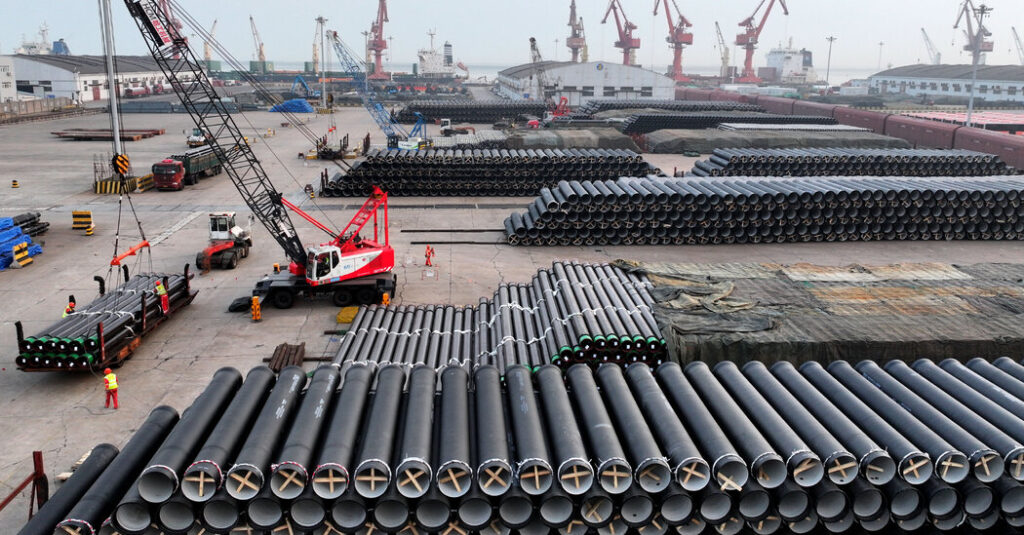
As China’s mammoth trade surplus stokes global tensions, Beijing has enacted sweeping new regulations to investigate and punish foreign companies that stop using Chinese suppliers in response to political pressure at home.
Foreign business groups expressed strong concern about the vaguely worded rules, which took effect when Premier Li Qiang signed them on April 7. Analysts warned that the regulations could make it harder for foreign companies to divest from joint ventures in China or shift orders to overseas suppliers.
The new regulations are part of Beijing’s broader effort to counter what it sees as rising protectionism in the West, driven by a surge in Chinese exports and growing concerns about trade imbalances. China’s exports exceeded imports by almost $1.2 trillion last year, and the country notched another large surplus in the first quarter.
China’s manufacturing dominance spans nearly every industry. But companies that once flocked to its factories for low-cost, high-quality production are now looking to reduce their dependence, pressured by their governments not to abandon local manufacturing and the perception that doing business in China is becoming more challenging. Foreign automakers have closed factories as the Chinese market slows.
The 18-point regulations, described in state media as an effort to “prevent security risks in industrial and supply chains,” supplement the already formidable authority afforded to Chinese regulators to investigate multinational corporations for moving supply chains out of China.
Under the new rules, regulators can question employees and examine corporate records during investigations. The regulations also allow authorities to bar companies and individuals from leaving China if they are suspected of moving supply chains elsewhere under foreign pressure.
“The threat that individual employees could be punished through exit bans is concerning, given the lack of a clear and transparent legal process,” Jens Eskelund, president of the European Union Chamber of Commerce in China, said in a statement.
The State Council, China’s cabinet, justified the measures as necessary to protect the country’s economic stability and national security — a rationale it has previously used to expand its ability to pressure companies. China has also adopted sweeping state secrets laws to prevent information from leaving the country.
The new rules build upon Beijing’s existing efforts to prevent Western companies from avoiding goods from northwest China’s Xinjiang region, where researchers have cited evidence of forced labor, mass arrests and confinement to re-education camps targeting the region’s predominantly Muslim Uyghur population.
China’s Ministry of Commerce investigated PVH, the parent company of Calvin Klein and Tommy Hilfiger, in 2024, accusing it of “discriminatory measures” against products from Xinjiang, which produces a fifth of the world’s cotton.
Michael Hart, the president of the American Chamber of Commerce in China, said that foreign businesses had not been consulted in drafting the latest rules and warned that the accumulation of legal threats against foreign businesses in China could backfire.
“There needs to be more clarity, or this could cause foreign players to de-risk further from China,” he wrote in a text message.
Evan Smith, chief executive of Altana, a New York-based supply chain mapping company, said that China’s global network of ports and port-management software gives Chinese officials detailed insight into multinationals’ supply chains, allowing them to detect when companies shift to suppliers elsewhere.
A severe housing downturn has left China’s economy heavily dependent on a trade surplus that has shattered previous world records, even as President Trump levied tariffs aimed at eroding that advantage.
On Tuesday, China’s General Administration of Customs announced that the country’s trade surplus narrowed slightly to $265 billion in the first three months of this year, as the cost of oil imports rose.
Car sales in China have plunged 17.4 percent so far this year, prompting automakers to turn outward . Car exports soared 50.3 percent in the first three months of this year. The export surge is raising concerns about job losses in the West and in developing countries like Malaysia, Mexico and Brazil.
China’s new supply chain rules come a year after it imposed strict export controls on rare earth metals and rare earth magnets, which are essential to a wide range of industries.
Initially aimed at the United States in response to President Trump’s “Liberation Day” tariffs, the restrictions have also curtailed shipments to the European Union over the past year, reflecting China’s opposition to European tariffs on imported Chinese electric cars.
In a report released Tuesday, the European Union Chamber of Commerce in China strongly criticized China’s growing use of export controls, particularly on rare earths. A survey found that the restrictions have affected European companies across a wide range of industries, although not in food, beverages, retail and education.
“There is now a recognition that China’s emerging export-control regime poses a long-term business risk, given that the ability to export a particular item could be taken away at any point based on political rather than security factors,” the report said.
The issuance of new supply chain regulations comes as thousands of auto executives and engineers prepare to gather in Beijing next week for the city’s auto show..
Ruoxin Zhang contributed research.
Keith Bradsher is the Beijing bureau chief for The Times. He previously served as bureau chief in Shanghai, Hong Kong and Detroit and as a Washington correspondent. He lived and reported in mainland China through the pandemic.
The post China Imposes New Rules to Block Foreign Companies From ‘Decoupling’ appeared first on New York Times.