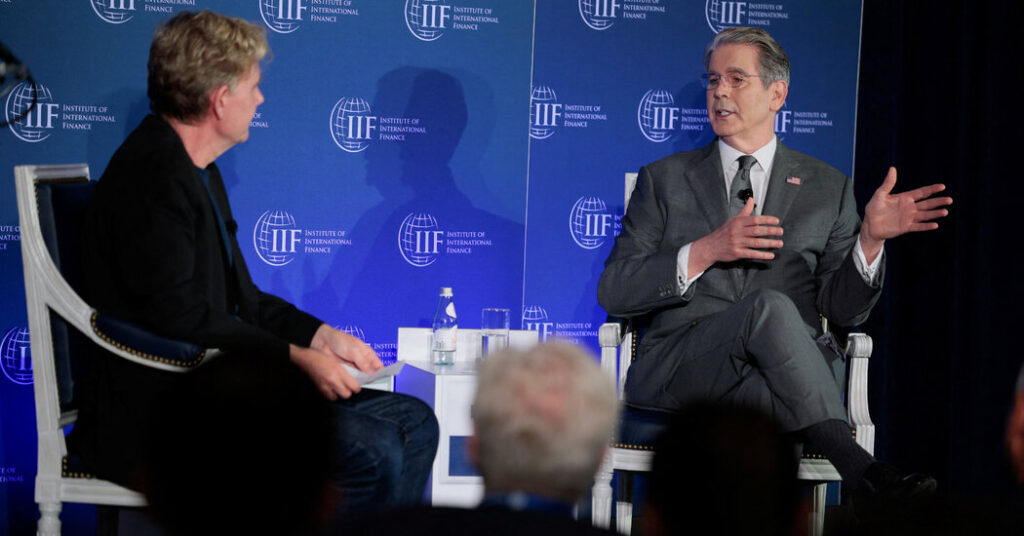
Treasury Secretary Scott Bessent claimed on Tuesday that it was difficult to determine the actual causes of climate change, dismissing decades of science that has attributed global warming to the burning of fossil fuels. He instead called on international financial institutions to focus their attention on economic growth and alleviating poverty.
The comments came in remarks on the sidelines of the spring meetings of the International Monetary Fund and the World Bank. Mr. Bessent had previously ordered the World Bank to remove some of its climate finance targets and finance “all affordable and reliable sources of energy” including gas, oil and coal.
The Trump administration has reversed most of the spending on clean energy that was underway during the Biden administration and pushed ahead with policies that end restrictions on greenhouse gas emissions and aim to ramp up domestic production of fossil fuels.
President Trump last year called global warming a “hoax” and a “con job.” While the Treasury secretary did not go that far, his comments contradicted the scientific consensus about why the world’s climate is changing.
“Yes, the climate does change,” Mr. Bessent said, adding that “we are going through cycles, and I believe that it is very difficult to deconstruct the reasons around why anything changes.”
Leading scientists have rejected claims like Mr. Bessent’s, and noted that natural factors like the sun, volcanic eruptions and orbital cycles would be cooling the earth if not for human activity. Instead, about 200 years ago, after the start of the Industrial Revolution, the direction of global temperatures reversed and began rapidly warming.
“The only reason for the observed warming are human activities, and the biggest of those activities are the emissions of heat-trapping gases from burning fossil fuels,” said Katharine Hayhoe, an atmospheric scientist at Texas Tech University.
Average global temperatures are expected to rise 1.5 degrees Celsius (2.7 degrees Fahrenheit) above preindustrial levels within the next decade. That would unleash dire impacts that include increased and more intense heat waves and heavy precipitation, melting of the world’s glaciers and ice sheets and a higher risk of severe wildfires.
The Earth has already warmed about 1.2 degrees Celsius (2.3 degrees Fahrenheit) since the Industrial Revolution, scientific estimates suggest.
The Trump administration has rejected both global and domestic efforts to address climate change. It has withdrawn from the Paris climate agreement, as well as the underlying treaty that convenes nations each year to seek solutions to the planet’s warming. It has ended U.S. participation in the United Nations’ scientific body and has withdrawn from a fund aimed at helping the world’s poorest countries cope with the impacts of rising seas and extreme weather fueled by the changing climate.
Critics of this approach argue that nations need to reduce their emissions and develop ways to adapt to climate change to avoid costly, catastrophic weather events that are growing in frequency. The drawbacks of the Trump administration’s focus on oil instead of renewable energy has been evident this year, as the war in the Middle East sent gasoline prices soaring.
Mr. Bessent’s partner in the discussion was Bjorn Lomborg, a Danish academic who argues that climate change is occurring but is not a crisis, and that poor nations require fossil fuels to develop. His work has been influential with members of the Trump administration, particularly Chris Wright, the energy secretary, who has referred to Mr. Lomborg as a friend.
On Tuesday Mr. Lomborg argued that the World Bank is making nations poorer by spending money on what he called a “climate fixation” and a push to transition away from fossil fuels.
“The money that the World Bank spends on the solar panel can’t be invested in health care or education,” Mr. Lomborg said, arguing the institutions “need to get back to making rational priorities.”
Mr. Bessent agreed and said policymakers instead needed to focus on how to “increase resiliency.” He argued that global financial institutions should emphasize economic growth, trade and development.
“We cannot have these elite beliefs get in the way,” Mr. Bessent said, referring to climate change.
Harjeet Singh, the founding director of the Satat Sampada Climate Foundation in India, said calling climate change an “elite” issue purposefully ignores the threats it poses to the world’s poorest. He pointed to 2022 floods in Pakistan that killed nearly 2,000 people and caused more than $40 billion in damage, caused by heavier than usual monsoon rains and melting glaciers that followed a severe heat wave, both linked to climate change.
“If you don’t integrate climate, any development gains are written in sand and washed away,” he said.
Trump administration officials have struggled to articulate their views on climate change and explain how they veer from the international scientific consensus.
The former World Bank president, David Malpass, resigned in 2023 after he appeared to deny the causes of climate change. Mr. Malpass was a senior Treasury Department official during Mr. Trump’s first term and struggled to balance embracing Mr. Trump’s climate views with the climate agenda of the bank.
When pressed about whether he accepted that man-made greenhouse gas emissions had created a worsening crisis, Mr. Malpass said, “I’m not a scientist.” After backlash about those comments, he later said he was not a denier, explaining, “It’s clear that greenhouse gas emissions are coming from man-made sources, including fossil fuels.”
Mr. Bessent suggested on Tuesday that most of the alarm about the economic impact of climate change was the result of a 2024 study that was published by the journal Nature that was retracted last year. After problems with the data in the study were discovered, the researchers determined that instead of a 62 percent decline in economic output by 2100 in a world where carbon emissions continue unabated, global output would be reduced by 23 percent.
“Everything was based on that,” Mr. Bessent said, overstating the degree to which global climate policy had been steered by a single study. “I don’t think that we can have this kind of short-termism. I think we have to stick with core principles.”
Alan Rappeport is an economic policy reporter for The Times, based in Washington. He covers the Treasury Department and writes about taxes, trade and fiscal matters.
The post Bessent Questions the Cause of Climate Change and Its Economic Toll appeared first on New York Times.