This article is part of our Museums special section about how institutions are commemorating the past as they move into the future.
Amina Shire looped blue and lavender yarn around the purple toe of her sock and pulled the ends to her lap. Demonstrating traditional Somali finger weaving for a small audience of Minnesotans, she swiftly rolled two strands together in an elegant spiral, again and again.
Shire is affectionately known as one of the “grandmas,” a group of Somali elder master weavers who teach at the Somali Museum of Minnesota in Minneapolis.
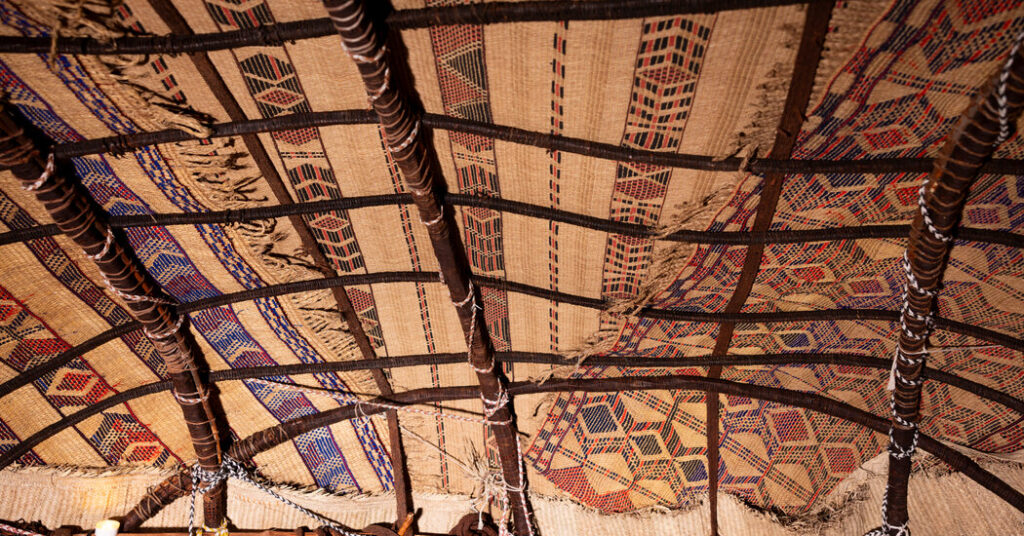
A pile of spiraled cords soon grew at her feet. They are used to make colorful bags, baskets and the mats that cover Somali nomadic huts, or aqal Soomaali, an architecture form traditionally made by women.
“The grandmas built this one,” said Osman Ali, the museum’s founding director, standing inside an aqal Soomaali at the museum. Ali was framed by the hut’s dome, woven in an intricate diamond pattern from vibrant yarns, acacia tree fibers and dried grasses.
Ali brought the raw materials back himself from Somalia, which is true for the majority of items on permanent display at the small Minneapolis museum, from necklaces of amber and wooden Quran tablets to camel milking jars and durbaans — large drums made from wood and animal skin.
It’s one of the few Somali museums in the world. Ali founded it in 2011 with two primary goals: to preserve and promote Somali culture and to teach this heritage to the Somali American youth in Minnesota, which is home to one of the largest Somali populations outside East Africa.
Many say the museum is more than a place of preservation: It has become a place of respite for the Somali community of Minnesota, especially as Somalis have been the target of enforcement efforts by federal immigration agents and as a fraud scandal involving the Somali diaspora has made national headlines. (Federal prosecutors said that more than $1 billion in taxpayers’ money was stolen from a government program meant to keep children fed during the Covid-19 pandemic.)
Immigration enforcement actions in Minneapolis have also inspired passionate protests.
“Our community has endured so much these past few years,” said Representative Ilhan Omar of Minnesota, a Somali American, in an email. “Yet through it all, we’ve seen Minnesotans lead with love time and time again.” The museum is in Omar’s congressional district, and a photo of her hangs in the museum next to other Somali American leaders.
Ali said the idea for the museum came after a fateful trip in 2009 to Somalia to visit his ailing father — the first time he had returned to his home country since moving to the United States in the mid-1990s.
“I was living in the diaspora, out of the country for a long, long time,” said Ali, who was born in northern Somalia. “Someone living out of the country dreams about his background, his ancestors, where he came from, where he belonged to.”
On that visit, he discovered that many cultural artifacts had been lost to the Somali civil war. In 1991, much of the National Museum of Somalia had been damaged and thousands of items looted. (It reopened in 2020 after 30 years.)
“Because of what happened in the civil war, because of the damage that happened to the museums,” Ali said, “that’s why I started to collect these collections and establish this museum.” Ali also noticed that traditions were waning in the younger generations.
“I thought about how all these unique things might disappear one day from the whole country, and to preserve something for the young generation who are going to ask about their heritage tomorrow,” he said.
Ali started making frequent trips to collect what he could, purchasing items mostly from individuals and stores in Somalia, but also from neighboring Somali communities in Djibouti, Ethiopia, Kenya, as well as from people in the United States. Today, the museum has more than 1,500 objects in its collection, some of which is stored with the Minnesota Historical Society.
Kate Roberts, an exhibit developer with the historical society, worked with Ali on a 2019 “Somalis + Minnesota” exhibit at the Minnesota History Center in St. Paul.
The Somali Museum “is one in a continuum of institutions that has worked very hard to preserve cultures for future generations, even as those generations are assimilating and becoming part of Minnesota,” said Roberts, pointing to the Hmong museums in St. Paul and the American Swedish Institute of Minneapolis.
Roberts, who has since joined the museum board, said community engagement has become as important as the collection.
The museum “is rooted in the Somali culture of welcome and the Somali culture of openness, which Osman often talks about, but open to everyone who’s interested in learning about people who are different from themselves,” Roberts said.
Ali’s son, Mohamoud Mohamed, the museum’s artistic director, has developed community programs, from monthly weaving classes to theater workshops. But foremost is the Somali Museum Dance Program, which features classes and a troupe of Somali American dancers who travel nationwide to perform traditional Somali folk dances like the dhaanto.
Dance “is a big part of Somali culture,” Mohamed said.
In January, the troupe performed at a diplomatic reception in New York hosted by Ambassador Abukar Dahir Osman, Somalia’s representative to the United Nations, to celebrate Somalia’s election to the presidency of the U.N. Security Council — the first time the country has held this position in 54 years.
“It was amazing,” Mohamed said. “What a time to be part of the Somali Museum.”
Ifrah Mansour, a Somali artist in Minnesota who often collaborates with the museum, credits the troupe for reviving Somali dance among youth.
“I’m so blessed to now see there are little kids that are wanting to dance because they’ve seen the Somali dance troupe,” Mansour said. “The museum, it’s our heartbeat. It reminds us of who we are, that yeah, we are people who are loud and brash and giving and kind and generous.”
The current political climate has had an impact on visitorship — many in the Minnesota Somali community, and other immigrant communities, have been fearful of leaving home, Mohamed said. The museum’s social media posts have also been bombarded.
“All these negative comments about ‘Go back home’ and fraud,” Mohamed said. “They’re horrible.”
The museum tries to counter the negative news and misinformation.
“That is dangerous, because then it promotes harmful prejudice and stereotypes,” Mohamed said. “Every society has people that commit wrongful doings.”
In spite of the negative attention, Mohamed and his father said the museum has become a healing center where young people, elders and families can gather safely, as well as a tool of diplomacy.
“One of the goals is to bridge the gap between Somalis and non-Somalis, to learn from one another,” Mohamed said. “Because I know, at the end of the day, Minnesota is with us.”
At the museum entrance, a sign says “Why Minnesota?” over a photo of a snowy street — a far cry from the climate of Somalia, Ali said, laughing. The answer in a nutshell, he said: Minnesota provided jobs and opportunity for people escaping a civil war.
“The best thing that we will never forget,” Ali said, “is how Minnesotans stand with the community.”
The post At a Difficult Time, a Minnesota Museum Offers Respite to Somalis appeared first on New York Times.