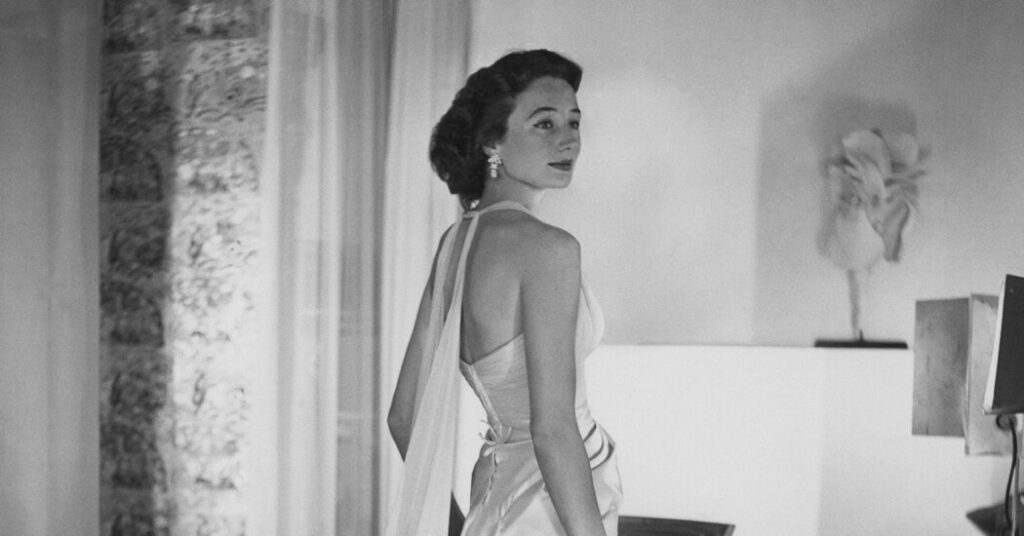
The Countess Jacqueline de Ribes, the Parisian grande dame, tastemaker, fashion designer and much-photographed emblem of a rapidly fading culture, died on Tuesday in Switzerland. She was 96.
Her death, in a hospital, was confirmed by Françoise Dumas, a friend and events organizer for Ms. de Ribes, who lived primarily in Paris and near Lausanne, Switzerland.
Few people in the world of style can legitimately claim the status of icon. But if anyone merited that overworked tag, it was Ms. de Ribes. As a socialite who designed clothes for herself and for a socially prominent clientele, she was an anomaly, simultaneously defying and exploiting her lineage with an extravagant, irreverent style.
As widely known for the image she projected as for her fashion career, she made no excuses. “Dressing up,” she once said, “doesn’t mean that you are frivolous; it has nothing to do with frivolity.”
She preened for the cameras, viewing her poses as a form of self-expression. Her striking aquiline features were memorialized in photography by the legends of the day — among them, Irving Penn, Slim Aarons, Cecil Beaton and, famously, Richard Avedon, who once shot her gazing imperiously into the distance, her hair coiled in a single braid that slid ropelike over her shoulder.
She was “a born actress,” Carolina Herrera, the Venezuelan-born society figure who preceded Ms. de Ribes in designing a fashion line, said. Arriving on the arm of her husband, Edouard de Ribes, she “made many parties famous just for walking in and out of them,” Ms. Herrera said.
“The topic of conversation the next day,” she added, “was always what Jacqueline wore.”
With a profile that could cut glass, she was likened alternately to Nefertiti and to Oriane de Guermantes, the fictional duchess in Marcel Proust’s “Remembrance of Things Past.”
Her fans included the couturiers Yves Saint Laurent, Marc Bohan of Christian Dior and Valentino Garavani, who designed and made sketches for Ms. de Ribes before he established his couture house in Rome and became known simply as Valentino.
She was feted by the Mexican mining heir and aesthete Charles de Beistegui, and attended his celebrated Bal du Siècle in 1951 at the Palazzo Labia in Venice costumed as a noblewoman from an 18th-century painting by Pietro Longhi. She appeared at the Baron Alexis de Redés’s Bal des Têtes in 1956 in an intricately feathered headdress, a rara avis with a single jewel pasted to her chin.
Turning up just in time for dessert at a 1959 dress ball attended by the Duke and Duchess of Windsor and Oscar de la Renta, she drew both glares and gasps of admiration for her costume: an opulent Turkish-style ensemble that she had created out of the remnants of three couture dresses, organza lame she had obtained from a remainders merchant, and a sable cape acquired from a down-on-her-luck ballerina.
“It was a show,” Mr. de la Renta said. “No one knew like Jacqueline the power of an entrance.”
Queen of the Sartorial Mash-Up
Whether swanning at ballet premiers or on the alpine slopes of Sant Anton in Austria, Megève in France or Zermatt in Switzerland, where she favored outsize fox-fur hats dyed to match her outfits, Ms. de Ribes emphatically dressed to impress. “Sometimes she would receive me at home wearing something right out of a Sargent painting,” Valentino once said.
The fashion editor and television personality André Leon Talley recalled: “Everyone used to stand in the great hall and wait for her arrival at the Met Ball when it was held in December. She would have on the most exquisite, and unexpected, Yves Saint Laurent couture.”
First and foremost, however, Ms. de Ribes saw herself as an artist. Queen of the sartorial mash-up, she was well aware of her gifts for improvisation and bricolage.
“Recently someone told me I’m like a D.J. of couture,” she said. “Whatever I pick up I can turn into something else.”
Her assessment chimed with that of Harold Koda, the former curator in charge of the Costume Institute at the Metropolitan Museum of Art. Mr. Koda, who organized the 2015 exhibition “Jacqueline de Ribes: The Art of Style,” observed at the time that “her approach to dress” is “a kind of performance art.”
But Ms. de Ribes’s fantasy-driven aesthetic had practical underpinnings: During couture fittings, she would make liberal used of the drapers, cutters and fitters at Dior and Saint Laurent, asking them to interpret her ideas. With the designers’ blessing, she reworked their designs into over-the-top confections of her own, eventually parlaying that experience into a fashion career.
When her friends and family eventually learned of her plans to run a fashion house, they scoffed. Mr. Saint Laurent worried that she would suffer as he had under the scrutiny of clients and a hypercritical public. Yet he sat in the front row at her debut runway show in Paris in 1983, applauding her collection as “a welcome projection of her elegance.”
She had arrived, it seemed, at the high point of a long journey.
Born Into Privilege
Jacqueline Bonnin de la Bonninière de Beaumont was born in Paris on July 14, 1929, Bastille Day, to Paule de Rivaud de la Raffiniere, a writer and translator of Tennessee Williams and Ernest Hemingway, and Count Jean de Beaumont, a fighter pilot and Olympic marksman, who helped build her mother’s fortune, derived from the Rivaud Group, her family’s investment house.
Ms. de Ribes recalled her mother as distant, undermining and disapproving. “I wasn’t brought up in a family that told me I was beautiful — quite the opposite,” she said. “For years, my mother told me that I didn’t know how to walk.”
Living in German-occupied France during World War II cast another shadow on her childhood. She watched as her Scottish governess was sent to a labor camp, while she and her siblings went to live in Hendaye, on the Côte Basque, at the summer residence that had belonged to her beloved maternal grandfather, Olivier de Rivaud de la Raffinière, who died just before the war. (“He lived a bit like a nouveau riche,” she later recalled fondly. “He had chateaus, yachts, racing stable, women, cars.”)
At a luncheon near Hendaye when she was 17, Jacqueline, who had never worn makeup or high heels, found herself drawn to a young man eccentrically kitted out in shorts, red socks and purple espadrilles. He was the Viscount Edouard de Ribes, a 24-year-old war hero and member of a socially conservative family of financiers. (After the death of his father in 1981, he would become a count.) They married when she was 19.
“I had been so unhappy as a little girl,” she later said. “I thought marriage had to be better.”
The couple eventually found themselves living with their two children at the home of Edouard’s parents, an 1868 townhouse in the central Eighth Arrondissement, an arrangement that Ms. de Ribes found confining. Still, she realized that marriage provided at least one signal advantage: a launchpad into a larger society.
In a circle that favored married women over their young, single counterparts, she established herself as a fashion plate, alighting in the 1950s on a Paris that was haltingly, if ostentatiously, recovering from the depredations of war.
“It was the peak era of sports cars, of haute couture, of society at its most international, of Paris as the capital of the world,” Helene de Ludinghausen, a former director of couture at Yves Saint Laurent, recalled.
A fixture at the splashiest events in the French capital, Ms. de Ribes “personified the idea that Frenchwomen were the most elegant in the world,” the Countess Marina Cicogna, a photographer and film producer, said.
She was not alone in her assessment. In 1956, Ms. de Ribes was voted onto the International Best Dressed List. She appeared on the list four more times before being inducted into its hall of fame in 1962.
During those years, she caught the eye of the designer Oleg Cassini, who asked her to create a few pieces for him. She promptly retreated to the attic of her house, cut muslin on the floor and enlisted a then-little-known Valentino to make accompanying sketches.
She emerged with designs for a small line of silk and linen dresses in an austere black-and-white palette. The partnership with Mr. Cassini lasted only two seasons.
In the years that followed, Ms. de Ribes gave rein to her love of the performing arts.
In the late 1960s, she collaborated with the stage designer and decorator Raymundo de Larrain, overseeing a sumptuous remounting of Prokofiev’s “Cinderella,” with Geraldine Chaplin in a small part. (“I already knew her father,” Ms. de Ribes said, referring to Charlie Chaplin. “I taught him to do the twist.”)
Her infatuation with show business reached an apex of sorts when the director Luchino Visconti considered casting her as the Duchesse de Guermantes in a film adaptation of “Remembrance of Things Past.” But Visconti died in 1976 before he could complete the project.
Getting Serious About Fashion
In 1982, following her 53rd birthday, Ms. de Ribes announced to family and friends that she was going into business as a fashion designer.
“We thought she was out of her mind. But it was her dream, and she did it,” Ms. de Ludinghausen recalled.
“When I started my business, everyone thought I was doing it for a lark, or that Saint Laurent, or who knows who, was doing it for me,” she told The Times. “But I’ll tell you something. I wouldn’t be doing this at all if I weren’t in it 100 percent.”
Her first collection, unveiled in March 1983 at the family townhouse in Paris and worn by the Saint Laurent stable of models, won praise from critics at Women’s Wear Daily and The New York Times, which described it as an “unexpected success.”
Among the highlights were her evening clothes. “They usually have some glamorous focal point, often a skirt that folds up from the back of the hem to the shoulders to form a cape,” The Times noted in 1984. “The clothes are in the grand dressmaking tradition and are designed to flatter the human body.”
For some, however, the originality of Ms. de Ribes’s designs was subject to debate. When she introduced her collection at Saks Fifth Avenue in New York in 1984, Carrie Donovan, then the fashion director of The New York Times Magazine, pronounced it “essentially a pastiche of faintly recognizable Diors, Valentinos, Saint Laurents and perhaps even Cardins.”
Ms. de Ribes thrived, just the same. By the next year, her collection — priced from about $1,500 to $8,000 a piece — was being sold at more than 40 stores in the United States. Fred Hayman, the owner of Giorgio in Beverly Hills, Calif., declared, “I wouldn’t do a season without her.”
She had signed an exclusive three-year contract with Saks Fifth Avenue, and her business was grossing $3 million annually (about $9 million in today’s money). She had a coterie of high-profile clients, including Raquel Welch, Barbara Walters, Cher, Marie-Helene de Rothschild and Joan Collins, who was said to have modeled her imperious character in the TV drama “Dynasty” after Ms. de Ribes.
Eager to succeed on a global scale, Ms. de Ribes sold a minority stake in her company to Kanebo, the Japanese cosmetics conglomerate, in 1986. “I’ve built the boat,” she said. “Now I want to put up the sails.”
But over her objections, the Japanese investors tried to change her designs. The relationship collapsed, its demise the first in a series of business and personal setbacks.
In 1994, Ms. de Ribes was hospitalized for debilitating back pain, and surgery left her unable to walk for three years. She subsequently learned that she had celiac disease, an autoimmune disorder. In the midst of these ordeals, the French government began investigating the Rivaud Group, the family business, for tax evasion and fiscal malfeasance. The company eventually fell into the hands of Vincent Bollore, a billionaire corporate raider.
Troubled by continuing ill health, Ms. de Ribes dissolved her company in 1995. The death of her husband in 2013 was another blow.
Ms. de Ribes is survived by their son, Jean, and daughter, Élisabeth Van der Kemp; a granddaughter; and two great-grandchildren.
Nevertheless, for all her trials her influence persisted.
“She is the essence of Parisian elegance,” Jean Paul Gaultier, who dedicated a collection to her in 1999, said. “She is one of the few women who would dress herself divinely, but who also knew how to dress other women.”
In 2010, Nicolas Sarkozy, then the president of France, awarded Ms. de Ribes the Legion of Honour, the country’s highest order of merit, for her philanthropic and cultural contributions.
With the death of Hubert de Givenchy in 2018, “she may well represent that last golden age of high fashion in Paris,” Mr. Talley, the fashion editor, once said.
Such extravagant praise would have pleased her, validating the creative ambition she nurtured during her lifetime. Hard work, she believed, was proof of one’s mettle.
As she once told The Times, “I didn’t want to be an old lady saying to herself, ‘I dreamed of doing something, and I didn’t have the courage.’”
Ash Wu contributed reporting.
Ruth La Ferla is a reporter in the Style section of The Times whose coverage ranges across fashion, influential personalities and societal trends.
The post Jacqueline de Ribes, Tastemaker and Fashion Avatar, Dies at 96 appeared first on New York Times.