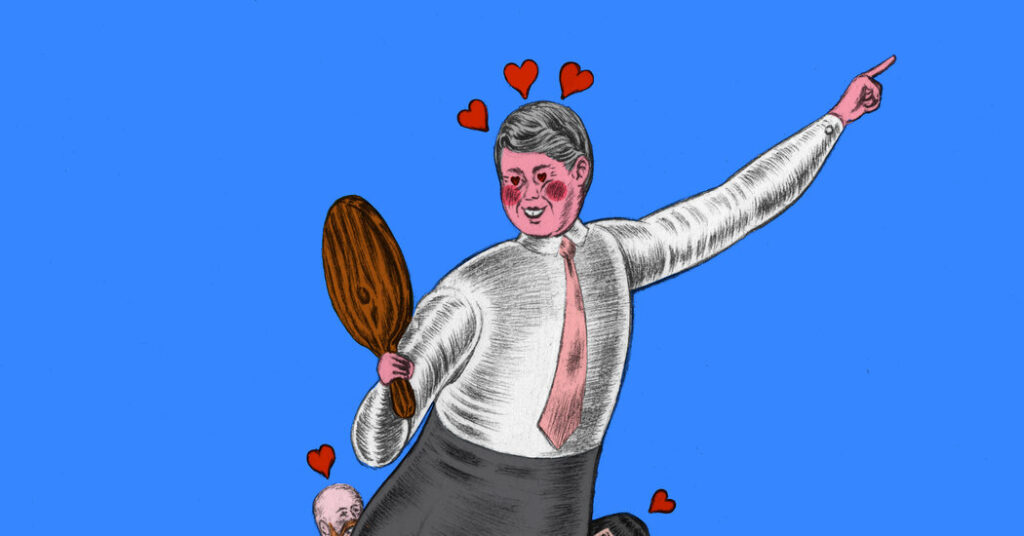
In ancient Greek mythology, a man who falls in love with his own reflection withers away and dies. In modern America, he gets promoted to the corner office — and sometimes even elected to the Oval Office.
We should know better. Great leaders put their missions above their egos. Narcissists do the opposite — they see themselves as special and superior, and put their egos above all else. So why do we keep falling for them?
A study of U.S. presidential elections from 1824 to 1992 revealed that the taller candidate consistently got more votes than the shorter candidate, but height was a stronger predictor in times of social, economic and political threat. The greater the societal instability, the more people wanted a leader who projected physical dominance and strength. That’s the allure of a narcissist today.
We live in a period of extraordinary unrest. Millions of people died in a pandemic, and for the first time in generations, hundreds of thousands of people have died in a land war in Europe. Climate change is a threat to our way of life and artificial intelligence is a looming threat to our livelihood. The result for many people is an overwhelming sense of uncertainty and anxiety. And those are fertile conditions for authoritarians who promise to restore order to chaos and narcissists who exude intoxicating levels of confidence and charisma.
Readers of a certain stripe will assume this is an article about President Trump. He is, after all, the man who has boasted, “I alone can fix it” and “I know more about ISIS than the generals do,” who exaggerated his wealth, refused to concede that he lost an election and described the brutal killing of a Hollywood couple as being somehow all about him. But my point is not about Mr. Trump per se — it’s about why people are attracted to him and so many others like him as leaders in politics and business right now.
A little grandiosity can be conducive to big, disruptive ideas, but the evidence is abundant that people with high levels of narcissism make for worse leaders. To advance their own interests, they’re more willing to manipulate others, cut corners and even break laws.
The stakes are especially high in politics. In one study, 120 experts rated the American presidents on their narcissism. The top three — Lyndon Johnson, Richard Nixon and Andrew Jackson — all saw their legacies tarnished by corruption and disastrous decisions. Hubris led Jackson to defy the Supreme Court and forcibly remove Native Americans from their land, led Johnson to escalate the Vietnam War despite warnings from his under secretary of state, and led Nixon to the Watergate scandal.
In business, too, narcissistic leaders wreak havoc. Banks led by people rated as narcissistic established riskier policies and recovered more slowly from the 2008 financial crisis. Instead of adjusting their decisions based on objective success or failure, narcissistic executives get high on social praise, which emboldens them to take even bigger risks. As they bask in the glow of yes men and flattery, they’re more likely to double down on ideas that aren’t working. Steve Jobs’s arrogance led him to launch the overpriced Apple Lisa, burn bridges with his board and ultimately get forced out of his own company. You can even see the costs of narcissism in professional sports. In the N.B.A., the more narcissistic players’ tweets were, the less their teams improved over the course of the season.
Narcissists are ball hogs and glory hounds. They take credit, give blame and put themselves above the group. They see leadership as an opportunity to seize, not a responsibility to serve.
A popular narrative is that we’re being bamboozled by these people. We’re seduced by superficial charm and fail to see the hubris that’s powering it. Yet research shows that narcissists are not hard to spot. They boast about themselves, post flattering photos of themselves, sign their names with oversize letters. They feel entitled to special treatment — and when they don’t get it, they signal virtuous victimhood, airing their grievances like it’s Festivus. Across multiple studies, people who were well aware of narcissists’ self-serving tendencies still preferred them as leaders for an unpredictable world.
Psychologists find that narcissistic leaders are more appealing to people with low self-esteem. The lower our opinions of ourselves, the more insecure we’re feeling, the higher our opinions of narcissists. Supporting them makes us feel special (and makes them feel less threatened). It begins early: One study of elementary and middle schoolers found that in 96 percent of classrooms, kids who displayed narcissistic qualities were more likely to be nominated for leadership roles.
If you’re stuck with narcissistic bosses, it’s possible to temper their worst impulses. The key is to compliment them on qualities that are clearly separate from any realm in which you need to deliver criticism. Before you question their decisions, praise their creativity, their golf handicap, their jokes. Narcissists are less aggressive when their egos are stroked.
Wise leaders balance confidence with humility. They’re secure enough in their strengths to acknowledge their weaknesses and learn from their critics. Whereas narcissists covet leadership roles, humble leaders are often reluctant to assume the mantle. It may not be a coincidence that George Washington had to be coaxed and cajoled into becoming the first U.S. president, and that he refused a third term.
One way to get more humble leaders into power is to change the default. Instead of expecting people to elbow their way into leadership, we should consider everyone who’s qualified unless they opt out. There’s evidence that this simple shift is enough to reduce the gender gap in promotions, which would have the additional benefit of lowering the number of narcissists in high positions, since women are less likely to be narcissists and psychopaths — and more likely to prioritize the collective good. Countries with more female legislators are less likely to go to war, and peace agreements involving women are 35 percent more likely to last at least 15 years. In the early stages of the pandemic, countries and U.S. states led by women had lower Covid-19 fatality rates, in part because they did a better job showing both confidence in their plans and empathy for people’s pain. And organizational psychologists have found that when male leaders are stressed, they’re more likely to be hostile and abusive. Tell me again that women are too emotional to lead.
It could also help to recruit people who emerged from humble beginnings. On average, people who grow up poor tend to be more effective leaders and are less likely to cheat, because they’re less prone to narcissism and entitlement. The same is true of people who start their careers in a recession: A history of struggle builds compassion.
Of course, group averages are poor proxies for individual traits. Ultimately, the best way to stop narcissists from rising in elected office is to address the threats that are making people anxious. Greater job security and income stability should leave voters less tempted by brash candidates. In the corporate world, we promote better leaders when we stop focusing on their individual results alone and start weighing their contributions to others.
The responsibility of leadership is too important to entrust to arrogant people. Narcissistic leaders deny their weaknesses and make themselves weaker. Humble leaders admit their weaknesses and make themselves stronger. Great leaders overcome their weaknesses and make us all better.
Adam Grant, a contributing Opinion writer, is an organizational psychologist at the Wharton School of the University of Pennsylvania.
The Times is committed to publishing a diversity of letters to the editor. We’d like to hear what you think about this or any of our articles. Here are some tips. And here’s our email: [email protected].
Follow the New York Times Opinion section on Facebook, Instagram, TikTok, Bluesky, WhatsApp and Threads.
The post Why We Fall for Narcissistic Leaders, Starting in Grade School appeared first on New York Times.