How the most massive objects in the universe first formed is one of the biggest headscratchers in astrophysics. With more advanced telescopes, astronomers have found fully formed galaxies and colossal black holes earlier and earlier in the cosmos, just a few hundred million years after the Big Bang. This shouldn’t be enough time for these structures to reach their incredible size; to astronomers, it’s like stumbling on a fully-grown oak tree that’s only a year old.
The dilemma was put into hyperdrive by the James Webb Space Telescope’s discovery of extremely bright “Little Red Dots” that were present when the universe was less than a billion years old, and are nowhere to be seen today. Though they’re suspected to be some kind of compact galaxy, they would be almost impossibly dense at the mass they appear to have, wall-to-wall with stars, according to Vadim Rusakov, an astronomer at the University of Manchester and lead author of a new study investigating the red objects published in the journal Nature.
“They would need to produce stars at 100 percent efficiency, and that’s not what we’re used to seeing,” he told Ars Technica. “Galaxies cannot produce stars at more than 20 percent efficiency, at least that’s what our current knowledge is.”
Another proposed explanation is that they’re some kind of supermassive black hole. But this, too, is fraught: the red dots show no signs of the x-ray emissions produced by these objects. And if they were black holes, they would be “overmassive,” weighing nearly as much as their entire surrounding galaxy, something that’s never been observed in a conventional galaxy. How such an enormous monstrosity could form when the universe was still in its infancy is equally baffling.
Thankfully, there may be a very tidy explanation. In his study, Rusakov and his team found that the gasses observed in the Little Red Dots, which astronomers use to infer the mass of invisible black holes, weren’t moving as quickly as once thought. If so, that means that the black holes are around 100 times less massive than previously estimated.
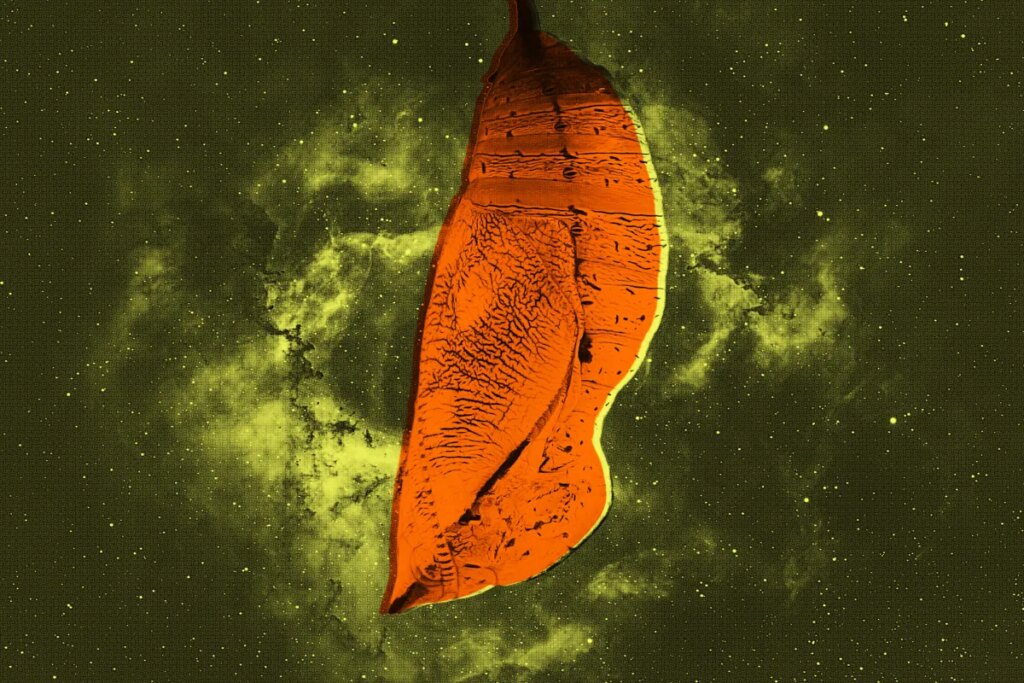
The upshot is that the supposedly “overmassive” behemoths are actually just young supermassive black holes. But if that’s the case, why don’t they resemble any black holes that we’re seeing today? The astronomers suggests that we may be witnessing a previously unknown “cocoon” stage of their evolution, during which they feed off of a dense, protective shell of ionized gas.
“They look like a [developing] butterfly or something in this young state that kind of grows wrapped in some sort of gas that also feeds it,” Rusakov told Ars. “It’s definitely new in the sense people didn’t predict there should be such a cocoon phase in the supermassive black holes’ lifecycle.”
In addition to feeding the black hole, the cocoon would also block the x-ray emissions we would expect to see, explaining their absence.
It’s probably one of the tidiest solutions out there to the Little Red Dots mystery, though there are more than a few. Other research suggests that they’re galaxies which are unusually tiny because they haven’t spun up to speed. An even bolder hypothesis proposes they’re “black hole stars” consisting of a black hole core surrounded by a sphere of gas so dense that it resembles the outer layers of a star. But if Rusakov and his team are on the right track, it raises another significant question that’s been haunting astronomers. “Does the galaxy start with the supermassive black hole or with the stars?” Rusakov pondered. “Is that a chicken or the egg?”
“We don’t know exactly what happens in this first sort of stage of galaxy formation,” he added. “But our model gives us a new way to look at this kind of object.
In our mature cosmos, black holes are formed from the collapse of dying star, but in the earliest moments of its existence, the extreme conditions may have given birth to these objects all around, long before the first stars would be born.
More on space: Mind Blowing James Webb Photo Shows Star Crumbling Into Dust
The post Galactic Monsters Grew in Cocoons Like Giant Bugs, Scientists Say appeared first on Futurism.