At a conference at Tsinghua University in Beijing in January, a group of the most influential executives and founders working in artificial intelligence in China gathered to discuss the state of their industry. The mood was bullish. One of the companies in the room, which included people from Tencent, Alibaba and Zhipu AI, could soon lead the world, they agreed.
But one thing was holding them back: They needed more superfast semiconductors.
This year, Chinese chip makers are likely to produce a small fraction of the number of advanced chips made by foreign firms. Huawei, the telecommunications and electronics company leading China’s chip charge, has said it will need almost another two years to make chips that can perform as well as the current offerings from Nvidia of Silicon Valley.
“Even the national champion is fighting an uphill battle,” said Xiaomeng Lu, a director with Eurasia Group, a political consultancy and research group in Washington.
Still, while Chinese chip companies make fewer, slower chips — in large part because U.S. policies have prevented them from importing key tools — there is no shortage of momentum in the country’s A.I. industry.
While Washington’s export controls have slowed China’s chip development, they have added fuel to Beijing’s decade-long push to make strategic technologies like semiconductors and A.I. entirely at home.
Government and private money has been pouring into the development of Chinese artificial intelligence. Chinese tech stocks have made huge gains — Alibaba soared more than 94 percent last year. A stream of Chinese A.I. start-ups are going public. Last month, two of China’s most promising A.I. companies raised more than $1 billion in Hong Kong listings.
The gap between the money flowing into China’s A.I. sector and the reality that Chinese companies produce fewer chips than the country needs underlines the urgency of Beijing’s self-sufficiency efforts, and how much the Chinese A.I. industry still depends on foreign chips.
In December, President Trump extended China a lifeline when he allowed Nvidia to sell some of its advanced chips to Chinese companies, reversing years of U.S. policy. But whether China will get broad access to those chips remains an open question ahead of Mr. Trump’s planned visit to Beijing next month.
The Memory Chip Lag
The Chinese government’s push to make cutting-edge chips at home began more than a decade ago. And it has spent more than $150 billion on the drive.
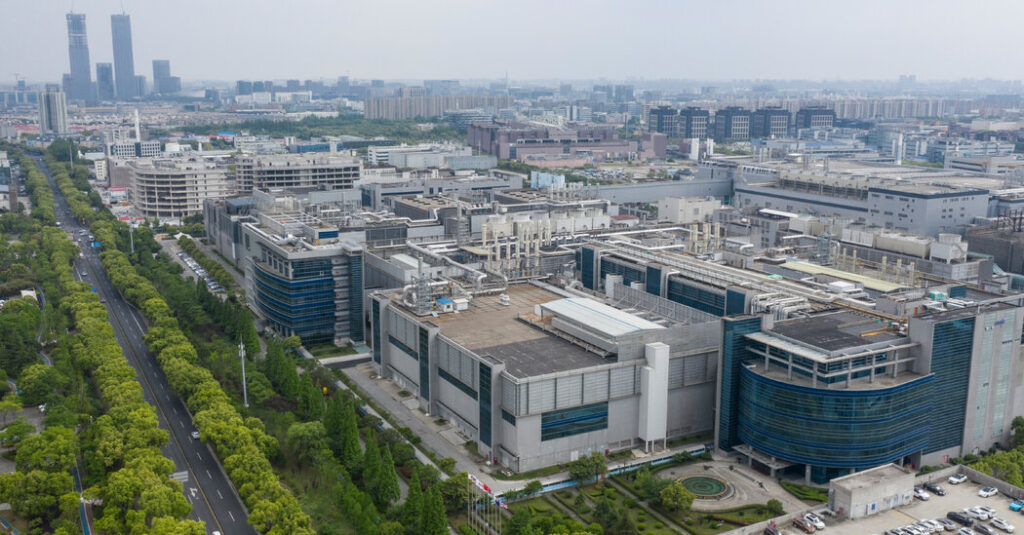
China’s biggest tech companies, including Huawei, Alibaba and the TikTok parent company ByteDance, have started chip design businesses. Chip makers, many working with Huawei, are building dozens of factories and have hired top engineers from Taiwan and South Korea.
But the task of catching up has gotten progressively more difficult. While Chinese companies have been building their own supply chain for chip making, officials in Washington have tried to hold them back. Three presidential administrations have used export controls to keep Chinese companies from buying advanced chips and the tools to make them, over concerns the technology could fuel China’s economic and military power.
The restrictions have kept Chinese companies from buying equipment made by the Dutch company ASML that performs a crucial step in the chip making process. The lack of access to these machines, which are the size of school buses, is one reason Chinese companies are making chips that lag the performance of the top of the line from Nvidia.
Those are the kinds of chips that power artificial intelligence systems. Chinese companies will most likely make just 2 percent as many A.I. chips as foreign firms do this year, said Tim Fist, a director at the Institute for Progress, a think tank in Washington.
The production gap between Chinese and foreign manufacturers is especially big for memory chips, which are essential for the large calculations done by A.I.
Companies outside China will make 70 times as much memory storage capacity this year as Chinese chip makers will, Mr. Fist said.
The leading makers of memory chips are the South Korean conglomerates Samsung and SK Hynix. Taiwan Semiconductor Manufacturing Company, the world’s biggest chip producer, dominates production of the most advanced chips.
Huawei’s Pivot
In 2014, China was the world’s largest market for semiconductors. But 90 percent of the chips its companies used were made outside the country.
Concerned about that dependency, the State Council, China’s top governing body, approved a plan to spend billions and made a vow: China would be making every part of its semiconductor supply chain at home by 2030.
Policymakers had reason to be concerned about the risks that foreign technology posed to Chinese infrastructure. Earlier that year, documents provided by the former National Security Agency contractor Edward J. Snowden had disclosed that the U.S. government had monitored the communications of top executives at Huawei.
Then in 2017, President Trump fined the Chinese telecommunications giant ZTE for allegedly violating U.S. sanctions on Iran, crippling its business overnight. Although ZTE does not manufacture chips, the action gave China another lesson in its need for self reliance.
Next came Huawei. The first Trump administration embarked on a global campaign to get countries to stop using Huawei’s equipment in their telecommunications infrastructure. Huawei responded by offloading that business line and getting in step with Beijing’s self-sufficiency program.
“Huawei was unique in its capabilities and its alignment with China’s national goals,” said Kyle Chan, a fellow at the Brookings Institution who studies Chinese industrial policy. “Huawei’s experience was a microcosm of China’s broader experience: suddenly being cut off and now scrambling to build its own.”
Beijing also pushed foreign companies to turn over technology as a price of admission to the China market. Qualcomm, a San Diego tech giant, entered into a joint venture with Huaxintong Semiconductor in 2016. The Chinese government provided land and financing, and Qualcomm offered the technology and about $140 million in initial funding.
During this time, Huawei became one of China’s most popular smartphone makers. And it started working closely with chip factories to make chips for smartphones and A.I. systems.
Huawei has come out with a line of chips that are comparable to some of Nvidia’s older models. But analysts said those chips contained key components that foreign rivals like TSMC and Samsung had made.
Clouds and Clusters
The inability to get essential tools from ASML has been a major chokehold for Chinese chip makers. Since U.S. officials led an effort to lobby the Dutch government to block shipments to China, no Chinese company has been able to buy ASML’s most advanced tools.
Instead, Chinese chip makers have recruited engineers with experience using those machines at TSMC, the world’s top chip maker. And now, Chinese start-ups are trying to make their own chip manufacturing equipment.
A.I. systems require an immense amount of computing power to learn. China’s A.I. companies are trying to get the computing power they need by strapping together numerous less powerful chips. Huawei has taken such an approach, and the Chinese government has built what it calls “intelligent computing clusters” that are essentially state-run data centers.
But those clusters need a lot of chips. Experts and people who work in the industry say China’s most advanced chip maker, Semiconductor Manufacturing International Company, which does some work for Huawei, has struggled to produce enough chips. The chips it does produce are prone to defects and use more electricity than cutting-edge foreign ones. SMIC did not respond to a request for comment.
“Manufacturing volume is going to be an issue,” said Kendra Schaefer, a partner at Trivium China, a research and advisory firm.
Nonetheless, multiple Chinese A.I. researchers have reported breakthroughs in finding new ways to link chips together for maximum efficiency. Zhipu said last month that it had built its latest model entirely using Huawei’s chips and software.
So far, the efficiency gains have been limited and have not helped Chinese companies escape the fact that A.I. demands huge quantities of chips.
Another way China’s A.I. companies are getting the computing power they need is by paying cloud providers like Alibaba and Amazon for remote access to massive data centers stocked with powerful chips.
But the strategy is expensive.
Documents filed by Zhipu and Minimax, another Chinese A.I. start-up, with the Hong Kong Stock Exchange last month show that the two companies are spending a lot more buying cloud services than they are earning in revenue.
Xinyun Wu contributed reporting from Taipei.
Meaghan Tobin covers business and tech stories in Asia with a focus on China and is based in Taipei.
The post How China Built a Chip Industry, and Why It’s Still Not Enough appeared first on New York Times.