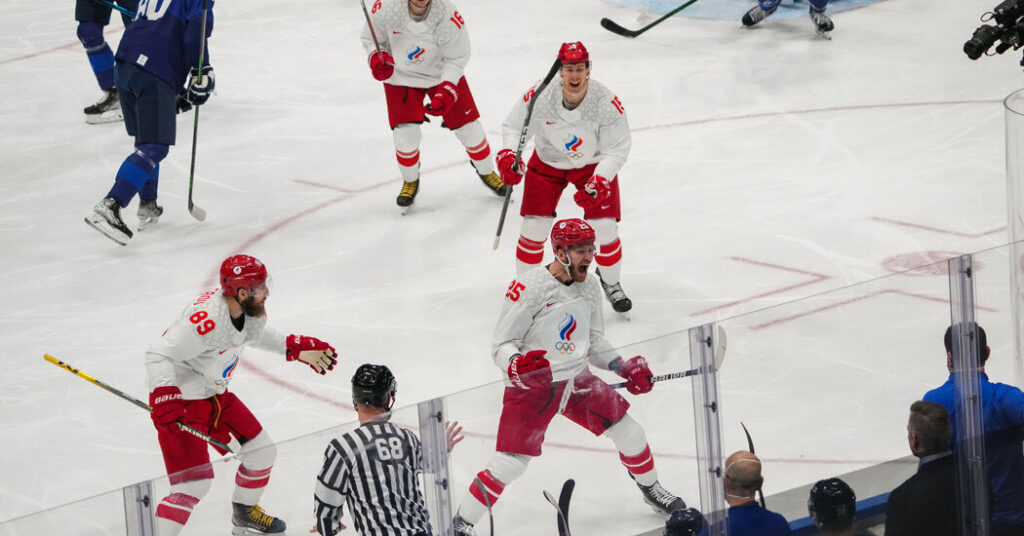
After a decade as a pariah in international sports, the onetime powerhouse Russia may be coming back in from the cold.
Russia has faced a series of sanctions and suspensions from the Olympics first because of a state-sanctioned doping program and then because of its invasion of Ukraine. But at a two-day meeting of the International Olympic Committee in Milan this week before the Winter Games got underway, committee members sounded ready to welcome Russia back into mainstream competition.
Kirsty Coventry, the I.O.C. president, did not mention Russia by name in her address to delegates in Milan, but she emphasized, “We are a sports organization.”
“We understand politics, and we know we don’t operate in a vacuum,” said Ms. Coventry, a Zimbabwean who is presiding over her first Olympics. “But our game is sport,” she added. “That means keeping sport a neutral ground.”
The comments added to a growing sense of momentum for Russia on the global sporting stage, even as its war on Ukraine grinds toward the four-year mark and with few clear signs that Moscow has addressed the doping scandal.
This week, Gianni Infantino, head of soccer’s global governing body, FIFA, told Sky News that his organization’s ban on teams from Russia and its ally, Belarus — imposed after the invasion of Ukraine — should be lifted because it had “not achieved anything.” Dmitri S. Peskov, the Kremlin’s spokesman, said Russia “welcomed” Mr. Infantino’s statement.
Heorhii Tykhyi, a spokesman for the Ukrainian Ministry of Foreign Affairs, called the idea of Russian or Belarusian athletes returning to the Olympics or other international competitions “unacceptable,” saying bans should not be lifted while the war was raging.
In recent months, the international sporting bodies governing judo and taekwondo — both Olympic sports — ended bans on Russia, allowing its athletes to compete under their own flag again at international competitions. Last December, the I.O.C. recommended that Russian and Belarusian youth athletes be allowed to participate again in international competitions, paving the way for them to compete for their countries at the Youth Olympic Games this summer in Dakar, Senegal.
“For those immersed in the sports world, there is a persistent sense that a full return to international competition is just around the corner,” said Vladimir Ivanov, who writes about the Olympics for Sports.ru, a Russian outlet.
But the process of a potential Russian return would be complex.
The I.O.C. would need to lift its suspension of Russia’s national Olympic committee, imposed in 2023 over Moscow’s decision to absorb the sports organizations in occupied territories of Ukraine. International sports federations for individual sports would also need to vote to allow Russian athletes back in their respective competitions.
At that point, athletes could be cleared to perform in their own uniforms at the summer Olympics in Los Angeles in 2028. But some sports federations might still choose to maintain their own bans.
At the I.O.C. meeting. in Milan, Johan Eliasch, head of the International Ski Federation, called for clearer guidelines to ensure that Russia was not being singled out unfairly, given the many other conflicts around the world — listing the recent U.S. incursion to seize Venezuela’s president and Israel’s war in Gaza.
“We can’t be a political organization,” Mr. Eliasch said in an interview.
The global governing body for the Paralympics, which take place after each Summer and Winter Games, lifted a ban on Russia last fall. But Russian athletes will not be allowed to represent their country at the Paralympic Games this winter in Milan because of bans still in place by individual sports federations.
“Boycotts never solved anything, and the only ones who are punished are the athletes,” Andrew Parsons, head of the Paralympics governing body, said in an interview.
For now, Russians are permitted to compete at the Winter Games only as “individual neutral athletes.” Russia’s flag is not displayed, its national anthem is not played and it has no spot in the medal table. Thirteen Russians qualified for the games in Italy, the lowest number since 1908.
Russia has not sent a full team of athletes to the Olympics since 2014, when it hosted the Winter Games in the Black Sea resort town of Sochi. The Russian team won the most medals in Sochi, only to face embarrassment months later when the German broadcaster ARD revealed a systemic, state-sponsored doping scheme that had existed in the country for years.
More revelations followed, culminating with a 2016 report commissioned by WADA that documented how Russia used a “state-dictated” system to help more than 1,000 athletes take performance-enhancing drugs from 2011 to 2015.
The international sports community was shocked by the audacity and breadth of the Kremlin-sponsored scheme. Sanctions followed. The Russian track and field team was banned from competing at the 2016 Summer Olympics in Rio de Janeiro. In 2017, the Russian Olympic Committee was suspended from the following year’s Winter Games in Pyeongchang, South Korea.
These restrictions were set to expire after the 2022 Winter Olympics in Beijing, where a team competed under the name and flag of the Russian Olympic Committee, winning five gold medals. But just days after those Games concluded, Russia began its full-scale invasion of Ukraine, prompting the I.O.C. to recommend bans on athletes from Russia and Belarus, which provided territory for the invading forces.
Before the 2024 Summer Games in Paris, Russian and Belarusian athletes who had met athletic criteria went through an additional vetting process to ensure that they had not supported the invasion of Ukraine, had no military ties and had complied with antidoping regulations.
Just 15 Russian athletes ultimately qualified for the Paris Games, which some Russian officials viewed as a humiliation. Stanislav Pozdnyakov, head of the Russian Olympic Committee at the time, called Russian neutral tennis players “a team of foreign agents.” Irina Viner, former head of the Russian rhythmic gymnastics’ federation, described the Russian athletes competing in Paris as a “team of hobos without a flag, an anthem or fans.”
The same vetting process was replicated for this year’s Games in Italy. Only 13 Russians qualified, though proportionally that is more than in Paris because the Winter Olympics is a smaller event. And Russia’s mood toward the Olympics appears to be shifting. The Paris Games were not broadcast in Russia, but the Winter Olympics in Italy are, if only by a streaming service. And, unlike in Paris, the Russian sports ministry supported athletes’ efforts to qualify for these Games.
“The difference compared to Paris 2024 is colossal,” Mr. Ivanov, the sportswriter, said.
Dmitri Guberniev, a sports commentator on Russian state-run television, said that the ice had cracked and that Russian fans would follow the exploits of their athletes at these Games. “Everyone in the world knows that these are representatives of a great sporting power: the Russian Federation,” he said in a phone interview.
Some Russian athletes who qualified to compete in Italy despite the restrictions said they were focused on their personal results.
“I don’t feel any extra pressure,” said Saveliy Korostelyov, 22, a Russian cross-country skier. “Whether we have a large team or a limited one like we do now, my focus remains on delivering my best possible performance.”
Nikita Filippov, who qualified to compete in the new event of ski mountaineering, said he saw a “positive trend” around Russian sports internationally.
“More people are being admitted, more federations are being allowed to participate,” he said.
“I hope that in the future — next year already — everything will be much brighter and more positive,” he added. “And that there will no longer be ‘neutral athletes.’”
Maria Varenikova contributed reporting from Kyiv, Ukraine.
Ivan Nechepurenko covers Russia, Ukraine, Belarus, the countries of the Caucasus, and Central Asia.
The post Russia’s Time as a Sporting Pariah May Be Coming to an End appeared first on New York Times.