On Monday, Chris Madel, who’d been polling competitively in the Republican primary for Minnesota governor, dropped out of the race, apparently because he was disgusted by ICE’s behavior in Minneapolis. “I cannot support the national Republicans’ stated retribution on the citizens of our state, nor can I count myself a member of a party that would do so,” he said in a video announcement.
Madel’s move was surprising because less than two weeks earlier, he’d stepped forward to provide pro bono representation to Jonathan Ross, the ICE agent who killed Renee Good. He didn’t condemn Donald Trump when, just days after Good’s killing, he threatened Minnesota on Truth Social with a “DAY OF RECKONING & RETRIBUTION,” blasting Trump’s comments only once he’d decided to drop out. In the wake of Alex Pretti’s killing, Madel underwent an abrupt shift, either in his conscience or his sense of the prevailing political winds, that made pursuing office as a Republican suddenly impossible.
With his abortive campaign for governor, Madel joins politicians as disparate as Mitt Romney and Marjorie Taylor Greene. What they have in common is less an ideology than a breaking point, after which they can no longer say things they don’t believe, or make themselves believe the things they have to say. To triumph in conservative politics, you need to either exist in lock step with Donald Trump or wrench your soul into alignment with your ambition. You need, in most cases, to be comfortable with a high degree of bad faith.
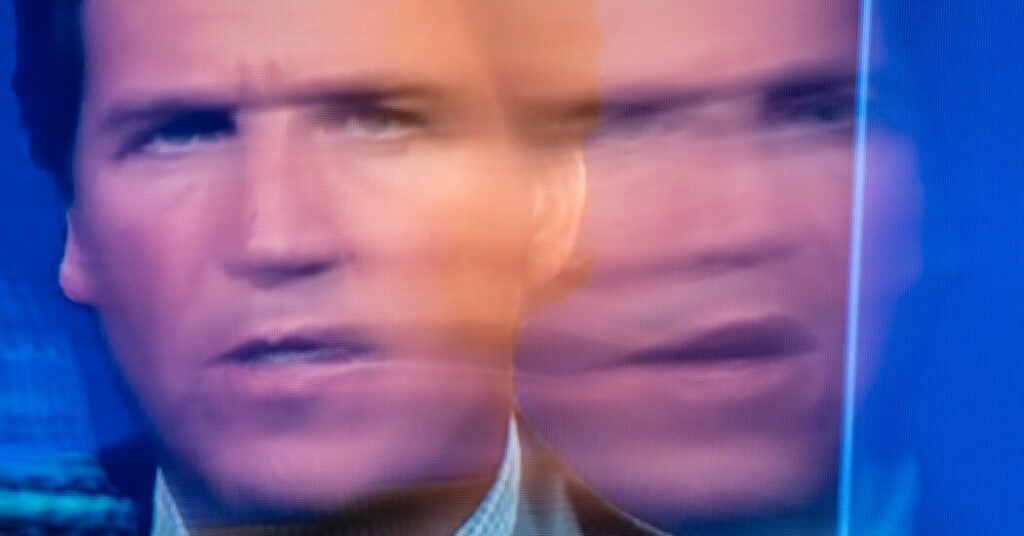
I’ve been thinking about bad faith a lot since reading “Hated by All the Right People,” Jason Zengerle’s shrewd new biography of Tucker Carlson. In the Trump era, many people have shocked their former friends with their authoritarian transformations, but few more than Carlson, who has morphed from a cheerful, proudly anti-populist Beltway habitué to a leading purveyor of antisemitic conspiracy theories. His arc is especially important to understand since it tracks the broader devolution of the Republican Party. How could people who once seemed to cherish constitutional democracy and civic institutions participate so eagerly in their dismantling? How do they justify it to themselves, never mind the rest of us?
In Carlson’s case, the answer seems like a toxic combination of professional climbing and fathomless resentment. Based on Zengerle’s account, a defining feature of Carlson’s career is his tendency to stake out politically advantageous positions that he doesn’t wholly buy into. Then, when maintaining those positions becomes untenable, he projects the resulting anger and shame onto others.
When he was a celebrated magazine writer in the 1990s, Carlson’s voice was impish and contrarian. He soon found, though, that he enjoyed both the platform and payday that came with TV punditry, where his job was to toe the Republican Party line. As a host of the CNN debate show “Crossfire,” writes Zengerle, he often found himself saying things “that seemed to contradict his personal views.”
Most important, in 2003, he choked back his doubts about the Iraq war to cheerlead George W. Bush’s disastrous adventure. Zengerle, a former New York Times Magazine writer now at The New Yorker, thinks much of Carlson’s current animus toward Israel stems from regret over his support for the war. “The story that he tells people, the story he tells himself, is that he was a tool of the neocons, and he was used and misled and kind of tricked into taking these positions and writing these articles and saying these things that hurt the white working class,” Zengerle told me.
But that episode did not teach Carlson to be truer to himself. In 2010, he set out to create, with The Daily Caller, a right-wing news site that would value serious, substantive reporting. Unfortunately, he soon found that his audience wanted not sober policy journalism but stories that “actively antagonized liberals,” Zengerle writes. So Carlson, committed to the site’s success, staffed up with a group of white nationalists, one of whom reportedly referred to his desk as “the Eagle’s Nest,” after Hitler’s mountain lair.
Carlson’s immersion in The Daily Caller’s analytics helped him understand, well before many of his peers, Trump’s potential appeal. His insight enabled his rise at Fox News, where he’d started as a low-level contributor. “The project at Fox of trying to find normal-seeming, television-camera-ready human beings who would make a sensible case for Donald Trump was not a small lift,” a former Fox producer told Zengerle. Carlson could do it, and that propelled him to prime time.
The point is not that Carlson is a grifter; by all accounts he usually means what he says. His challenge was to find an authentic way to cater to a MAGA audience despite the contempt he privately felt for Trump, which would eventually be revealed in the Dominion Voting Systems lawsuit against Fox. Carlson, Zengerle writes, couldn’t bring himself to become a fulsome Trump booster like his colleague Sean Hannity.
But he wanted to channel the currents that brought Trump to power, and the most expedient way to do that was to cultivate an all-consuming hatred of Trump’s foes. He would, as Zengerle wrote, “devote his airtime to opposing Trump’s opponents — helping to invent the ideological escape hatch now known as anti-anti-Trumpism.” Doing so would make him very rich, but also very angry and paranoid.
Carlson’s journey isn’t unique. JD Vance, his closest political ally, has traveled a similar route, from worrying that Trump could be “America’s Hitler” to serving as his vice president. And just like Carlson, who once praised the Hungarian autocrat Viktor Orban for being “hated by all the right people,” Vance has been fueled by hatred. “I think our people hate the right people,” Vance told The American Conservative in 2021. This psychological reliance on loathing, I suspect, accounts for Carlson and Vance’s similar affect. Neither seems, despite phenomenal success, to be very happy. Instead, they radiate spite and grievance, forever making a show of incredulity about the awfulness of their enemies.
Bad faith, obviously, doesn’t belong only to the right. (Just look at the Democrats who assured us all that Joe Biden was up for a re-election campaign.) But Trump’s Republican Party requires of its adherents an exponentially greater degree of mind-warping rationalization. Occasionally this rationalization becomes insupportable, and people break away from Trump’s movement. More often, it’s just corrosive.
On his podcast on Wednesday, Carlson didn’t try to defend the federal agents who shot Good and Pretti or minimize the horror of their deaths. Instead, he tried to redirect that horror toward the people he despises. “What you’re seeing through this very narrow aperture on the screen of your phone is just a scene in a much larger movie that has a totally different plot,” he said. That movie, in Carlson’s telling, is about Gov. Tim Walz of Minnesota, Mayor Jacob Frey of Minneapolis and their political allies fomenting revolution, driven by an ideology that is, “above all,” opposed to “Christianity and whites.”
It might sound absurd, but the alternative would be to admit, to his audience and himself, that Trump is behaving rashly and provoking violence. Were Carlson to do that, he might have to follow Madel’s lead and defect. Better to imagine a great festering evil out there somewhere than to look closer to home.
The Times is committed to publishing a diversity of letters to the editor. We’d like to hear what you think about this or any of our articles. Here are some tips. And here’s our email: [email protected].
Follow the New York Times Opinion section on Facebook, Instagram, TikTok, Bluesky, WhatsApp and Threads.
The post The Fathomless Resentment of Tucker Carlson appeared first on New York Times.