Near the middle of the first movement of Beethoven’s “Eroica” Symphony, a powerful moment stands out. The music is barreling along, picking up steam, when a dissonant chord crashes against the rhythm again and again. That extreme tension is cut off with a beat of silence, then the music skulks away in a crouching decrescendo.
When I learned that Justin Peck had chosen this music for his next ballet, I wondered what he would do with that moment. At the work’s premiere at New York City Ballet on Thursday, I learned: not much.
Titled “The Wind-Up,” Peck’s ballet takes on the largeness of Beethoven with a modest cast of six, though the six are among the strongest dancers in the company. The musical moment I was waiting for comes during a duet for Mira Nadon and Chun Wai Chan. The duet is nicely enlivened with tension and release; she ricochets within the field of his gentle support. But the extraordinary moment is barely marked.
A bit earlier in the ballet, Peck turns a similar moment into a weak joke in a duet for Tiler Peck and Roman Mejia. As a slashing chord is repeated, ratcheting up tension, Mejia carries Peck toward a wing in a series of low, arcing lifts. By the last one, she’s offstage, and he’s left holding nothing. Ha ha.
In short, “The Wind-Up” doesn’t rise to the challenge of the “Eroica.” But it’s refreshing in other ways. For a while now, Peck has seemed to be making the same ballet over and over: a prototypically millennial affair about breakable young people finding community, set to music by an electronic composer trying to be symphonic. “The Wind-Up,” his 26th work for the company, isn’t like that.
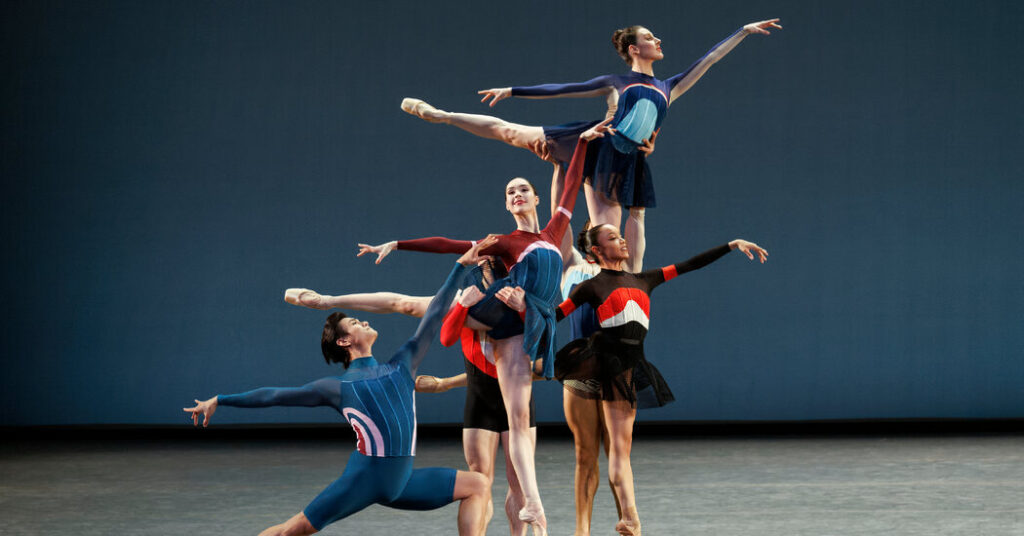
Its vocabulary might be called “sporty classical,” amped up and flecked with a few sports-derived gestures but missing the feints at hip-hop physicality of Peck’s youth ballets. Costumes by Reid Bartelme and Harriet Jung reinforce the sporty feel with stripes and curves of color. Tiler Peck’s outfit has a little rainbow on her chest.
At the start, Daniel Ulbricht pounces in, setting the tone with a flurry of turns and jumps. After everyone else slides on, Mia Williams rolls on the floor as Ulbricht leaps over her and lands in a somersault. There’s a whiff of sawdust and peanuts in the air.
That circusy sequence returns as a motif — reversed in direction, set on a diagonal. That motif and a few others — like a quickly formed group tableau that resembles a three-tiered wedding cake — impart some structure to what is otherwise a string of insufficiently differentiated solos and duets. The hints of circus also suggest a traveling group of players, a band of equals, and there’s generosity in the casting. Peck gives Ulbricht, the company’s senior-most member, another chance to flash his virtuosity, and he gives Williams, still in the corps de ballet, an opportunity to dance alongside principals. Their performances show why.
The ballet gets better as it goes. In a later duet for Nadon and Chan, she keeps sinking into him, catching a similar quality in the music. The last ensemble section, with facing lines and cutting vectors, matches some of Beethoven’s brass and drive. The final image — Ulbricht spinning in grand pirouettes with a leg raised to the perpendicular as the curtain falls — is a bit cliché, but at least it jibes with the ballet’s title.
I had hoped that in selecting Beethoven — a composer whose music City Ballet’s founding choreographer, George Balanchine, considered unsuitable for ballet — Peck would be goaded into creating a more ambitious work. “The Wind-Up,” though, is too close to “toy.”
But surely Peck means to associate the title with what happens before a baseball pitch, a shift of weight to give more momentum to what follows. In music history, the “Eroica” Symphony is considered the start of Beethoven’s “middle period,” a bold departure from the earlier work that earned him fame. Peck’s new ballet is no “Eroica,” but here’s hoping it’s a windup for a phase both more mature and more adventurous.
New York City Ballet
Continues through March 1 at the David H. Koch Theater; nycballet.com
The post Review: In Justin Peck’s New Ballet, Beethoven Gets Sporty appeared first on New York Times.