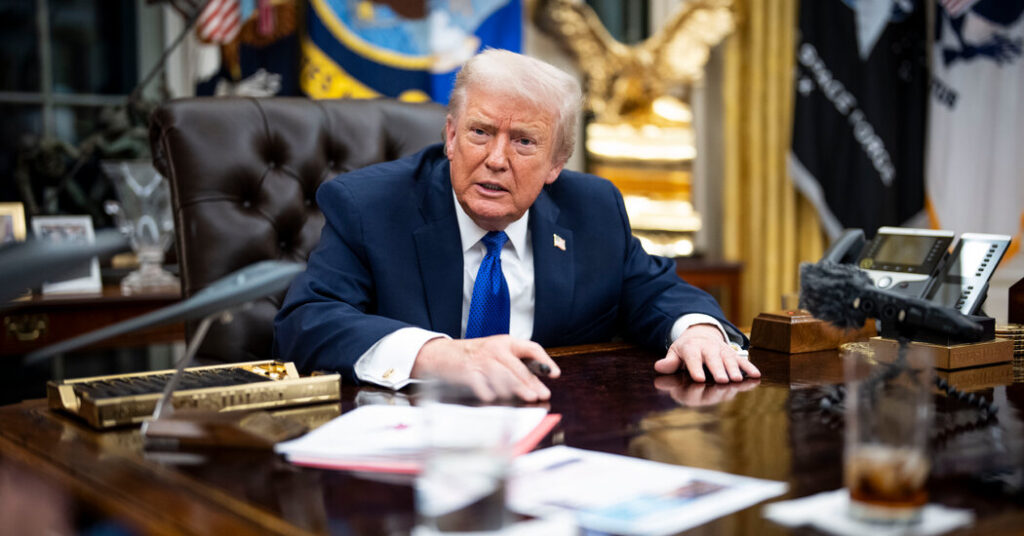
President Trump said during an interview with The New York Times that he regretted not ordering the National Guard to seize voting machines in swing states after his loss in the 2020 election, even though he doubted whether the Guard was “sophisticated enough” to carry out the order effectively.
The remarks by Mr. Trump in the interview last week harked back to one of the most perilous moments from his first term in office, when he was urged by some advisers to order his national security agencies to take control of machines manufactured by Dominion Voting Systems in an effort to find evidence that they had been hacked to rig the election against him.
The statement also came as he has continued his attacks on digital voting machines, saying that he wants to “lead a movement” to get rid of them altogether in advance of this year’s midterm elections.
Mr. Trump has long been obsessed with voting machines, particularly those built by Dominion, a company that has figured prominently in conspiracy theories that technology was used to rob him of victory in his race against Joseph R. Biden Jr.
Allegations that Dominion machines were hacked in a plot to flip votes away from Mr. Trump swirled constantly in the chaotic period after the 2020 election and sat at the heart of several lawsuits filed by the pro-Trump lawyer Sidney Powell that sought to overturn the results of the vote in four key swing states.
The accusations about Dominion came to a head during a pitched Oval Office meeting on Dec. 18, 2020, when a team of outside advisers, including Ms. Powell and Michael T. Flynn, the former national security adviser, pitched Mr. Trump on a brazen plan: They wanted the president to use the military or federal law enforcement officers to seize Dominion machines in several states where he believed there had been fraud in order to conduct a recount of the vote.
The advisers went so far as to present Mr. Trump with draft executive orders that they claimed would grant him the authority to follow through on the outrageous plan.
Even proposing the idea of inserting armed federal forces into the administration of a presidential race shattered the most basic norms of American democracy. And it was vigorously opposed at the meeting by several of Mr. Trump’s top aides, including Pat A. Cipollone, his White House counsel at the time. The aides argued that Mr. Trump had no legal basis to seize the machines and they quickly called other top officials in an effort to persuade the president that there was no evidence that Dominion systems had been interfered with.
Still, Mr. Trump explored the possibility of seizing the machines. He raised the question separately with Attorney General William P. Barr, who immediately shot it down. And he directed one of his personal lawyers, Rudolph W. Giuliani, to ask high-ranking officials in the Department of Homeland Security if they could legally seize the machines. Again, he was rebuffed.
In the end, Mr. Trump did not move forward with the proposal — a decision he said in the interview with The Times that he regretted.
“Well, I should have,” he said.
Asked whether using the military to impound voting machines had been a viable option, the president questioned the sophistication of the National Guard.
“I don’t know that they are sophisticated enough,” he said. “You know, they’re good warriors. I’m not sure that they’re sophisticated enough in the ways of crooked Democrats, and the way they cheat, to figure that out.”
Mr. Trump’s expression of regret, while somewhat vaguely worded, was nonetheless a warning sign that he had not given up on the idea that voting machines were dangerous or that they could be seized in an effort to curb fraud.
Just last week, he reposted several social media messages that continued to push the claim that Dominion machines had been rigged against him. And last month, he sought to pardon Tina Peters, a former Colorado county clerk who is serving a nine-year prison sentence on state charges of tampering with Dominion machines in an effort to prove that they were used in a plot against Mr. Trump.
At the same time, Mr. Trump has not been shy in using the National Guard, deploying thousands of its troops in recent months to cities that he says are overrun with crime. He has argued that the deployments are necessary to restore law and order to the cities, despite the objections of state and local leaders, who have called the moves unnecessary and unlawful.
The president’s use of the National Guard during his second term has become the focus of a multistate legal battle. While some cases remain largely unresolved, in December, the Supreme Court ruled against Mr. Trump for his deployment of troops in the Chicago area, citing an 1878 law, which bans the use of the military for domestic policing.
Since taking office again almost a year ago, Mr. Trump has sought to expand the scope of his powers and has wielded federal authority to exact retribution on political enemies and push his domestic agenda. And he has said he is willing to invoke the Insurrection Act and federalize some National Guard units if he feels it is important to do so.
Alan Feuer covers extremism and political violence for The Times, focusing on the criminal cases involving the Jan. 6 attack on the Capitol and against former President Donald J. Trump.
The post Trump Regrets Not Seizing Voting Machines After 2020 Election appeared first on New York Times.