A day after offering conflicting justifications for the decision to take military action against Iran, Secretary of State Marco Rubio sought to walk back his earlier assertion that the operation was precipitated by Israel’s plans to strike Iran.
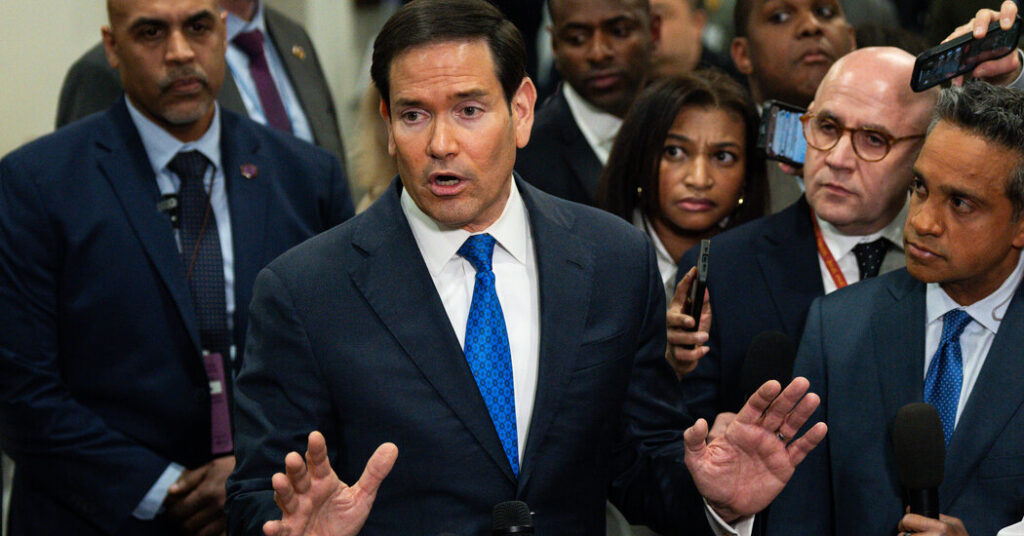
On Monday, Mr. Rubio told reporters on Capitol Hill that the United States struck Iran “proactively in a defensive way” under the assumption that Iran would target U.S. forces after Israel began its own attack on the country. But on Tuesday, ahead of a pair of classified briefings on the war for members of the Senate and House, Mr. Rubio sought to play down Israel’s role in prompting the strikes.
“The bottom line is this: The president determined we were not going to get hit first. It’s that simple, guys,” Mr. Rubio said. “We are not going put American troops in harm’s way. If you tell the president of the United States that if we don’t go first, we’re going to have more people killed and more people injured, the president’s going to go first. That’s what he did. That’s what the president will always do.”
He argued that the long-planned campaign to strike Iran and an effort by Israel to lobby President Trump to join the effort was not what ultimately influenced Mr. Trump to decide to take military action. Instead, Mr. Rubio said, it was the threat of Iran’s increasing military capability and growing arsenal of weapons.
“The president of the United States made a decision: This is intolerable. Iran cannot have these missiles, cannot have these drones, cannot threaten the world,” Mr. Rubio said. “The president said this is the weakest they’ve ever been. If we don’t hit them now, a year from now, a year and a half from now, no one will be able to touch them and they’ll be able to do whatever they want and he made a decision to go.”
Mr. Rubio had told reporters a day earlier that Israel had been prepared to act with or without the United States, a situation that left Mr. Trump facing a difficult decision and limited time to make it.
His comments came after the president rejected the notion that Israel had forced the Americans’ hand.
“No, I might have forced their hand,” Mr. Trump told a reporter in the Oval Office during a meeting with Chancellor Friedrich Merz of Germany.
“We were having negotiations with these lunatics, and it was my opinion that they were going to first,” Mr. Trump said. “They were going to attack if we didn’t do it. They were going to attack first — I felt strongly about that.”
Robert Jimison covers Congress for The Times, with a focus on defense issues and foreign policy.
The post Rubio Walks Back Suggestion That Israel Forced U.S. Hand in Iran Strikes appeared first on New York Times.