Current theories suggest that dark matter — the mysterious substance that’s believed not to emit, absorb, or reflect light — dominates in the known universe, making up over 85 percent of all matter.
But thanks to its elusiveness, it remains incredibly difficult to study, leaving a significant gap in our understanding of what determines the structures and shapes of celestial objects that crowd our astronomical observations.
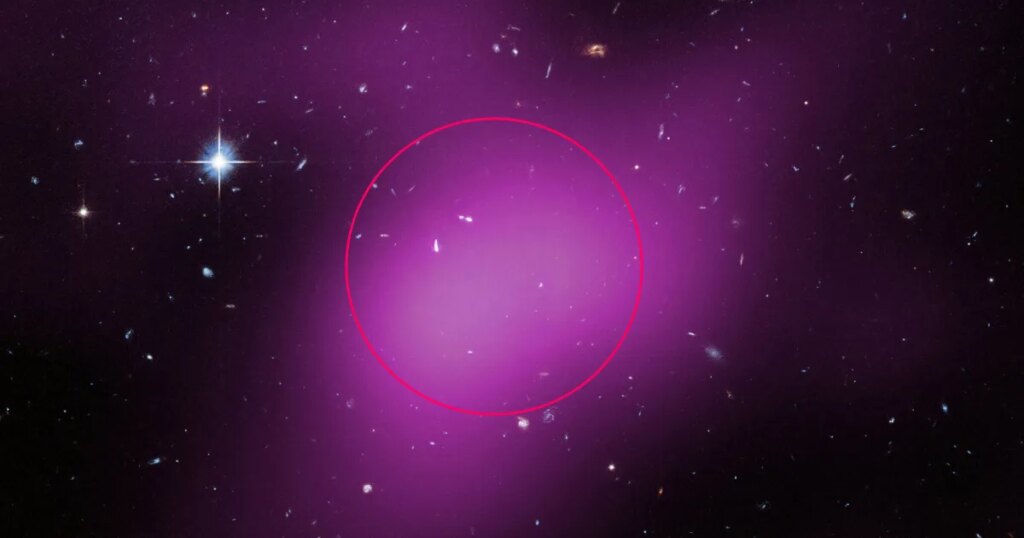
Now, an international team of researchers claims to have used NASA’s Hubble Space Telescope to discover an entirely new type of celestial object: dubbed “Cloud-9,” it’s a “starless, gas-rich, dark-matter cloud,” per the European Space Agency. The lack of stars caught the team by surprise, indicating Cloud-9 was a “fossil leftover” — what ScienceAlert memorably termed the “dark-matter bones of a failed galaxy.”
“This is a tale of a failed galaxy,” said Milano-Bicocca University physics assistant professor Alejandro Benitez-Llambay, coauthor of a paper published in The Astrophysical Journal Letters, in an ESA statement.
“In science, we usually learn more from the failures than from the successes,” he added. “In this case, seeing no stars is what proves the theory right. It tells us that we have found in the local Universe a primordial building block of a galaxy that hasn’t formed.”
The discovery could also allow us to better understand dark matter, the researchers argue.
“This cloud is a window into the dark universe,” team member and ESA astronomer Andrew Fox explained in the statement. “We know from theory that most of the mass in the Universe is expected to be dark matter, but it’s difficult to detect this dark material because it doesn’t emit light. Cloud-9 gives us a rare look at a dark-matter-dominated cloud.”
The research serves as a reminder that studying stars themselves often gives us a limited picture of the universe. The vast gulfs between them just might hold the key to the gaps in our understanding.
Until now, astronomers have only theorized about the existence of an object like Cloud-9. The unusual gas cloud is largely made up of hydrogen gas that dates back to the very early days of the known universe, yet doesn’t feature any stars.
NASA’s Hubble telescope, however, allowed them to get an unprecedented view of the starless region, which is located 14 million light-years from Earth.
“Before we used Hubble, you could argue that this is a faint dwarf galaxy that we could not see with ground-based telescopes,” said lead author and Space Telescope Science Institute researcher Gagandeep Anand in the statement.
“They just didn’t go deep enough in sensitivity to uncover stars,” he added. “But with Hubble’s Advanced Camera for Surveys, we’re able to nail down that there’s nothing there.”
Cloud-9 is much smaller and compact than other hydrogen clouds in the vicinity. Its core stretches some 4,900 light-years across, with the hydrogen gas measuring in at around one million times the mass of the Sun. The researchers suspect the vast majority of its mass is made up of dark matter, which would weigh in at around five billion times the mass of the Sun.
If it were any bigger, it would’ve collapsed and eventually formed stars. However, it’s big enough to stop the gas from dispersing, meaning it’s at a rare sweet spot.
Interestingly, Cloud-9’s name has little to do with the common English expression, which denotes being extremely happy or over the Moon. It was named sequentially — the ninth gas cloud spotted in the vicinity surrounding spiral galaxy Messier 94 — by researchers, who first discovered it three years ago using the Five-hundred-meter Aperture Spherical Telescope (FAST) in Guizhou, China.
The researchers suggest many other objects like Cloud-9 may still be lurking out there — the remains of failed galaxies strewn across millions of light-years.
“Among our galactic neighbors, there might be a few abandoned houses out there,” suggested coauthor and Space Telescope Science Institute astronomer Rachael Beaton.
More on dark matter: Scientists Claim to Detect Dark Matter for the First Time Ever
The post Scientists Weirded Out by Cosmic Bones in Distant Space appeared first on Futurism.