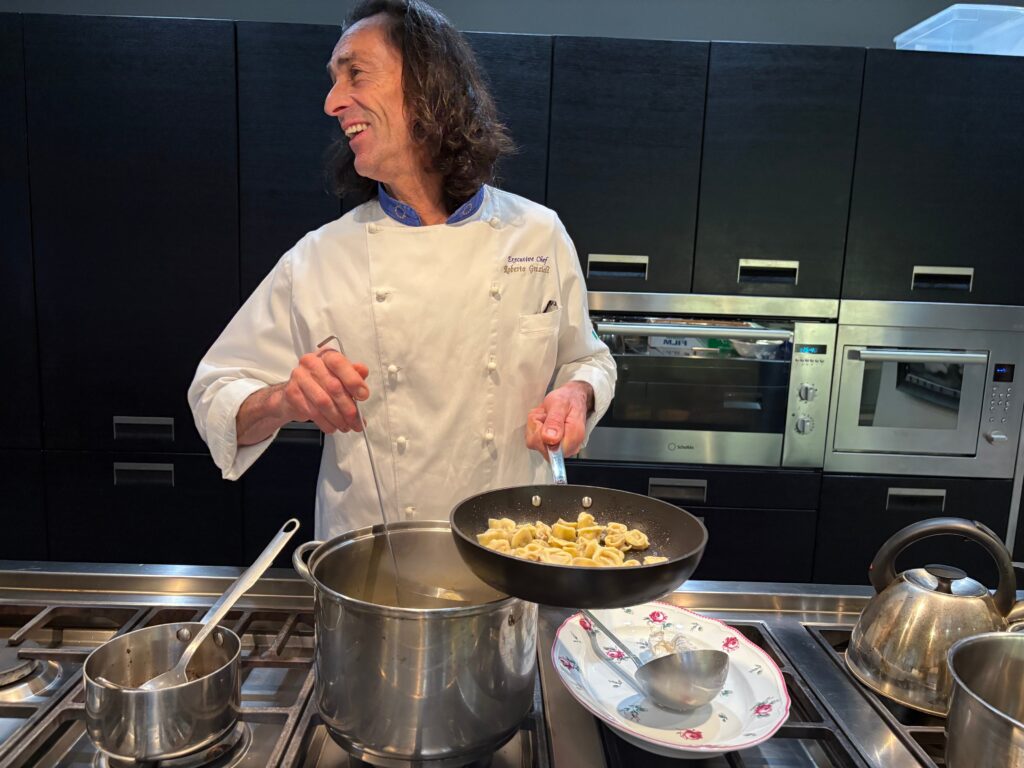
From the Italian ambassador’s stone villa in Washington, Chef Roberto Grazioli has cooked for prime ministers, presidents and first ladies.
But at Christmas, he cooks for his mom.
Grazioli headed home to northern Italy this month for a visit to the village where, when he was a boy, the two of them fried bits of dough into delicate pastries, opening worlds to him.
“She’s my first teacher,” he said on a recent afternoon, before rolling out sheets of pasta for a dish he has made for six ambassadors over two decades in the United States. It’s an intense and gratifying job that has left him little space for much else.
Grazioli is part of a community of embassy chefs and other culinary evangelists who lean on their nations’ dinner-table traditions to bring a bit of warmth in a world of roiling tensions. The soft power of good food takes many shapes, particularly during the holidays.
D.C. is a city of embassies, home to more than 175 of them. Part of representing a country’s interests in Washington is piquing interest in what matters to its people, and food is a common source of pride and connection. Dozens of countries have showcased beloved holiday and national dishes in the U.S. capital in recent years in a medley of formats.
In the depths of a covid winter, ambassadors and chefs from 27 embassies in D.C. printed a “European Union Holiday Cookbook,” which gathered stories and favorite dishes and was distributed to Cabinet secretaries, U.S. government staffers and others. It was an exercise in diplomacy with a “human touch,” said Stavros Lambrinidis, who was then the E.U.’s ambassador to the U.S. in Washington and now heads its delegation to the United Nations. They got so many texts thanking them that they kept the project going for a few years.
Over the summer, Events DC, the city’s convention and sports authority, hosted its latest Embassy Chef Challenge, pitting cooks and cuisines against one another.
Packed with personal touches, national quirks and family lore, the dishes that have emerged from such efforts have offered a peek at the vast diversity of tastes throughout the capital city. They have included: a Greek ambassador’s great-grandmother’s recipe for New Year’s Eve sweet bread, vasilopita; a Luxembourgish winter hare or rabbit recipe with a two-day marinade, huesenziwwi; chiles en nogada, or poblano peppers in walnut sauce, a green, white and red dish that mirrors the colors of the Mexican flag; and chicken pelau, a one-pot, pigeon-pea-and-rice recipe from Trinidad and Tobago.
In a spirit of good cheer after a long year, some of the diplomatic corps’ culinary standouts — from Brazil, India and Italy — shared with The Washington Post recipes for their favorite celebratory dishes. The recipes provided by the embassies have been minimally edited for clarity but have not been tested by The Post.
Brazilian Embassy
Fish Moqueca
The embassy’s chef, Carol Simões, says cooks throughout Brazil put their own spin on this classic stew, which is traditionally simmered slowly in clay pots. It features tomatoes, fish, peppers and chiles “bobbing in a broth enriched with coconut milk and dendê oil,” an earthy, deep yellow extract from the fruit of a palm tree originally brought from Africa. Pronounced mo-KEH-kah, the dish is eaten at family celebrations and gatherings throughout the year and is “an initiation to Brazilian gastronomy,” said Simões, who provided her version of the dish.
Ingredients
1 large yellow bell pepper
1 large red bell pepper
3 tomatoes
2 onions
2 small garlic cloves
2 small red Brazilian lady’s fingers chile peppers (Simões says sweety drop peppers could be an alternative.)
Generous ¾ cup coconut milk (from one 14-ounce can)
¼ cup dendê oil (from a specialty store or online)
½ teaspoon fine salt, plus more as needed
6 sea bass fillets, skin and pin bones removed
2 tablespoons olive oil
2 sprigs cilantro, plus more for leaves for serving
Directions
Cut the bell peppers in half, remove the seeds, and slice into strips. Remove the tomato skins and slice. Peel and slice the onions into rounds. Peel and finely chop the garlic. Slice the chile peppers into rounds.
In a blender, blend the coconut milk with the dendê oil and ½ teaspoon of the salt for 1 minute, until fully emulsified and creamy.
Season the fish with salt to taste.
Heat a large pot (preferably a clay pot) or a high-sided skillet over medium heat.
Drizzle in the olive oil, add the onions, season with a pinch of salt, and sauté for about 3 minutes until softened. Add all the pepper slices and cook for another 3 minutes. Add the garlic and cook until lightly golden.
Reduce the heat, add the cilantro sprigs and the coconut milk mixture. Add the tomatoes and stir well.
Nestle the fish steaks among the vegetables — this keeps the fish partially submerged in the broth so it cooks evenly.
Cover the pot and cook for about 15 minutes, or until the fish is cooked through but still moist and the vegetables are tender. Garnish with cilantro leaves.
Indian Embassy
Carrot Halwa
Like many diplomatic missions in Washington, India has no dedicated embassy chef. But it has many informal diplomats of deliciousness, among them press secretary Neha Singh, who shared this personal favorite for the season. “It has ingredients which are readily available in all American stores, so it would be easy to make, and best of all, it’s a dessert,” she says. Singh made a few linguistic and other modifications, for taste and ease of understanding, to her go-to recipe from Hebbars Kitchen, a popular global site for recipes and videos on vegetarian Indian cooking.
Ingredients
2 pounds carrots, scrubbed
¼ cup ghee
10 raw cashews, chopped
10 raw almonds, chopped
10 raw pistachios, chopped
3 cups milk
¾ cup granulated sugar
½ cup evaporated milk
¼ teaspoon ground cardamom
Directions
Peel the carrots and grate finely using a box grater or food processor.
In a large, heavy-bottom pan, heat the ghee over medium heat, then add cashews, almonds, pistachios and any other nuts or raisins that you like, and toast until they turn slightly golden brown. Transfer to a bowl or plate. In the same pan, add the grated carrots and sauté for 5 minutes or until they change color slightly.
Stir in the milk and cook over medium heat, stirring occasionally, for 10 minutes. Continue to simmer until the carrots are cooked well and milk reduces. Once the milk thickens completely, stir in the sugar and cook until the sugar dissolves and thickens. The result shouldn’t be mushy — you should still be able to see the grated pieces of carrot separately.
Turn off the burner and stir in the evaporated milk, cardamom and toasted nuts until well combined. Serve warm or let cool completely.
Italian Embassy
Chef Roberto moves through the kitchen in Villa Firenze, the residence of ambassador and longtime Italian diplomat Marco Peronaci, with an artful precision, sliding around a long steel island with an industriousness forged over decades of making delicacies that disappear within minutes.
He said he wants to keep working until his last day of life.
“When you retire, you are finished,” said Grazioli, 58. “What are you going to do? Sit on the couch and watch Juventus versus Torino or Lugano?” he asked, naming the Italian and Swiss football clubs.
He relies on creativity and the freshness of ingredients and mostly eschews easy additions like butter or sugar in his meals. He also has a dramatic flair and is quick to jettison rules when a recipe, or whim, demands.
During a recent bout of “pastry diplomacy,” the Norwegian Embassy — and its chef Eilif Røsok — chronicled a friendly visit by Germany’s ambassador, who brought over some franzbrötchen in a basket to show off the nation’s cinnamon pastry prowess. “Now, who’s next?” the Norwegians prodded fellow chefs on Instagram.
Grazioli took the challenge and amped up the competition.
Using a short list of ingredients — among them, flour, eggs, oranges, chocolate, wine and almonds — he created a tray of seven provincial specialties, including cannoli and baci di dama, hazelnut sandwich cookies also called “lady’s kisses.”
“I did it with my heart,” Grazioli said in an accompanying video.
Ferocious pride can be a big part of being an embassy chef, and Grazioli carries the weight of heavy expectations. This month, Italy’s cuisine was recognized by the U.N.’s cultural agency, UNESCO, as part of the Intangible Cultural Heritage of Humanity, an honor excitedly shared by its diplomats.
“For us Italians, cuisine is not just food or a collection of recipes,” Italian Prime Minister Giorgia Meloni said following the announcement. “It is culture, tradition, work and well being. Cooking means taking care of family, friends and guests.”
This year, in time for Christmas, Grazioli returned to the small village where, in the 1970s, his family had an outhouse, food was scarce, and they practically lived on his grandmother’s inexpensive polenta with a bit of olive oil and cheese.
In preparation for Christmas Eve dinner, following family tradition, he and his mom, Adriana Righetto, 84, made his family’s tortelli di zucca alla mantovana recipe, a provincial specialty dating to the 1500s. They filled delicate pasta pockets with pumpkin puree and crushed amaretti cookies, which are made from almonds and have no wheat flour.
“This is 100% required,” he said.
They cook them on Christmas Eve, even though it is a somber time for the family. It’s the anniversary of the day his father was buried.
“It’s not a good time for us, but we keep the tradition, you know, pretending that he’s there with us,” Grazioli said.
Tortelli di Zucca alla Mantovana
Grazioli’s family makes this pumpkin-filled pasta from his hometown, on the outskirts of Mantova, on Christmas Eve. He shared this recipe, which he originally published as part of the “European Union Holiday Cookbook.”
Ingredients
For the filling
2 cups roasted kabocha squash puree; see directions (May substitute pumpkin puree, from two 15-ounce cans)
1½ cups amaretti cookies
½ cup grated Parmigiano-Reggiano cheese, plus more for serving
1 large egg
Ground nutmeg to taste
Finely grated lemon zest from 1 lemon, to taste
Fine salt to taste
Quince preserves (optional)
For the pasta
1¾ cups all-purpose flour, plus more as needed
2 large eggs, at room temperature, beaten
1 to 2 tablespoons butter
Fresh sage leaves
Directions
Make the filling: Preheat the oven to 425 degrees. Line a large sheet pan with parchment paper.
Using a sharp knife, cut the squash into slices, discarding the seeds and strings. Arrange the slices on the prepared sheet pan and bake for 20 minutes, or until tender when pierced with a fork. Turn off the oven and let cool in the oven to help it dry.
While the squash cools, crush the amaretti cookies by hand into a large bowl.
When the squash has cooled, peel the skin and use a potato ricer to puree the squash in the large bowl with the crushed cookies. (Alternatively, mash the squash by hand with a fork.) Add the grated Parmigiano-Reggiano, egg, nutmeg, lemon zest, salt and a spoonful of quince preserves, if using, to the squash and cookie mixture, and mix well with a spatula. Once you have a homogeneous mixture, cover the bowl and refrigerate for 12 to 24 hours.
Make the pasta: Sift the flour into a little mound on your working area or in a bowl. Make a well in the middle of the mound and add the beaten eggs. Mix the ingredients with a fork until you have a dough that is soft and not sticky. If the dough is sticky, you may have to add a little flour.
Roll the dough into a ball, wrap it with plastic wrap, and let it rest in a cool place for about 30 minutes.
Once the dough is rested, divide it in four pieces. Take one piece at a time (keep the rest of the dough wrapped) and use a rolling pin or a pasta machine to make large, thin rectangles about 1 millimeter thick and 4 inches (10 centimeters) wide, and as long as the machine will allow you to make, while maintaining the desired thickness.
Place the rolled-out sheets of dough on a lightly floured surface, and square off the edges with a pastry cutter. The rectangles should now be about 3½ inches (9 cm) wide.
Using a teaspoon, dollop the filling on the upper half of one of the pasta strips, spaced about 1 inch apart, leaving about a ½-inch (1.25-cm) border from the edge of the pasta.
Brush the edge of the pasta with a little bit of water, then fold the strips of pasta to cover the filling. Press the spaces between the filling to remove any air and to prevent the dough from separating. Then cut with a pastry cutter to separate into individual tortelli. These can be made rectangular, circular or semicircular with the help of a cookie cutter. As you make them, place them on a lightly floured surface or a piece of parchment paper.
Repeat with the other pieces of dough until you finish the pasta and filling.
Cook the pasta: Bring a large pot of water to a boil.
Meanwhile, place the butter in a frying pan and add some fresh sage leaves. Once the leaves start to crisp, remove the pan from the heat and set aside.
When the water comes to a boil, salt it, then place a few tortelli in the water at a time, and cook until they rise to the top, 4 to 5 minutes depending on the size and amount of filling. If they do not rise, take one out and taste it to make sure it’s cooked.
Using a slotted spoon, remove the tortelli from the water and place them in the butter and sage mixture. Stir gently to coat in the butter, then plate them and dust them with grated Parmigiano–Reggiano.
On Christmas, Grazioli and his mom will share another pasta filled with tradition. Recently, they gently folded small, navel-shaped tortellini, a cherished version of the dish with a gloriously pedestrian secret ingredient: leftovers.
His recipe for the filling calls for ⅔ of a pound of beef, veal or other meat from a previous night’s meal, preferably a stew, as a way to imbue deep flavor and align with his passion not to waste something as precious as food.
The results are served on a plentiful holiday table, alongside a new roast and the promise of the coming year — and of more leftovers.
“You recycle back again — and you might want it for the next Sunday!” Grazioli said. “So you keep going.”
Roberto Grazioli’s Christmas Tortellini
Ingredients
For the pasta
About 3½ cups (400 grams) 00 flour
4 large eggs
8 cups (2 liters) beef broth, plus more as needed
For the filling
1 carrot
1 celery stalk
½ onion
2 tablespoons (30 milliliters) extra-virgin olive oil
1 medium pork sausage (optional)
About 11 ounces (300 grams) leftover cooked beef, veal, etc.
½ glass red wine
1 whole clove
Fine salt
Freshly ground black pepper
½ cup (50 grams) grated Parmigiano-Reggiano cheese, plus another ½ cup for serving
1 to 2 large egg yolks
Directions
Make the pasta: Knead the flour and eggs very well, and then let the dough rest in the refrigerator for a few hours. (Refer to previous tortelli recipe for more detailed pasta-making directions.)
Make the filling: Chop and sauté the vegetables with the extra-virgin olive oil. Cook the sausage, if using, and add the other meat. Deglaze with the red wine, add the clove and a little salt and pepper. Add a small amount of broth, if needed, so there is enough liquid for the mixture to simmer for about 1 hour. Remove the meats from the pan and, once cold, grind them with a meat grinder (or appliance on hand). Add the cheese and 1 or 2 egg yolks to the meat mixture to bind everything together, and season with salt.
Roll out the pasta, as described for the tortelli above, about a millimeter thick. Cut the pasta into 1¼-inch-by-1¼-inch squares. Roll some of the meat filling into a log about ¼ inch in diameter. Break off small pieces, place them on the pasta pieces, and seal in triangles. Pull the corners around the tip of your thumb, and attach them to shape the tortellini.
In a large pot, bring the 8 cups of broth to a boil. Add the tortellini, and after 7 to 8 minutes of cooking, enjoy them — as tradition dictates — sprinkled with Parmigiano-Reggiano on top.
The post D.C. is a city filled with embassies, and each has a special holiday dish appeared first on Washington Post.