If life is a numbers game, ants are winning. There are around 20 quadrillion individual ants on Earth (more than two million per human), representing over 15,000 species, according to one estimate. Their omnipresence bolsters their global importance as aerators of soil, recyclers of dead matter and dispersers of seeds.
A new paper investigated one way these tiny workers achieved such enormous success. For the study, published on Friday in the journal Science Advances, researchers measured the exoskeletons, or cuticles, of nearly a thousand ants across hundreds of species. They found a strong correlation between thinner cuticles and larger colony sizes.
This suggests that over evolutionary time, some ant species may have made a “trade-off between quality and quantity,” raising their overall numbers by giving each worker slightly less cuticle, said Arthur Matte, a Ph.D. student at the University of Cambridge and lead author of the new paper. These ants “sacrifice their self-investment to have a more distributed work force,” allowing their society as a whole to become more complex, he said.
An ant’s cuticle guards against threats at all scales, from fungal infections to looming hiking boots. The thicker the cuticle, the better it protects. But cuticle-building requires nitrogen — a limited resource. As a result, “the costliness of producing a single worker is higher” when that worker has a larger cuticle, said Evan Economo, a professor at the University of Maryland and the Okinawa Institute of Science and Technology and one of the study’s authors.
In 2017, researchers published a paper investigating cuticle thickness across 42 ant species. The group, led by the myrmecologist Christian Peeters, who died in 2020, found a broad range: Some ants’ cuticles were just over a micrometer thick (comparable to the length of a bacterium), while others’ were nearly a hundred times as thick, about the width of a human hair.
What could account for this variation? Perhaps, Dr. Peeters and his co-authors wrote, some species were redistributing their “manufacturing costs,” reducing their investment in each worker’s exoskeleton in order to make more workers overall.
The scope of the 2017 study was limited by the methods available. The team analyzed cuticle thickness by hand, using scissors and digital microscopes. It took them several months to gather their measurements.
Mr. Matte wanted to pick up their thread and “investigate the evolution of cuticle investment,” he said. But this would require a much larger data set, and proceeding by hand could take years.
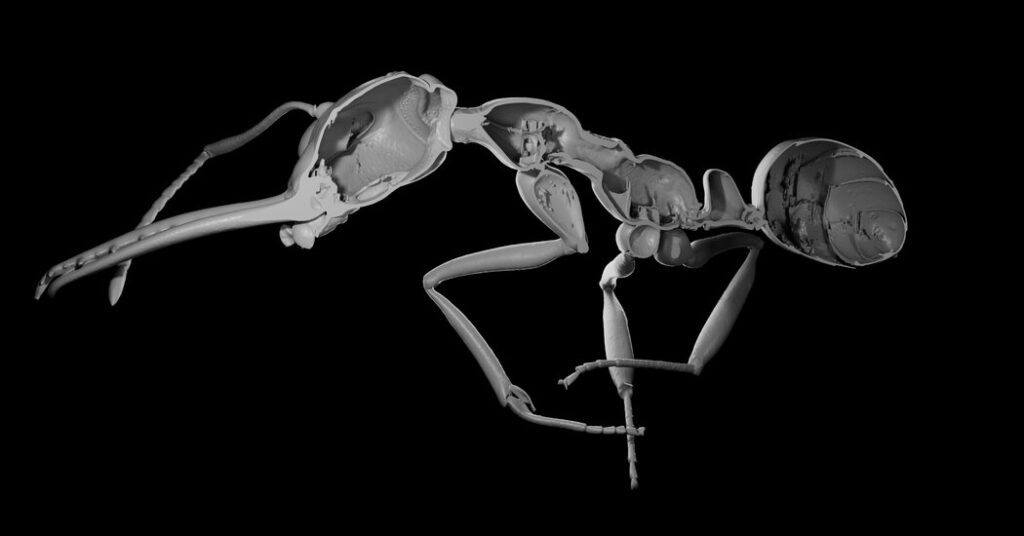
So Mr. Matte developed computer vision algorithms that used CT scans of ants to measure cuticle thickness. He ran his algorithms on digitized specimens from Antscan, a database built by Dr. Economo and his colleagues. After about a week, he had 880 cuticle measurements of ants from 507 species.
The researchers checked for correlations between the cuticle and other ant attributes, such as body size, preferred habitat and evolutionary history. Some showed no link with cuticle thickness, such as whether or not a species lives in trees, Dr. Economo said.
But ants in hot climates are more likely to have thicker cuticles, they found. So are ants that hunt or farm fungus instead of feeding on sugar liquids, like honeydew harvested from aphids. With these diet strategies, larger colony sizes are still associated with thinner cuticles. “The nutritional strategy will shape the magnitude at which the trade-off will happen, but the trade-off will always be there,” Mr. Matte said.
The team also found that, in addition to having larger colonies, ant groups with thinner cuticles seem to have a greater ability to adapt to new environments through diversification.
The rapid diversification of ants has “led to their role as ecological engineers” that can work in habitats across the world, said Mathieu Molet, a professor at the Institute of Ecology and Environmental Sciences of Paris at the Sorbonne who was an author of the 2017 study but was not involved with the new one.
In addition, ants’ outsize impact on their environments “is mainly thanks to these species that evolved cheap workers,” Dr. Molet said. Pinpointing the trade-off they made in order to accomplish these feats is “an amazing result,” and experiments could help reveal how it might have played out.
Dr. Economo also looks forward to learning how everything fits together. “I think as we understand more about the evolution of social complexity in ants, there’s going to be a lot of pieces to that puzzle,” he said. “This is one of them.”
The post The Meek Really Did Inherit the Earth, at Least Among Ants appeared first on New York Times.