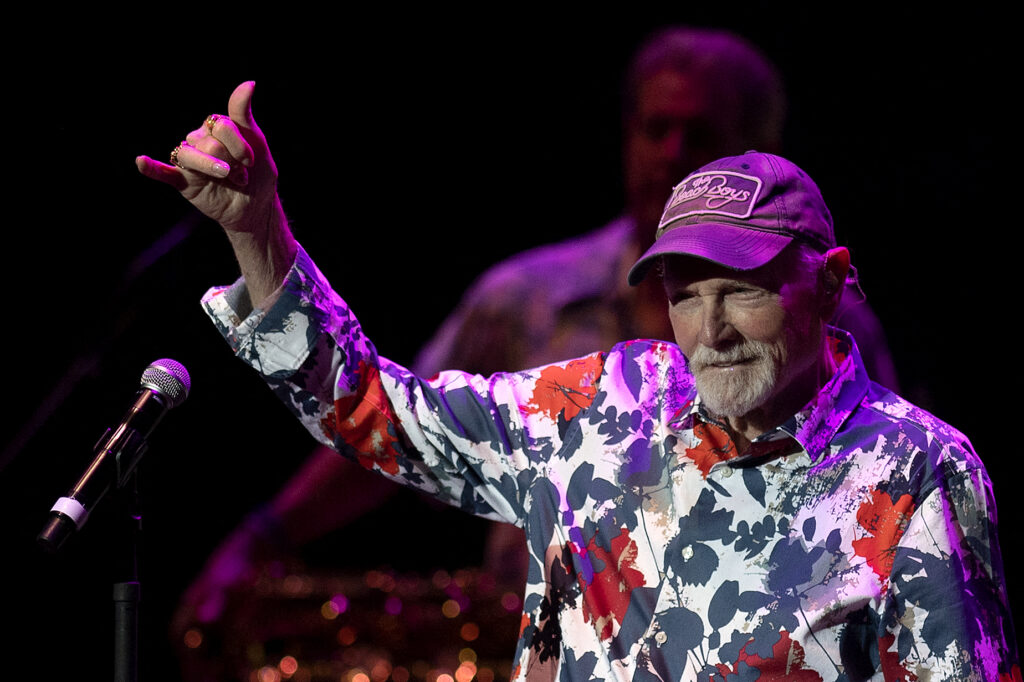
Mike Love, a founding member of the Beach Boys and an essential, if sometimes controversial, figure in the group’s long history, died Nov. 28. He was 85.
Mr. Love had called off numerous Beach Boys shows this year, and publicist Katie Altman confirmed his death in a statement Saturday, the Associated Press reported. No cause was given.
Mr. Love was a member of the Beach Boys from its beginnings in the Los Angeles suburb of Hawthorne, California, when his cousin Brian Wilson began writing and tape-recording songs about cars, surfing, girls and California’s beaches. Wilson’s two younger brothers, Dennis and Carl, and friend Al Jardine were also part of the original group.
The Beach Boys made their first single, “Surfin,” for the Candix label in 1961. It became a local hit in Southern California, and Capitol Records quickly signed the group as its first rock act.
Over the last decades of the 20th century, the Beach Boys would reach the Billboard Top 40 at least 35 times, a count unequaled by any other American band. Almost all their songs were written by Wilson, although their last and biggest hit, “Kokomo,” was written largely by Mr. Love. It went to No. 1 in 1988, when it was used in a Tom Cruise movie, “Cocktail.”
Mr. Love also contributed to earlier songs, such as “I Get Around,” “All Summer Long,” “California Girls,” “Wouldn’t It Be Nice” and “Good Vibrations.”
He later became a sort of master of ceremonies for the group’s live appearances after Wilson stopped touring and devoted himself to songwriting.
The album “Pet Sounds,” released in 1966, dazzled many, including the conductor and composer Leonard Bernstein, who concluded a warmly appreciative, nationally telecast exploration of rock in 1967 with Wilson at home, playing alone at the piano. Yet “Pet Sounds” also sold relatively poorly when it came out.
At the same time, a struggle began within the band that would last for decades. Some members, particularly Mr. Love, were opposed to any deviation from what had become a lucrative formula, while Wilson was increasingly out of sight and out of touch. Starting with “Wild Honey,” released in 1967, the other members of the band were contributing songs to each album.
Mr. Love had become increasingly irritated by Brian Wilson’s meticulous production standards in the studio.
“We would do 25 takes on one section of ‘Wouldn’t It Be Nice.’ And I would say: ‘Brian, that was perfect.’ He says: ‘No, do it again.’ So I started calling him Dog Ears, because he heard things that most human beings didn’t hear. He was looking for a particular vibe, a vibration.”
In less charitable moods, Mr. Love would refer to his cousin as the “Stalin of the studio.”
By 1969, Mr. Love had taken over the touring band. Neal Umphred, who wrote the texts for the Goldmine Record Collector guides, called Mr. Love one of the great front men in rock history.
“His competitiveness drove him to a level of showmanship that seemed to indicate he wanted to make people forget Mick Jagger,” Mr. Umphred said on his Rather Rare Records blog. “During a concert he was all over the stage, doing whatever it took to give the audience a great show and to encourage them to be a part of the show.”
A reviewer for the Los Angeles Times in 1993 had a different take, calling Mr. Love “one of the smarmiest, most condescending showmen in the business.”
“Maybe he’s doing his earnest best to entertain,” Jim Washburn continued. “But his efforts only push the show toward being a slick, moribund Vegas revue. His ultra-nasal vocals on the old Beach Boy hits may have been part of their innocent charm; hearing him sing in a flippant seeming parody of that style today isn’t nearly so charming.”
In the twilight of the counterculture movement in the early 1970s, interest in early rock music enjoyed a revival, largely ignited by George Lucas’s film “American Graffiti.” In 1974, the Beach Boys released a two-disc reissue of their songs from the 1960s, titled “Endless Summer,” and they were reborn as an oldies band.
Throughout his career, Mr. Love appeared with the band in more than 7,500 concerts. Until 2026, when his health began to fail, he had missed only one scheduled appearance, leaving the band onstage with no direction.
Actor John Stamos, who performed occasionally with the band over the years, paid tribute to Mr. Love in a Facebook post Saturday: “Tonight, I’ll cry myself to sleep. … I’ve spent so much of my life celebrating the joy that he brought. Now I’m realizing that the deeper the joy, the deeper the sorrow. It’s been a privilege to have loved someone enough to hurt this much.”
In the early 1980s, the Beach Boys played free Fourth of July concerts on the National Mall. But in 1983, Interior Secretary James Watt, whose department ran the Park Service, announced that no more rock bands would perform there. Without naming the Beach Boys, he said that such acts drew “the wrong element” and that the government did not want to encourage drug and alcohol use. The Las Vegas-based entertainer Wayne Newton was booked instead.
The press, politicians and fans across the country were aghast, and Watt and the Reagan administration apologized to the Beach Boys. The band returned to the Mall on July 4, 1984, to perform before more than half a million people.
Mr. Love would later pride himself on his friendships with Republican presidents, including Ronald Reagan, both Bushes and particularly Donald Trump. He was the only original member of the band to play with the Beach Boys in a fundraiser for Trump in 2020 at a home in Orange County, California.
Wilson and Jardine released a statement distancing themselves from the event.
Despite everything, Mr. Love remained close to Wilson, visiting his cousin a few weeks before he died last year.
“We grew up together,” Mr. Love told the Los Angeles Times in 2012. “We sang Everly Brothers songs together at Aunt Audrey’s piano. We played football together. We formed a band together. We wrote songs together that have been woven into the fabric of this nation.”
Michael Edward Love was born in Los Angeles on March 15, 1941, and was the oldest member of the original Beach Boys. His mother, Emily Wilson, was the sister of Murry Wilson, the father of the Wilson boys and the Beach Boys’ first manager. His father, Edward Love, ran a family business, the Love Sheet Metal Company, where Mike Love worked part-time in the late 1950s.
Mr. Love sang with his cousins during family holidays when they were children and teenagers. He had a deep, baritone voice that could also reach occasional bass notes, providing a tonal contrast to his cousins’ voices, which were higher and sweeter.
In 1992, after Dennis and Carl Wilson had died, Mr. Love sued Brian Wilson, claiming his name had been left off songs he helped write. In 1994, he won a court battle and was co-credited for 35 songs, while the authorship of another 40 remained unsettled.
In 1998, the band’s company, Brother Records, granted him exclusive license to tour with any musicians he chose as the Beach Boys.
The remaining members came together in 2012 to release the well-received album “That’s Why God Made the Radio” and embark on a tour.
Mr. Love made several solo records, including “Looking Back With Love,” in the early 1980s and three others late in his career: “Unleash the Love,” “12 Sides of Summer” and the Christmas holiday record “Reason for the Season.”
His released a memoir, “Good Vibrations: My Life as a Beach Boy,” written with James S. Hirsch, in 2016.
Mr. Love was married six times and divorced five times. He is survived by his wife, Jacquelyne Piesen, whom he wed in 1994, and eight children: Melinda Love and Theresa Love with his first wife, Franci St. Martin; Hayleigh Love and Christian Love with his second wife, Suzanne Belcher; Summer Love with his third wife, Tamara Fitch; Mike Love Jr. with his fourth wife, Catherine Linda Martinez; and Brian Love and Ambha Love with Piesen.
Mr. Love practiced transcendental meditation for nearly 60 years. He learned the technique from its founder, Maharishi Mahesh Yogi, in 1967 during a visit to India. He meditated twice every day and credited it with keeping him from becoming addicted to drugs. All three of his cousins in the band struggled with substance abuse.
Because of the Beach Boys’ history of ups and downs, he once compared the band to a long-married couple.
“We caught a romantic wave of success, the likes of which few have ever known,” Mr. Love wrote in the Los Angeles Times in 2012. “And since that time, we have collectively experienced profound joy, love, heartbreak, betrayal, anger, bitterness, pride and eventually resolve.”
The post Mike Love, a Beach Boys founder who kept surf vibes alive for decades, dies at 85 appeared first on Washington Post.