Patti Davis is the author, most recently, of “Dear Mom and Dad: A Letter About Family, Memory, and the America We Once Knew.”
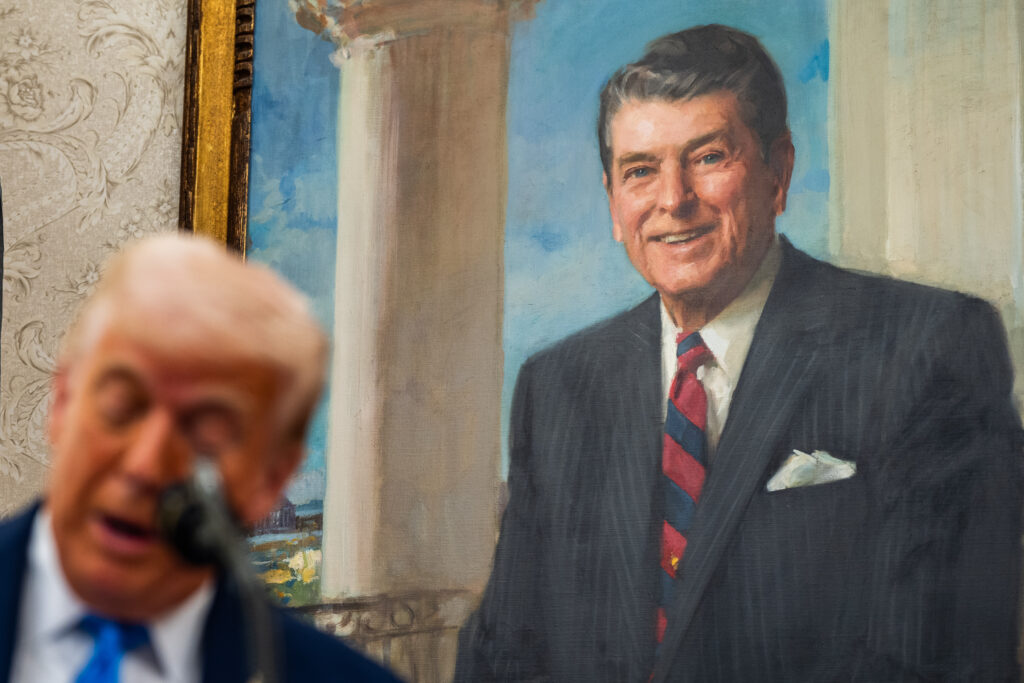
The portrait of my father, Ronald Reagan, looms large in the Oval Office. So many times when I see a photo or video of President Donald Trump, my father is there behind him. It’s distracting; my attention gets pulled to the portrait, away from the news story of the moment. At times I have imagined my father’s smile darkening, his eyes narrowing, as insults are tossed out, as reporters and others are called rude names. That’s the odd thing about portraits — there is a life there, deeper than the canvas, and the longer we look, the more our imagination stretches itself.
The portrait was painted by Everett Raymond Kinstler in 1991, and it shows my father, smiling and at ease, on the Truman Balcony. Trump told ABC News that he wanted to give the portrait a prominent spot in the Oval Office, and he had it moved from another White House location last year to honor my father’s birthday. The reason he offered for the placement was a shared love of America.
My wish was that my father’s prominence in that historic room would stir up other reflections. I thought about this even more after the midterms, when I heard commentators say that the election was less about politics and more about how the American people feel they have been treated. A few said the “blue wave” had a lot to do with corruption, which is, at its heart, a way of treating others. As in, your needs don’t matter — mine do.
The reflections that drift over me when I see my father’s portrait are not about politics or policies. I had many disagreements with him on those fronts, often feeling that the policies of his time in office didn’t reflect the man I knew. That man is who I see when I look at his portrait.
This is a man whose instinct was to treat others with dignity and respect. A man who, at Christmas, drove to the gas station where he filled up our station wagon, to give the owner a check inside a Christmas card. A man who, as governor of California, reached out to the pastor of his church to pray with him when faced with the decision of whether to enforce the death penalty for a convicted murderer. A man who, as president in 1982, hastily chose to get on Marine One with my mother to visit a Black couple, Phillip and Barbara Butler, who had been targeted by the Ku Klux Klan. My father had read about it that morning in The Washington Post. A man who comforted a shocked and grieving nation, speaking to our hearts when the space shuttle Challenger exploded in the sky, killing all seven astronauts on board.
Portraits capture a moment in time. But if the artist is skilled and observant, subtle qualities of the human being come through. My wish, my hope, is that those in the Oval Office take time to look at my father’s portrait and think about the man looking back at them.
My father believed that God is always looking down on us and sees everything we do and feel. I was a small child when we walked up a hill behind our house on a windy day to fly a kite. I reached my hand up to the sky, stood on my tiptoes, and asked my father how high I had to reach to touch God. He answered that I didn’t have to reach up at all. God is everywhere, he said, as close as the wind.
When I look at my father’s portrait, that’s the man I see.
I think what the midterms showed is that a huge majority of Americans are looking for leaders who can see beyond politics to the tenderness of humanity, and who feel history brush across them with lessons and wisdom, and the need for a wider vision.
The post My father looks on in the Oval Office. I hope someone looks back. appeared first on Washington Post.