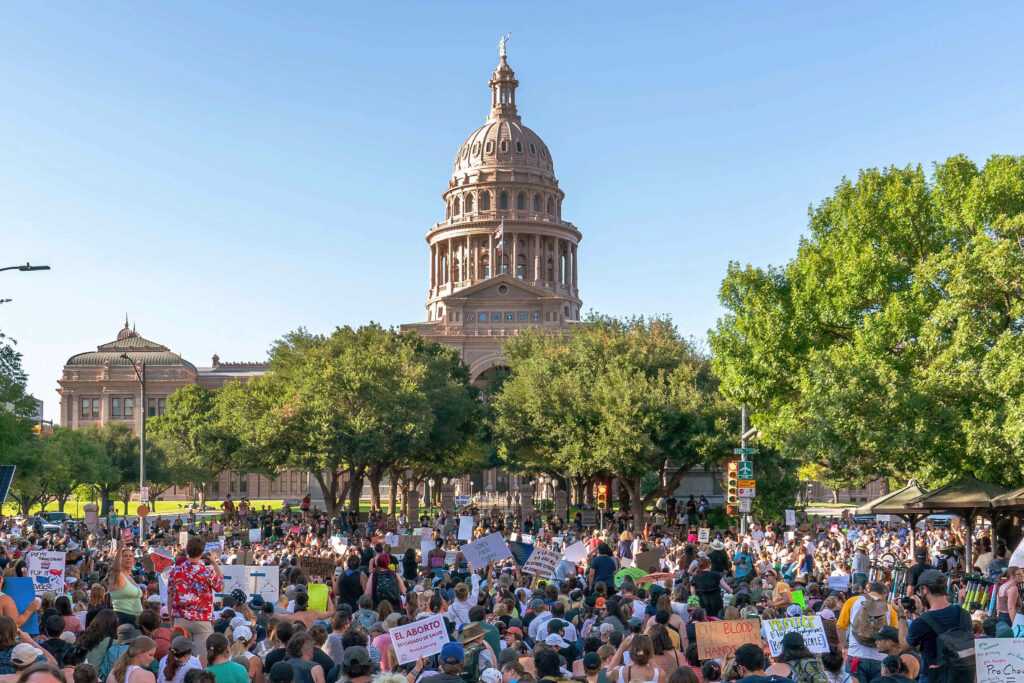
Less than a week after the midterm elections, a Texas Democrat filed a bill in the state House to repeal the near-complete abortion ban there, one of the nation’s most restrictive.
While voters were not nearly as motivated by abortion as they were the economy this year, Democrats are seizing on the election results as their most sweeping opportunity to reshape abortion law since the Supreme Court overturned Roe v. Wade in 2022.
Efforts like the one in Texas, where abortion proponents are still staring down a Republican-held Senate, remain uphill battles.
But even months ago, a Democratic House and governor seemed unfathomable in Texas.
Lawmakers there and elsewhere who support abortion rights are taking advantage, particularly in the six states where Democrats will hold new trifectas, meaning they will control the House, Senate and governorship. In these states, lawmakers are working to codify abortion rights and increase access to abortion pills.
And their colleagues in Washington are preparing to reintroduce legislation in the opening months of a Democratic-controlled Congress that would codify a national right to abortion.
Some of those efforts — such as congressional lawmakers’ likely push to codify Roe next year — are all but certain to fail again. Still, such moves inch abortion supporters closer to passing that measure, which will probably require Democrats keeping the House, reaching a 60-vote majority in the Senate and winning the presidency in 2028.
For the GOP, abortion has been a tricky political issue since Roe, as more and more Americans say they support at least some access to the procedure.
Mini Timmaraju, president of the national group Reproductive Freedom for All, said Democrats can use the federal bill that would codify that right, called the Women’s Health Protection Act, as a political cudgel against conservative lawmakers, especially those who are up for reelection in 2028.
“We haven’t been able to get Republicans on the record because we haven’t had control of the floor for quite some time,” Timmaraju said.
Beyond holding largely symbolic votes on Roe, Democrats are eager to eliminate the Hyde Amendment, a 50-year-old prohibition on federal funds being used for abortions. Lawmakers could undo the provision with legislation or through the budgeting process, which requires only a simple majority in the Senate. Democrats will lead the committees that oversee the annual congressional spending bills starting next year.
Ending Hyde would allow for funding from programs such as Medicaid to cover abortions, at least in states where the procedure and federal reimbursement for it are both legal.
Early this year, President Donald Trump — whom antiabortion leaders once listed as one of their fiercest allies — said Republicans should be “a little flexible” on Hyde as a health care deal was at a standstill in Congress.
The comment was among a string of what antiabortion activists view as missteps from the Trump administration, and a sign that the president was in danger of backsliding on some of their issues.
In recent months, conservative activists have pressed the president’s allies on a number of priorities, including finishing a safety study on the abortion pill mifepristone and banning the mailing of abortion drugs. But those were put on the back burner before the midterm elections, given the already fraught environment for Republicans and the party’s struggle on the issue with swing voters.
The resulting Republican losses have made it necessary for the antiabortion movement to regroup.
Its leaders are pledging to counter Democratic efforts on abortion by pushing Trump to use his executive authority. They argue Republicans erred in downplaying the issue, depressing turnout among socially conservative voters.
The party will keep hemorrhaging support if it does not campaign on abortion in 2028, said Kristi Hamrick, a spokesperson for the antiabortion group Students for Life of America.
“Not talking about something doesn’t make it go away,” she said. “Ask anybody in a relationship, right?”
The most concerning issue for her movement continues to be abortion pills.
The drugs, which can be used through 10 weeks of pregnancy, are accessible in all 50 states despite abortion bans. “Shield laws” enacted in some Democratic-controlled states after Roe was overturned allow providers to legally prescribe and mail abortion pills to women regardless of where they live.
That widespread availability has in part kept abortion numbers steady or higher in the years since the 2022 Supreme Court decision. Antiabortion activists have lobbied multiple federal agencies — namely the Justice Department and the Food and Drug Administration — to curb abortion pill access. They’ve seen little progress.
In the weeks since Election Day, antiabortion activists have sent a letter to Trump and contacted administration officials friendly to their cause.
The response so far has been “radio silence,” said John Seago, president of Texas Right to Life.
“I think they’re still weighing, what are the political consequences of moving on this,” he said.
The White House did not respond to a request for comment.
At the state level, Democrats in places that will have new trifectas are planning to shore up protections for abortion pill mailers. They also want to enact measures to enable remote prescription in states that don’t already allow it.
In Pennsylvania, which landed a Democratic trifecta in the midterms for the first time in decades, state Sen. Amanda Cappelletti (D) said she and her colleagues are working on legislation to put shield protections for abortion providers into state law during the next session. The state already has some similar protections in place because of executive orders signed by two Democratic governors, Josh Shapiro and, before him, Tom Wolf.
Cappelletti said November’s results give the state an opportunity to codify those protections so they cannot be overturned by a future governor in the purple state.
In the absence of action at the federal level, conservatives have looked to red states for guidance on how to challenge abortion access. Texas, until now, had been the cornerstone.
Antiabortion activists, lawmakers and attorneys in Texas, where abortion is illegal after six weeks, have constructed novel legislation and legal strategies to attack providers who have mailed pills into the state. Under Attorney General Ken Paxton (R), the state sued providers based in New York, Delaware and California for allegedly mailing pills to Texas women.
But this month, Texas elected as its next attorney general Democrat Nathan Johnson, who has said he would not prosecute out-of-state providers. Paxton’s office this month moved to drop two of its lawsuits against out-of-state providers that antiabortion activists had hoped would make their way to the Supreme Court and reverse shield law protections.
Antiabortion advocates are bracing for similar, smaller-scale changes to the abortion landscape in states like Iowa and Georgia, where the Democratic Party didn’t win complete control of state government but did flip the governor and attorney general offices.
Seago said he expected Johnson would withdraw from many of Paxton’s legal efforts, especially those targeting pills and providers.
For now, Seago is finding solace in Republicans’ success in holding the state Senate, making the odds of repealing the near-total abortion ban low.
He said he is also confident that other conservative-led states will lead the charge for the antiabortion movement’s multistate legal efforts.
Abortion rights advocates are preparing for that, too.
The post The Democratic wave is set to change abortion laws in several states appeared first on Washington Post.