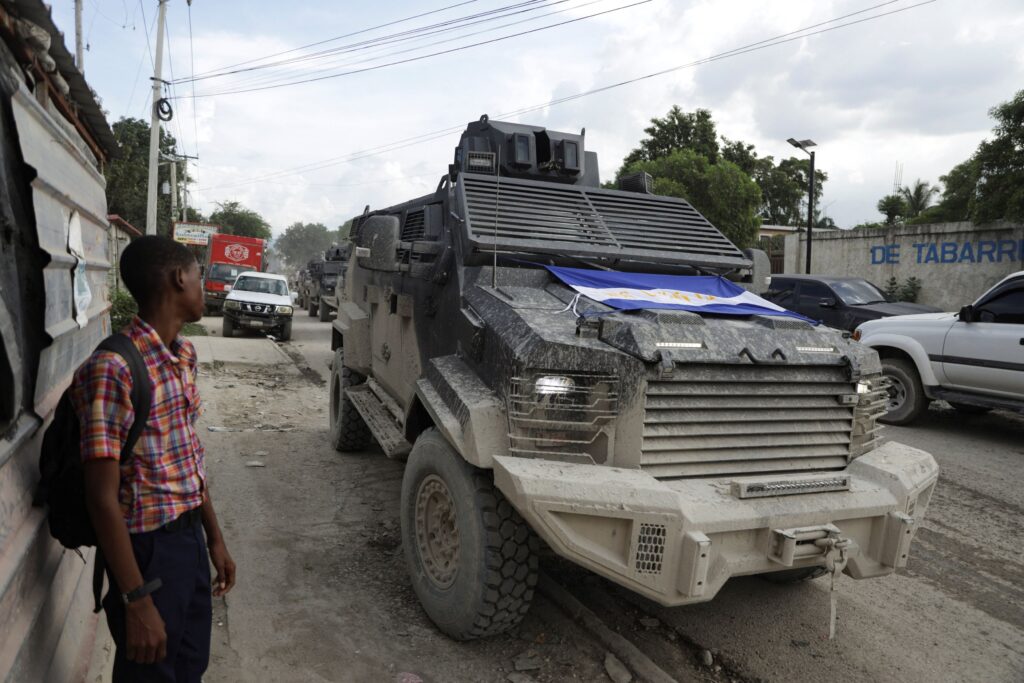
PORT-AU-PRINCE, Haiti — When heavily armed gang members attacked a forward operating base of the international Gang Suppression Force north of Haiti’s principal airport, the U.S.-backed, U.N.-approved troops turned to a force newly arrived from El Salvador for help.
GSF asked for drone support to identify the source of incoming fire, a senior diplomatic official told The Washington Post.
The Salvadorans, whose deployment was supported by U.S. Southern Command but who are operating here independently of the GSF, instead launched helicopters and engaged what they assessed to be gang positions, the official said. Their rounds landed some 200 yards from GSF personnel on the ground.
The international force did not request the attack, a U.N. official said. There had been no communication between the Spanish-speaking troops in the air and the Arabic-speaking Chadian on the ground.
The force of some 2,500 Salvadorans, as many as the GSF, is presenting a challenge to the volatile mix of Haitian police and soldiers, international troops, private security contractors and vigilantes trying to beat back the gangs that are destabilizing this Caribbean nation.
Sent here last month by Salvadoran President Nayib Bukele, they’re not answering to the other forces or holding themselves to their rules of engagement. More aggressive than the GSF, they’ve launched attack helicopters to destroy the home of two gang leaders, helped retake control of the national soccer stadium and deployed rifle-wielding robot dogs.
To many here, such tactics have made Bukele a hero. Others are concerned about the potential for disaster — civilian casualties, friendly fire or some other, unforeseen catastrophe.
“Haiti now has five forces operating side by side, under five different legal regimes,” said Romain Le Cour Grandmaison, director of the Haiti and Caribbean Observatory at the Global Initiative against Transnational Organized Crime.
“They all operate in the same neighborhoods, among the same civilians, but they do not answer to the same rules,” he said. “When something goes wrong, who is accountable?”
GSF commanders are concerned that Salvadoran operations could cause significant civilian casualties and harm their own force’s legitimacy, a U.N. official said.
“Everybody in the GSF got vetted,” the official told The Post. “They received training and briefings on Haiti. They have rules and guidelines governing the use of force and arrests.
“None of that is true with regard to the Salvadorans. Nobody’s got vetted.”
Neither Bukele’s office nor the office of Haitian Prime Minister Alix Didier Fils-Aimé responded to requests for comment. A lobbyist for Bukele in Washington said GSF and U.N. officials were “getting pretty defensive.”
“It’s kind of embarrassing that the U.N. have been there for years and years and spent hundreds of billions of dollars and don’t have a whole lot to show for it,” lobbyist Damian Merlo said.
The Salvadorans are pursuing their own missions, Merlo said, with “a lot fewer bureaucracy steps.”
“They coordinate with [the GSF], but, they’re not in a position to always wait for the U.N. to make a move. Because you’ve seen how long it takes the U.N. to do anything.”
U.S. Southern Command acknowledged a U.S. military aircraft provided “logistical support” during the Salvadorans’ deployment last month. Flight records showed an Air Force C-130J transport plane operating from San Salvador at the time. A State Department spokesperson said the United States would continue to work with international partners through the GSF.
“Our focus remains on improvement of Haiti’s security,” the spokesperson said. “Recent images of Haitians enjoying improved safe freedom of movement in public spaces are a signal of the positive direction we all aspire to for Haiti.”
In a country beset by overlapping political, security and humanitarian crises, the Salvadorans have seemed to many a godsend.
There have been no elections here in a decade. The presidency has been vacant since the 2021 assassination of Jovenel Moïse. The National Assembly has been empty since the last senators’ terms expired in 2023. The tenure of a transitional presidential council has lapsed, leaving a prime minister running a skeletal government.
Armed groups, some of them believed to be associated with politicians or business leaders, outgun the police and military. They control roughly 90 percent of Port-au-Prince, the U.N. office here estimates, and major roads in and out of the capital. They’ve stolen fuel shipments and periodically closed the airport and seaport.
An initial international police force, the Multinational Security Support Mission, also backed by the United States and approved by the U.N. Security Council, proved ineffective at fighting them. The GSF, its successor, is now ramping up.
Their aim is to establish security conditions sufficient to hold elections. The schedule has repeatedly been pushed back; the goal now is a first-round vote and constitutional referendum next July, followed by a second round in October.
Thousands of people here have been killed this year in gang violence, the U.N. office says, nearly half the population is facing acute food insecurity, 1 in 8 have been forced from their homes.
A helicopter unit of around 125 Salvadorans deployed here with the GSF earlier this year. Bukele sent the larger force, his first major international military deployment, after four of those initial troops went missing in an ambush last month north of the capital.
The helicopter unit remains integrated with the GSF. The larger force is controlled by the Salvadoran government.
The missing military aviation technicians are now believed to have been killed, but the Salvadorans’ mission has expanded from search and rescue to a broader and independent assault on the gangs.
That mission was approved by Haiti’s ministerial council this month. But it has encountered significant obstacles on the ground.
At the GSF forward operating base in Sarthe, Bukele’s lobbyist said, the international force should be grateful the Salvadorans intervened.
“The attack helicopters went and rescued GSF forces from Chad,” Merlo said. “If the GSF didn’t ask for it, they should at least be thankful that they went, to protect their soldiers.”
Salvadorans showed up at the base the next day and demanded entry, the senior diplomatic official said. Lacking authorization, they were denied access, the official said, leading to an armed standoff between ostensible allies.
More broadly, according to the senior diplomatic official, two U.N. officials and a fourth well-placed official, logistical support has been inadequate, leaving Salvadoran personnel initially dispersed across Port-au-Prince with inadequate supplies.
The U.N. Support Office in Haiti initially assisted the deployment, two of the officials said, but later informed Salvadoran officials that its mechanisms were designed for the GSF.
“They arrived with little more than their rifles and the clothes on their backs,” the well-placed official said. “Transportation, food, water, sanitation, housing. All of that had to be set up from scratch.”
On multiple occasions, a U.N. official said, the Salvadoran forces moved into areas without informing all involved. Fils-Aimé’s office this month set up a joint information center at the airport to improve coordination and reduce the potential for conflict, GSF special representative Jack Christofides told The Post.
Merlo said the Salvadorans maintain close contact with Fils-Aimé’s office and the Haitian National Police. “It’s coordination, but sometimes it’s like, ‘FYI, this is what we’re doing. Even if you don’t always agree with what we are going to do.’”
The troops take care to protect bystanders, he said. “I can tell you that the measures in place to minimize civilian casualties are much better than the measures that the gangs apply because the gangs don’t really care.”
Bukele, a 45-year-old, social media-savvy authoritarian, whose military deployments, mass arrests and large new prisons inside El Salvador are credited with neutralizing the country’s once-powerful gangs, was already the hemisphere’s most popular leader.
Among many Haitians, the devotion has been almost cultlike. They’ve erected billboards in his image, produced songs in his honor and mocked up identity cards proclaiming his citizenship. Thousands marched in cities across the nation this month chanting his name.
Bukele said last month that El Salvador would cover 90 percent of the cost of the deployment. Three Salvadorans were killed and two wounded while handling “explosive material,” the military said Nov. 20.
According to Merlo, Bukele’s goals have extended beyond recovering the four missing technicians, whatever their condition, to “doing what he did in El Salvador, which is to liberate 10 million Haitians from being under the the constant threat of death by gangs.”
Haiti’s minister of justice and public security, Patrick Pélissier, toured Bukele’s maximum-security CECOT prison east of San Salvador this month and announced that the government had reached an agreement with El Salvador to build three new prisons here.
Others caution that real progress remains illusory. “Their success has been largely psychological,” said sociologist James Beltis, co-founder of the anti-impunity group Nou Pap Dòmi (We Will Not Sleep).
“The fear has changed camps,” Beltis said. “They brought people a sense of safety, but they have yet to produce concrete results. They haven’t made any arrests, and they haven’t restored access to the country’s main roads.”
“Haiti has seen this movie before,” Le Cour Grandmaison said. “Fifteen years ago, U.N. forces cleared gang strongholds, and the victories were real. Then the networks behind the gangs came back, and the crisis returned stronger.”
“Clearance without justice does not last,” he said. “If the people who arm, finance and protect these groups remain untouched, the next generation of leaders is already waiting.”
Samuel Oakford and Samantha Schmidt contributed to this report.
The post El Salvador’s Bukele exports gang fight to Haiti to popular acclaim, concern appeared first on Washington Post.