LONDON — As five men in white vans made their way toward a British air base used by U.S. bombers shortly after midnight Sept. 27, a sixth figure in Iran was secretly directing the operation.
He sent the drivers a stream of instructions over an encrypted messaging app as they navigated rural roads toward the base, RAF Fairford, according to new details disclosed in U.S. and British criminal proceedings. Two-way dash cams gave him a live view of the route as well as the vans’ interiors, enabling him to keep an eye on his untrained recruits for an alleged terror plot he masterminded.
The remote-control role of Mohammed Ali al-Hassani, an Iraqi national who resided for years in England, provides what security officials described as the clearest link established to date between the attempted attack and a network of operatives overseeing Iran’s campaign of retaliation against the United States and its allies.
Al-Hassani, 35, helped to orchestrate a wave of nearly 20 stabbings, arson attacks and other terror plots across Europe this year, working closely with an Iraq-based operative of Iran’s Revolutionary Guard Corps who is now in U.S. custody, according to a recently unsealed Justice Department indictment.
The Fairford operation marked an effort to broaden that campaign and deliver on a threat the IRGC issued in July to treat any base used by the U.S. military as a legitimate target, according to details in the U.S. indictment and disclosures by British prosecutors that provide a remarkable glimpse into how Iran set the plot in motion.
The attempted attack on Fairford represents “a consequential expansion of Tehran’s covert campaigns using disposable criminal proxies in Europe,” said Matthew Levitt, director of counterterrorism and intelligence at the Washington Institute for Near East Policy.
The IRGC has broadened its focus, Levitt said, “beyond dissidents, Jewish communities and other civilians to hardened military targets.”
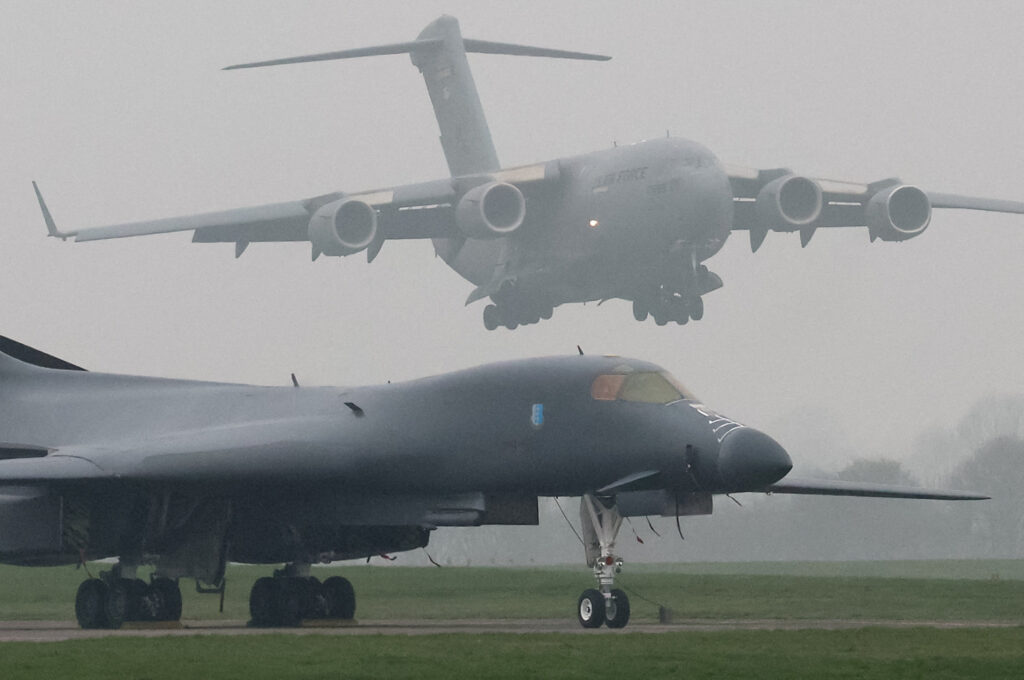
The unraveling of the Fairford plot — which ended with the suspects calling the police on themselves and the United States evacuating a squadron of B-1 bombers — underscores Iran’s ambitions and limitations as it seeks to orchestrate but also outsource high-stakes operations, officials and experts said.
The plan to attack at Fairford imploded amid blunders and baffling developments, including the alleged plotters’ apparent failure to account for the possibility that they might encounter a military checkpoint on their midnight run toward a high-security complex.
Having been turned back by guards at a cordon near the base, the alleged plotters abandoned their vans and called police on themselves after al-Hassani told them — falsely — that the vehicles had been rigged with explosives, according to British prosecutors.
In a measure of their confusion, one of the drivers spent the final moments before police arrived sending frantic texts to al-Hassani. “Wtf is going on?” wrote Nouman Essghir, 25, who was arrested at Fairford and charged with violating British national security laws.
U.S. and British security officials have wrestled with their own questions about what happened at Fairford, and reached divergent conclusions about the purpose of the plot and the danger it posed to a base that dates to the D-Day operations of World War II and is set in Britain’s Cotswolds countryside.
The British investigation was barely underway when President Donald Trump declared that the suspects had been under investigation for “a very long time” and were “looking to do big damage.” Days later, the Pentagon rushed all 12 B-1 bombers then stationed at Fairford back to U.S. bases.
U.S. officials cited additional concerns about the threat of an attack involving drones packed with explosives — a scenario that triggered an emergency “shelter-in-place” order at another base in mid-November after a suspected drone sighting.
But British authorities, who found two barrels of gasoline in the suspects’ vans but no explosives, still see no sign that Fairford or any of the United States’ $300 million bombers based there were in real danger. To some, the U.S. decision to evacuate its aircraft delivered an unwarranted propaganda win to Iran, showing that its dubious asymmetric capabilities were enough to send a symbol of U.S. firepower into retreat.
“It reeks of panic,” a former senior British security official said, speaking on the condition of anonymity to discuss sensitive diplomatic relations. “You’re signaling that you’re scared.”
Months later, security officials are still struggling to determine whether the alleged plotters were engaged in a hoax or trial run, planning to set barrels of gasoline on fire to sow panic, or unwittingly involved in something more nefarious envisioned by al-Hassani, whom they referred to as “Ali.”
Within weeks of the IRGC’s July 23 threat to target bases used by U.S. forces, al-Hassani had enlisted Essghir to conduct surveillance at Fairford, according to British and U.S. court documents. The two had known one another in England, where al-Hassani resided from the 1990s until 2024, according to British officials.
Essghir circled Fairford on Aug. 22, taking video of “fencing, gates and entrances,” and noting whether he could see planes behind security barriers, according to British prosecutors. An attorney who represents Essghir declined to comment on the case.
In September, al-Hassani assigned tasks to other London contacts, including Mohmed Abdulkarim, 24, who told British police after his arrest in October that he had known Ali for a decade and considered him “a brother.” Abdulkarim also seemed aware that al-Hassani was an agent of the Iranian government, according to prosecutors, saying in a text to another suspect that “he’s a spy I believe he’s against Israel and he works for Iran.”
Abdulkarim made at least three trips to a money exchange on London’s Edgware Road, where he used code words to collect bags of cash containing about 65,000 British pounds, roughly $85,000, according to prosecutors. An attorney for Abdulkarim declined to comment, citing ongoing criminal proceedings.
Abdulkarim, who uses a wheelchair, then tasked others with making a series of purchases, according to prosecutors, including five utility vans that were subsequently fitted with decals to make it appear they were operated by fuel delivery and swimming pool maintenance companies.
Additional purchases were made in the following weeks, according to prosecutors, including metal barrels, “a large quantity of chlorine granules” and thousands of metal fasteners from a hardware store.
As these items were gathered, al-Hassani tasked recruits with “researching the purchase of chemical accelerants, including large quantities of potassium chloride, and buying metallic objects that could be used as explosive shrapnel,” according to the U.S. indictment, which does not identify those who were given these tasks.
Two days before the vans’ departure, a senior IRGC operative in U.S. custody used a prison phone call to relay a cryptic message to “Ali,” according to U.S. officials.
Mohammad Baqer Saad Dawood al-Saadi, the alleged leader of an Iran-backed militia, has long-standing ties to the highest ranks of the IRGC, according to the U.S. indictment, which includes photos of him with Qasem Soleimani, who served as commander of Iran’s elite Quds Force until he was killed by a U.S. drone strike in 2020.
Al-Saadi and al-Hassani were “co-located in Iraq planning European terror attacks” in March and April after the launch of the U.S.-Israeli war with Iran, according to the U.S. indictment, which charges both men with conspiracy to provide material support to a foreign terrorist organization.
Al-Hassani, who has been stripped of his British citizenship, remains at large and is believed to be in Iran or Iraq, officials said. But the more senior Al-Saadi was detained by Turkey earlier this year and extradited to the United States.
In a call to relatives Sept. 24, two days before the vans departed for Fairford, al-Saadi asked about Ali and instructed relatives to send him “money so he can do it,” according to the indictment, which notes that “three days later, al-Hassani orchestrated the RAF Fairford Terrorist Plot.”
Al-Saadi has denied sending coded messages. At a hearing this month, His attorney, Andrew Dalack, described the government’s claims as “pure surmise and speculation.”
British officials are skeptical that al-Saadi’s calls with relatives set the Fairford plot in motion, noting that money already had been sent to the recruits weeks earlier and that al-Saadi was in a New York prison for months before the plot was conceived.
It remains unclear why the alleged plotters took only three of the five vans they had purchased as they set off for Fairford late on the night of Sept. 26. Most of the suspected bomb components they had purchased also were left behind.
All five suspects arrested that night were subsequently released on bail. Essghir was later rearrested and since has been charged with approaching Fairford “for a purpose … prejudicial to the safety or interests of the United Kingdom.”
Abdulkarim, the only other defendant in the case, has been charged with conduct that “would likely materially assist a foreign intelligence service.”
He has submitted statements to police saying that “he believed he was being tasked by Ali to assist in the creation of two legitimate businesses” and that he believed the trip to Fairford was for “a promotional video shoot.”
Despite the outcome at Fairford, British military bases remain on heightened alert. Citing particular concern about the possibility of attacks using drones packed with explosives, the Royal Air Force this month ordered planes to be moved into hangars at night.
The post Botched air base plot shows Iran’s ambitions and limits in hitting U.S. targets appeared first on Washington Post.