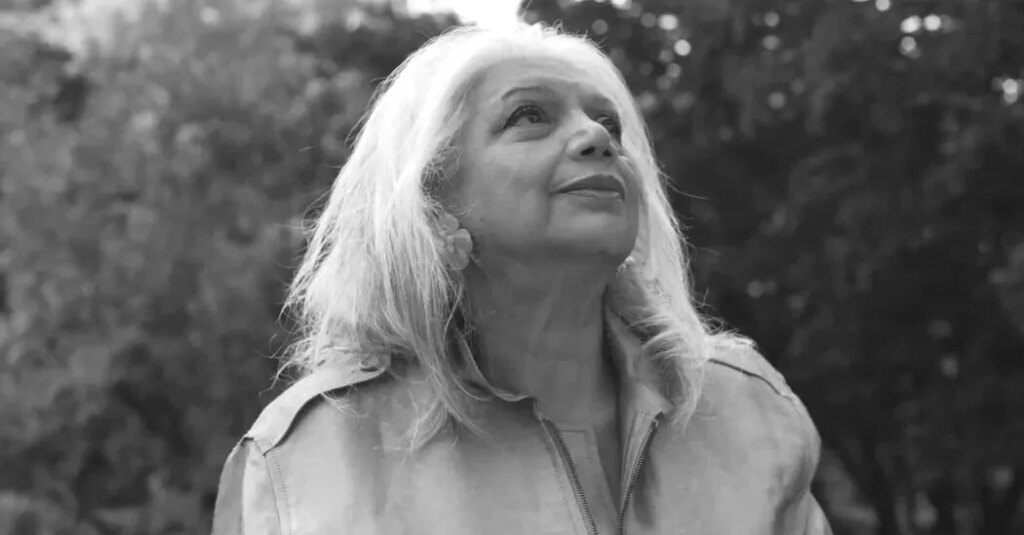
About an hour into the Gorillaz concert at Madison Square Garden in late September, an octogenarian South Asian singer was waiting in the wings. Damon Albarn, the leader of the band, began playing a gentle tune at his keyboard.
“Please,” he said, “can you welcome to the stage the magical Asha Puthli.”
Puthli emerged from stage left. She was dressed all in silver, complete with a floor-length cape and bedazzled cat’s-eye sunglasses. When she reached center stage, she faced the crowd and basked in the applause.
“New York, I love you,” she said. “It’s so good to be back home.”
Gorillaz launched into “The Moon Cave,” from the band’s latest album, “The Mountain,” with Albarn singing lead and Puthli offering up wordless harmonies and vocal accents, her soprano rising above the music. Toward the end of the song, the band stopped playing, leaving one sound: Puthli’s ethereal voice. Then came thunderous applause.
As far back as the 1970s, Puthli has been prized more by music aficionados than the general public. But in recent years the rest of the world has begun to catch up to her innovative blend of disco, jazz and South Asian sounds, making her a model for other South Asian artists who have followed her path in the United States and Europe.
In 2024, she toured the world. The next year, she collaborated in the studio with Gorillaz. In the spring, there she was again, on the stage of “Saturday Night Live,” when Gorillaz was the musical guest.
Over lunch on the Upper East Side one recent afternoon, she was asked if it was fair to use the word “comeback” for what she has been going through lately.
“I don’t know what you call it,” Puthli, 81, said. “Because I’ve never had a mainstream platform to come back to.”
She wondered if her career might have gone a different way if she hadn’t quit the music business in the 1980s.
“Would it have taken me 60 years to get here?” she said.
‘Cognitive Dissonance’
When Puthli recounted her early days in New York, she sometimes sounded like someone trying to put words to a foggy, serendipitous dream.
The daughter of a wealthy industrialist in Mumbai, she arrived in New York in 1969, armed with $50 and a voice that could span five octaves. She recalled spending her first night in the city in the back of a friend’s truck parked in what is now Dumbo, with a view of the Manhattan skyline.
She told me she’d befriended Andy Warhol simply by bumping into him downtown. In 1970, she fell for a man she met by the entrance of the Museum of Modern Art, the painter George Stillwaggon, and married him two weeks later. She was young, impulsive and “he looked like a prince,” she said. She added that she was also in need of a green card.
“The planets were conspiring with me, in conjunction with my thoughts,” she said.
She happened to have an influential fan, Ved Mehta, a writer for The New Yorker, who had praised her in print. Mehta’s article, reprinted in a 1970 book, then caught the attention of John Hammond, a top executive at Columbia Records who had advanced the careers of Billie Holiday, Aretha Franklin and Bob Dylan, among many others. Soon, Puthli was taking part in recording sessions led by a notable Columbia artist, the jazz musician and composer Ornette Coleman, for his 1972 album “Science Fiction.”
Puthli had a chance to sign with Columbia, but she didn’t like the terms — a $6,000 deal, she recalled, an amount smaller than what she’d heard other artists were receiving. And she was put off when executives told her it would be impossible for an Indian singer to have mainstream success in the U.S. “Cognitive dissonance” is how they framed the inability of Americans to accept a singer from Mumbai who was recording anything other than “temple bells and the sitar,” she said. They even suggested she change her name to Ann Powers.
“They told me that Indians won’t buy my music, Black people won’t buy it and white people won’t buy it,” she said. “There was no place for someone like me.”
When she turned down the Columbia deal, she was branded as difficult, she said. (Sony, which now owns Columbia, declined to comment.) She made her first album, “Asha Puthli,” a fusion of rock, soul and Mumbai pop, in London. Then came a string of innovative records that failed to dent the pop charts but found devotees in Britain, Germany and Japan.
Her third album, “The Devil Is Loose,” released in 1976, is her most successful. Robert Palmer, The Times’s music critic, suggested it could “set the disco world on its ear” and urged for a U.S. release, to no avail.
Puthli never signed with a major American record label, but her music wormed its way into clubs and the underground dance parties organized by the influential D.J. David Mancuso. She also became a fixture of New York’s creative scene, performing at Studio 54, working on projects with Warhol’s Factory and posing for Richard Avedon.
“Space Talk,” from her third album, would have a long tail, sampled across hip-hop in the late 1990s and early 2000s, most famously in the Notorious B.I.G.’s “The World Is Filled.” Still, Puthli never earned much from any of her albums, she said. For “The Devil Is Loose,” she got a $3,000 advance.
“If there’s a poster child for being South Asian and ahead of one’s time, it’s Asha Puthli,” said Raghav Mani, a D.J. and co-founder of Naya Beat, a reissuing label. “The world just wasn’t ready for an Indian disco diva back then.”
In the Wilderness
Puthli’s first marriage ended in divorce. In 1974, she married a businessman, Marc Goldschmidt. The following year, she gave birth to their son, Jannu, named after a Himalayan peak.
In 1980, Goldschmidt took the boy to Connecticut, claiming he should have sole custody because Puthli was “in show business, and my life is too up and down, no stability, blah blah blah,” she said. She eventually won custody when they divorced later that year. She said she was so desperate to cut ties with her second husband that she didn’t ask for child support. (Goldschmidt did not reply to requests for comment.)
At the same time, Puthli was growing frustrated with the music business, worn out by the frequent trips to Europe to record her albums and the fights to have them released in the U.S. In 1982, she put out what would be her last solo album for years, “Only the Headaches Remain,” a Japan-only release. It ends with the sound of a toilet flushing, which was her way of “saying goodbye to the record business,” she said.
Puthli spent the next decades cut off from the industry. When I asked how she could live in New York without the income from her music, she snapped: “Are you with the I.R.S.?”
She invested in the stock market, she said, and took on various work projects, including helping Mikhail Gorbachev with his environmental nonprofit Green Cross International. In 2000, when the market crashed, she lost nearly everything.
“I’m quite stupid, if you ask me,” she said.
In 2021, Mani messaged her on Facebook to ask if she would be interested in working with Naya Beat, the label he had started with his friend Filip Nikolic. Puthli invited them to come to her apartment in a retirement community in West Palm Beach, Fla.
Mani and Nikolic discovered boxes packed with recordings, including some that had never been released, along with tapes of TV appearances. They digitized her work and signed on as her temporary managers, focused on reviving her career.
In 2023, Naya Beat released two LP records of remixes of Puthli’s biggest hits. The pair then arranged her 2024 tour — her first in 44 years — with stops in Los Angeles, Melbourne, Sydney, Paris and London. A high point was a performance at the Glastonbury Festival in England.
Toward the end of that year, Albarn’s team reached out to Puthli to collaborate on the upcoming Gorillaz album. In January 2025, he flew into Miami to record “The Moon Cave.”
“Asha belongs to many worlds,” Albarn said in a statement. “I think that is her superpower.”
Part of the motivation for her return is financial, she conceded. “I need to earn money to be more secure in my older age,” she said. But it was vindicating, she added, to hear huge crowds finally applauding the music that couldn’t find mainstream acceptance all those years ago.
Two months after her performance at Madison Square Garden with Gorillaz, Puthli headlined a sold-out solo show at the Barbican Centre in London. She was dressed in a flowy gold robe and shared the stage with musicians from a new generation — the sitar player Anoushka Shankar, the trumpeter Yazz Ahmed and the tabla player Sarathy Korwar.
After her performance, as she was leaving the stage, an aide at the Barbican who was helping her down the stairs pointed out that all three tiers had given her a standing ovation.
“I think even a corpse would rise up when you have that kind of reception from people,” Puthli told me. “It’s a wonderful feeling.”
The post It Took Decades for the World to Catch Up to Asha Puthli appeared first on New York Times.