Two of the largest food-delivery app companies have made a last-ditch effort to overturn tipping laws in New York City that go into effect in January just as its next mayor, who has been highly critical of the companies and the app industry, takes office.
Tips to delivery workers have plummeted since some food-delivery apps switched to showing the tipping option only after a purchase had been completed; that change came after New York City established the country’s first minimum pay-rate for the workers in 2023. The new laws will require the apps to suggest a minimum tip of 10 percent at checkout, though customers can contribute more or less, or nothing at all.
Two of the app companies, DoorDash and Uber, filed a joint federal lawsuit in the Southern District of New York late last week targeting the City Council legislation, arguing that the new rules violated the First Amendment by requiring them to “speak a government-mandated message” and exceeded the Council’s authority.
Although tipping will be optional under the law, the companies wrote in the suit that a “mandated pre-delivery 10 percent tip suggestion” would cause customers to use the app less because they were suffering from “tipping fatigue.”
“Lessened engagement would result in fewer orders,” the suit said.
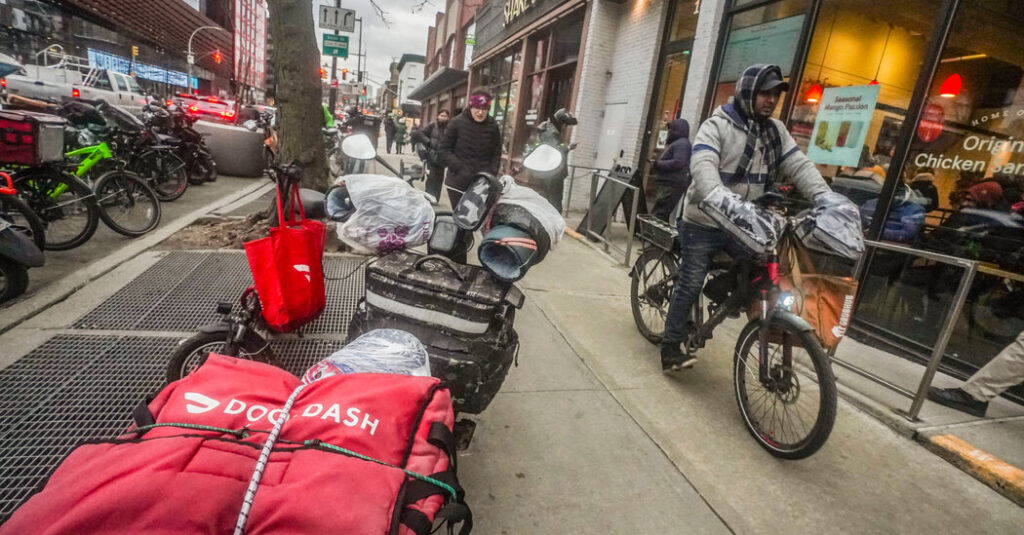
Five years after the pandemic, food delivery workers — on electric bikes and scooters and in cars — are more ubiquitous in New York City than the yellow cab, crisscrossing neighborhoods with orders at all hours and in all types of weather for an industry that has boomed. New Yorkers spent more than $265 million on restaurant deliveries in the first half of 2025, up from $183 million during the same period of 2022, according to the city.
Since the rise of the food-delivery apps, New York City has enacted the strictest regulations in the country on the multibillion-dollar industry, targeting the fees that they charge restaurants as well as the conditions for the workers. There are about 80,000 delivery workers in the city.
Before the minimum-wage standard, about half of delivery workers’ earnings came from tips, according to the city. With the new pay rate, which only applies to periods in which a worker is delivering food, their earnings per hour have nearly doubled, to about $24 an hour. Now, tips make up about 10 percent of their total pay.
Mayor-elect Zohran Mamdani has been particularly critical of the industry, saying that the companies have “exploited” delivery workers by taking advantage of the lack of stronger regulations. A spokeswoman for Mr. Mamdani on Monday did not respond to a request for comment on the lawsuit.
During his campaign, Mr. Mamdani said he supported giving customers the option to tip at checkout. During the Democratic primary, DoorDash donated $1 million to his chief rival, former Gov. Andrew M. Cuomo.
Mr. Mamdani will be sworn in as mayor on Jan. 1, several weeks before the tipping law and other new rules go into effect. One such rule establishes safety standards for electronic bikes following a string of deadly lithium battery fires during the pandemic. Another requires delivery companies to pay drivers and provide a detailed compensation summary no later than a week after the end of a pay period.
The City Council member who introduced the tipping legislation, Shaun Abreu, a Democrat who represents parts of Upper Manhattan, said the goal was to provide transparency to customers ordering food and the workers delivering it. Mr. Abreu said the new rules did not harm the companies, noting that apps had included a tip option at checkout for years.
“At the end of the day, there is nothing forced on anyone,” Mr. Abreu said. “There’s no additional costs to the apps.”
Ligia Guallpa, a co-founder of Workers Justice Project, which includes the delivery-worker advocacy group Los Deliveristas Unidos, said she believed that the delivery-app companies prefer not to advertise the option to tip as a way to reduce worker pay.
“Removing the tipping option is to keep workers in poverty and making them dependable on taking more orders,” she said.
Jose Lino, 39, started delivering food orders early in the pandemic, bringing in upward of $500 a week in tips. Today, he gets a small fraction of that amount, he said.
“We have seen how the apps have been discouraging consumers from even tipping,” Mr. Lino said. “It will help us bring more income that we need.”
A spokeswoman at the city’s Department of Consumer and Worker Protection, which enforces its workplace laws, said it was “disappointed” in the companies’ lawsuit.
“Once again, Uber and DoorDash are attempting to limit app-based delivery workers’ right to fair and dignified compensation — now, by seeking to restrict consumers’ ability and choice to decide how and when to tip,” the spokeswoman, Stephany Vasquez Sanchez, said in a statement.
Matthew Haag is a Times reporter covering the New York City economy and the intersection of real estate and politics in the region.
The post Uber and DoorDash Try to Halt N.Y.C. Law That Encourages Tipping appeared first on New York Times.