Travis Eiler explores sunken planes, shipwrecks and forgotten bridges in the murky waters of the Pacific Northwest, yet the recreational diver still wasn’t prepared for his unsettling discovery last fall in Seattle’s Lake Washington: fish, arrayed in neat pyramids, seemingly unharmed, except they were dead.
“It was like some kind of bizarre science experiment,” Mr. Eiler said.
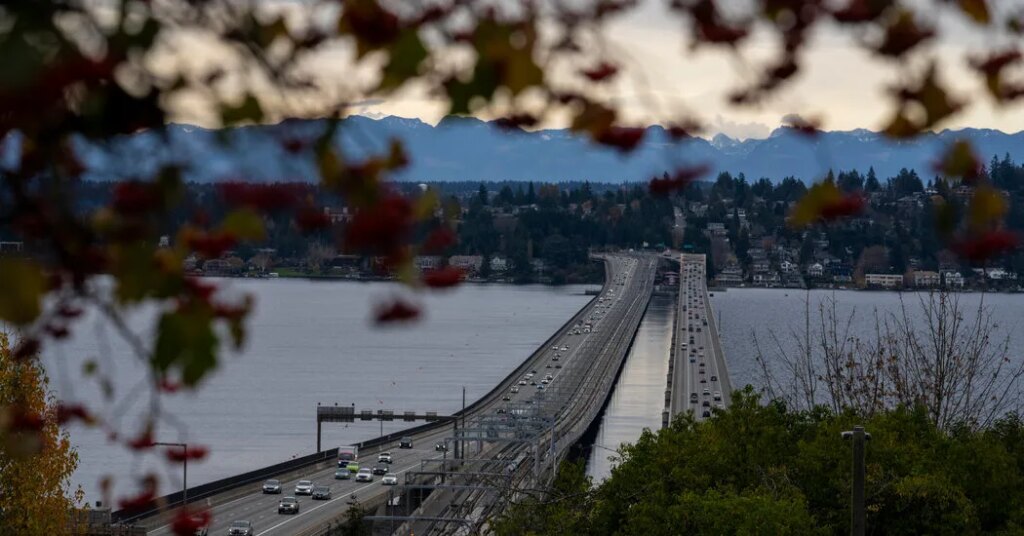
The finding — and the mystery that ensued — threatened to waylay a $765 million engineering marvel overhead, the world’s first floating rail bridge that stretches the region’s light rail system across the 1.5-mile-wide lake.
Since the 1960s, Puget Sound leaders had dreamed of a transit bridge connecting Seattle’s urban core with communities on the east side of the lake, but Seattle-area voters repeatedly rejected rapid transit measures. In 1989, engineers incorporated space for future transit into the Interstate 90 floating bridge over Lake Washington, part of a highway that stretches from Seattle to Boston. But legal battles still kept the trains at bay.
Voters finally approved a sales tax dedicated for transit in 2008, but an engineering challenge remained. More than 200 feet deep in spots, Lake Washington has a soft, muddy bottom that makes support piers impossible, but a floating rail bridge seemed far-fetched. Pontoons pitch and roll with the waves, while light rail requires high-voltage power lines that must stay steadily aligned. And the electrical current used to power light rail can corrode the steel inside concrete pontoons.
Brad Owen, an engineer and executive with the Seattle-area transit authority Sound Transit, said the hardest part of a floating bridge wasn’t keeping it afloat; “it’s the motion that stops you.”
So crews insulated the tracks, invented articulated steel joiners that flex with the water’s motion and dangled dozens of electrical cables — known as anode strings — into the lake to draw stray current safely away from the pontoons.
Some 252,000 people rode the bridge on opening day, waiting an hour or more for the smooth, fast ride and sweeping views of Mount Rainier. Ridership on the line that rolls over Lake Washington has roughly quadrupled, and Seattle residents are so enthusiastic about transit these days that they voted this month to double the city’s transit sales tax, a small portion of which will help Sound Transit’s continued expansion.
“Everybody wants it, they want it to their neighborhood, and they wanted it yesterday,” said Dow Constantine, Sound Transit’s chief executive.
Deep below water, however, lay a problem.
Unlike other recreational divers who head for the brighter, marine-rich waters of Puget Sound, Mr. Eiler prefers to explore the lake’s darkness and its sunken World War II-era airplanes and “modern ruins,” such as collapsed bridges.
He and his diving partner, Shahein Moussavi, were hunting for concrete bridge remnants last fall when they found a stack of dead fish, so neatly placed that “it almost looked like a net had been dropped down and opened,” Mr. Eiler said.
Subsequent dives revealed more than a dozen other mounds of dead perch, carp and chinook salmon — a big problem in a region where salmon are protected by federal tribal treaties. Scavengers like crayfish and sculpin hadn’t touched the carcasses, suggesting whatever killed them was either poisoning the water or generating an electrical field that kept bottom-dwellers away.
Last November, the divers emailed photos of the dead fish to a Washington Department of Transportation worker. When no one responded, Mr. Eiler and Mr. Moussavi in July alerted conservationists and tribal leaders, who pressed state officials to act. This time, the culprit was revealed: The dead fish were all beneath those anode strings dangling from the bridge to help prevent corrosion.
Were the deaths caused by electrical current coming off the bridge’s cables, engineers wondered, or by a chemical reaction between that current and lake-bed sediments?
Anti-corrosion systems are common on floating bridges for cars and trucks, and engineers and planners assumed the low-voltage current generated by the light-rail bridge wouldn’t cause a problem. They also initially didn’t include plans for routine underwater inspections because the anti-corrosion cables could be pulled out for safety checks.
Nothing in the planning “indicated that this system should not work,” Mr. Constantine said.
This fall, state and tribal biologists and engineers tested both the fish and the water and determined that resting the anodes on the lake’s bottom silt had created concentrated, localized electrical fields strong enough to stun or kill fish. That explained both the lack of visible injuries on the carcasses and scavengers’ reluctance to eat them. Sound Transit lowered the voltage coming off the cables, lifted lines that had been resting on the lake bed and began installing protective cages around the anodes, adding several million dollars to the cost of the bridge.
In all, Sound Transit says around 2,000 fish died, mostly invasive species rather than salmon.
When Mr. Eiler and Mr. Moussavi dived under Lake Washington again a few weeks ago, they found what they had hoped for. No stacks of dead fish and plenty to explore.
The post This Seattle Engineering Marvel Hid a Mystery: Pyramids of Dead Fish appeared first on New York Times.