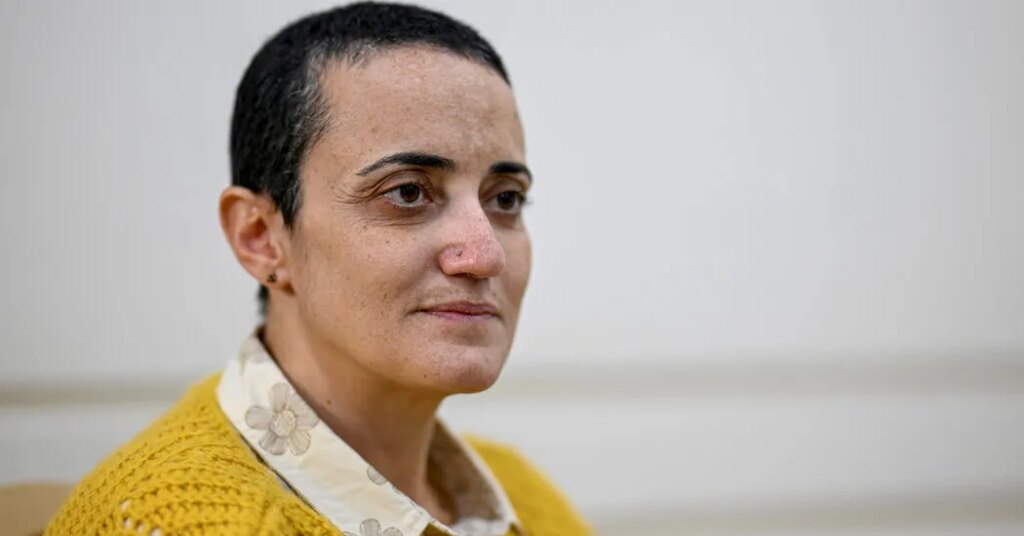
Lina Attalah, one of Egypt’s leading journalists, is facing a prison sentence. A court has ordered the news website she runs to close. Several journalists she mentored have been jailed, and they say they were tortured.
Yet the woman who has become the face of the Egyptian independent news media’s struggle to survive has not lost hope for free speech in the Arab world’s most populous nation.
“We live in a moment of madness — not just here, but a moment of global madness, in some ways,” Ms. Attallah, 44, said in an interview in the garden of the tranquil Cairo villa where her news outlet, Mada Masr, is based.
“I’d like to believe that in the midst of madness, there is enough wisdom not to lock everything up, not to close the space completely,” she said.
Egypt is in the throes of an intensifying crackdown on press freedom, rights and media monitoring groups say, narrowing the already constrained space left to independent journalism. Ms. Attallah is on the front line of that fight.
Last month, after a one-day trial, a court ordered Mada Masr to close and fined it three million Egyptian pounds, about $53,400, for running an unlicensed website. Mada Masr said that it has repeatedly applied for a license, but that its requests were rejected or ignored.
Ms. Attalah paid the fine and filed an appeal. While she was doing so, the authorities informed her that she had also been tried in 2024 by another Cairo court in absentia — despite living in the city.
Without being informed of the trial or detained, she said, she had been convicted on charges of publishing false news and running an unlicensed website. The authorities told her she faced a one-year prison sentence, and a fine of two million Egyptian pounds.
Ms. Attalah returned to court this week to seek a retrial for herself and to challenge the closure of Mada Masr. The cases are ongoing and are seen as a test of whether an independent press can survive in Egypt.
“What happened to Mada Masr makes us feel that a real and imminent danger is yet again knocking on our doors,” said Mohamed Salah, the editor of Fakar Tany, a small independent outlet. Most independent news organizations, including his, he said, had also been unable to obtain a license to operate.
The Egyptian authorities declined to comment on Ms. Attalah’s case. They pointed to a 2023 statement that said Egypt’s media regulator had referred Mada Masr’s case to a criminal court, both because of the licensing dispute and for “publishing false news without verifying its sources, misleading the public, and harming national security.”
International media monitoring groups rank Egypt among the lowest in the world for press freedoms. The Committee to Protect Journalists says Egypt has one of the highest numbers of jailed journalists, with 25 in detention.
The villa where Mada Masr operates is hidden behind high walls and shaded by a mango tree, an oasis from the frenetic, traffic-jammed energy of Cairo. The calm belies the risks that Ms. Attalah and her colleagues are grappling with.
The reporters that gather there are no longer editing articles or debating story ideas. Since publishing was suspended, they instead come to share breakfast and find comfort in each other’s presence, Ms. Attalah says.
Our interview with her last week was interrupted with goodbyes and hugs from reporters for her before her trial date. “I will see you well,” she told them, offering a typical Egyptian farewell that felt especially poignant.
Ms. Attalah refuses to contemplate what she would tell her colleagues were her prison sentence to be upheld. “I really don’t want to go there,” she said, shaking her head. “I shouldn’t go there.”
Rights groups say the new media crackdown began in September, when the authorities arrested the entire newsroom of Matsaddash, a small fact-checking publication. Several of its six journalists said they were tortured by security forces and forced to give fake confessions, according to a statement by the Egyptian Initiative for Personal Rights, a rights group whose lawyers represent them.
The Egyptian authorities has “categorically denied” the torture claims. They have accused the outlet and its journalists of being affiliated with the Muslim Brotherhood, an Islamist movement, and of publishing “false news and distorting facts.” The Muslim Brotherhood was banned after the army overthrew Mohamed Morsi, the country’s first democratically elected president and one of the group’s leaders, in 2013. Matsaddash has denied any affiliation.
Ms. Attalah said what happened to them made her hesitant to encourage up-and-coming journalists to carry on in her stead.
“Right now, I have nothing to say but offer a full commitment to try to come back for them, and for others,” she said.
After Mada Masr came under attack, international institutions, including the United Nations and the European Union, began to condemn the crackdown. “Journalists must be able to carry out their essential work free from intimidation and reprisals,” Thameen Al-Kheetan, a spokesperson for the U.N.’s human rights chief, said this month.
Mada Masr was founded in 2013, two years after the Arab Spring protests that toppled Egypt’s then president, Hosni Mubarak. Later that year, after the army chief, Abdel Fattah el-Sisi, seized power and ousted Mr. Morsi, independent media outlets quickly came under pressure. Mr. el-Sisi has been president ever since.
Over more than a decade, media monitoring groups say, state-linked conglomerates have taken control of many Egyptian outlets.
“Mada was a child of crisis,” Ms. Attalah said. Its founders sensed that “the politics of rule were going to be changing, and there needed to be the work of independent, brave journalists to engage with that and create a record for it.”
The court cases that Ms. Attalah and Mada Masr face now are not their first run-in with the authorities. The outlet has been blocked in Egypt since 2017 and the police raided its offices two years later, arresting several of its journalists. Ms. Attalah said she had no clear explanation for what sparked the current crackdown. Nor did other Egyptian journalists interviewed.
Hossam Bahgat, the executive director of the Egyptian Initiative for Personal Rights, said the government’s actions were unusual compared with previous efforts to curb the independent news media, which had come in response to specific articles. “That is why this crackdown is so dangerous,” he said. “It’s a crackdown on the practice of independent journalism itself.”
Mr. Bahgat, who was in the courtroom with Ms. Attalah during the trial when Mada Masr was ordered to close, said the hearing was “shocking.”
The judge largely emptied the courtroom after refusing to hear the defense team’s plea. Then, according to both Mr. Bahgat and Ms. Attalah, the judge brought in a new attorney whom Ms. Attalah did not know, and appointed him to represent her. A statement from the country’s top judicial body said that the move was “not an infringement,” and had been done because the defense had refused to accept the case filings that the court planned to use.
Ms. Attalah said that when she loudly objected to the appointment, police officers handcuffed her and removed her from the courtroom. She was pulled her away with one arm, she said, while her lawyers pulled on the other, trying to keep her in the courtroom.
The tug of war became so painful, she said, that she called out to her lawyers: “It’s OK. Let me go.”
The judiciary’s statement said that it “categorically rejects attempts to cast doubt on the integrity of the Egyptian judiciary and undermine its prestige.”
Once Ms. Attalah was removed, the judge ordered the three million pound fine, and said that it would have to be paid up front to secure her release, according to Mr. Bahgat.
Journalists, activists and readers of Mada Masr instantly mobilized across the city to raise the money, he said. Some called relatives for loans, others turned up at the courthouse with plastic bags of cash, Ms. Attalah added. Mr. Bahgat described seeing crowds of people lining up at A.T.M.s outside the courthouse and maxing out their daily withdrawals.
“It just shows how much people feel this is a project they own, not just a news outlet they read,” Mr. Bahgat said. “It’s a fight to keep them alive.”
Within two hours, they had collected the money and secured Ms. Attalah’s release — for now.
Ms. Attalah could move her work abroad, but she says she has no intention to go into exile.
For journalism to survive in Egypt, she said, “There have to be institutions, like Mada.”
What that looks like after these cases, however, she does not know. “It’s going to be challenging,” she said. “But we have to find a way.”
The post A Journalist Fights for Free Speech in Egypt, and to Stay Out of Jail appeared first on New York Times.