Locked in a bitter legal fight with New York education officials, a school district in a Republican stronghold on Long Island made a direct plea to President Trump: Help us save our beloved Chiefs mascot from a statewide ban.
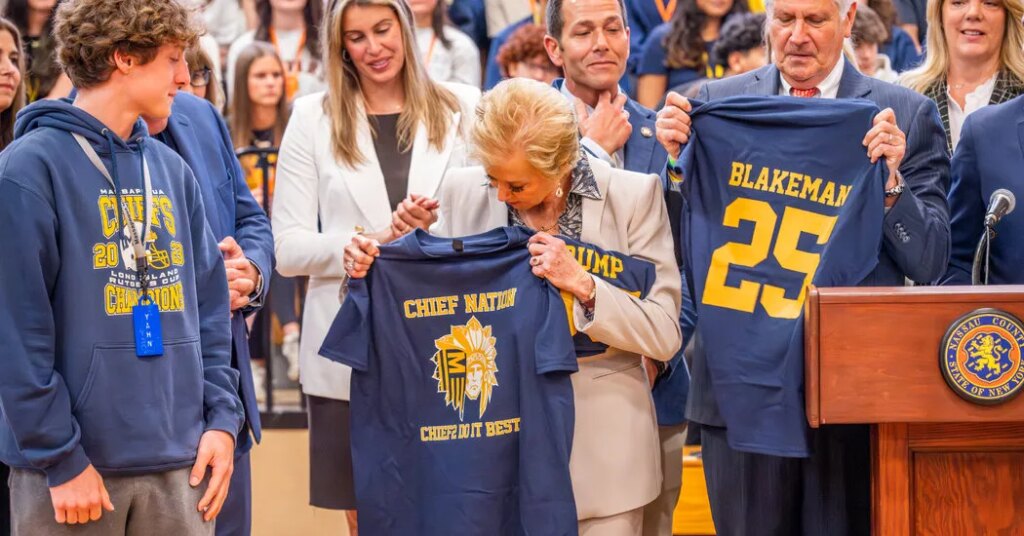
The president listened. Over 39 days last spring, Mr. Trump announced his support for the district, the Massapequa Union Free School District, on social media and ordered his education secretary to “fight for the people of Massapequa.” He held up a Chiefs sweatshirt in the Oval Office.
Then the federal Education Department opened a civil rights inquiry, sent the secretary, Linda McMahon, to a pep rally in Massapequa, a coastal hamlet in Nassau County, and wrapped up the investigation. It concluded that the state’s ban had discriminated against Native Americans.
That dizzying series of events breathed new life into a faltering lawsuit brought by the school system, challenging a state Board of Regents regulation that bars school mascots using names derived from Native American culture. After a federal judge dismissed the district’s claims last December, the Trump administration’s findings became central to its appeal: If Massapequa complied with the ban and removed the century-old Chiefs logo, the district said, it would be violating federal law.
Now, the New York State Education Department is accusing the federal agency’s Office for Civil Rights of conducting a politically motivated rush job and of stonewalling its efforts to uncover how the rapid-fire inquiry came together. State officials filed a Freedom of Information request about a year and a half ago for documents about the origins of the inquiry and the evidence the agency considered. Nothing has been released, the state said.
“While the extent to which O.C.R. employees hastily conducted an investigation to appease the president or Massapequa may be embarrassing, it is not a valid reason to withhold public records,” Daniel Morton-Bentley, the deputy commissioner for legal affairs at the state’s education agency, wrote in a letter this month.
In the letter, Mr. Morton-Bentley issued an ultimatum to his federal counterparts, warning that New York would sue if the documents — including records sought in three other requests — were not released within 30 days. A few days later, the state stood down, at least for now, after the department replied that it could provide all the documents by next August.
The department had operated “like a political arm,” Mr. Morton-Bentley argued. “They never made the pivot from campaigning to governing,” he said in an interview.
The dispute over school mascots is the latest flashpoint in a series of clashes in recent years involving New York education officials, Massapequa and the Trump administration. Massapequa battled the state over a mask mandate during the coronavirus pandemic and is fighting another lawsuit with the state over the district’s policy requiring students to use bathrooms that align with their sex assigned at birth.
Under Mr. Trump, the federal government has set out to reshape policy in America’s colleges and school districts, which the president has long derided as bastions of progressive orthodoxy. Despite pledges of returning education to the states, Mr. Trump and his administration have waded into local issues often ignored by past administrations, pursuing investigations and lawsuits that invert the original purpose of the country’s civil rights laws.
The Education Department denied that it politicized investigations and blamed the delays on a backlog of Freedom of Information requests left by the Biden administration. The department has received about 200 requests per month this year. They include the requests from New York and just one other state agency, records show.
A department spokesperson said agency officials “uphold the rule of law and vigorously enforce” the protections of Title VI of the Civil Rights Act of 1964, which prohibits recipients of federal funding from discriminating based on race, color or national origin.
The state education agency first encouraged schools to abandon Native American names and imagery in 2001. The directive was largely ignored.
The Board of Regents formally prohibited them in 2023, amid a nationwide push to remove logos with racially insensitive images or words. Districts that do not comply could lose state funding. (The board next month is expected to repeal part of the regulation that has prohibited school employees from promoting Native American imagery or words on campuses.)
When New York’s ban was enacted, about 60 school districts were still using Native American-inspired mascots and logos. At least one district, the Salamanca City Central School District in the state’s Southern Tier, has kept them after receiving approval from a local tribe.
Just two districts have defied the ban, the state said. They are Massapequa, whose town’s name is derived from a Native American word that means “great water land,” and Connetquot Central School District, also on Long Island. Connetquot did not respond to a request for comment.
Images of Massapequa’s mascot — an illustrated side profile of a Native American man wearing a feathered headdress — adorn school campuses, welcome signs and athletic fields. Of the district’s 6,500 students last school year, four identified as Native American, according to state records.
The Massapequa Board of Education said that state education officials were trying to erase Native American representation in New York schools. In a statement, the board noted that a federal district judge had mentioned in the order dismissing the case that the ban “may have serious constitutional defects.”
“Rather than confront those concerns,” the board said, “the state is attempting to shift the narrative to politics.”
At a hearing this month, a federal appeals court panel appeared skeptical of Massapequa’s claim that the Trump administration could take action against it if the district abandoned the Chiefs logo. The federal government has supported the district in its fight, two judges said.
The federal government’s 2025 findings on the mascot ban pointed out that New York had not prohibited mascots that were derived from other racial or ethnic groups, such as the Dutch, the Huguenots and the Scots. To settle the case, the Office for Civil Rights asked the state to rescind the mascot ban and to apologize to Native American tribes.
The state objected to the terms but said it would be willing to work with the Education Department on broadening the mascot regulation. The federal agency called the state’s response unacceptable and referred the case to the Justice Department for enforcement action. No action has been taken, and the Justice Department did not respond to a request for comment.
Michael C. Bender contributed reporting.
The post New York and Trump Officials Locked in Unlikely Clash Over Mascot Ban appeared first on New York Times.