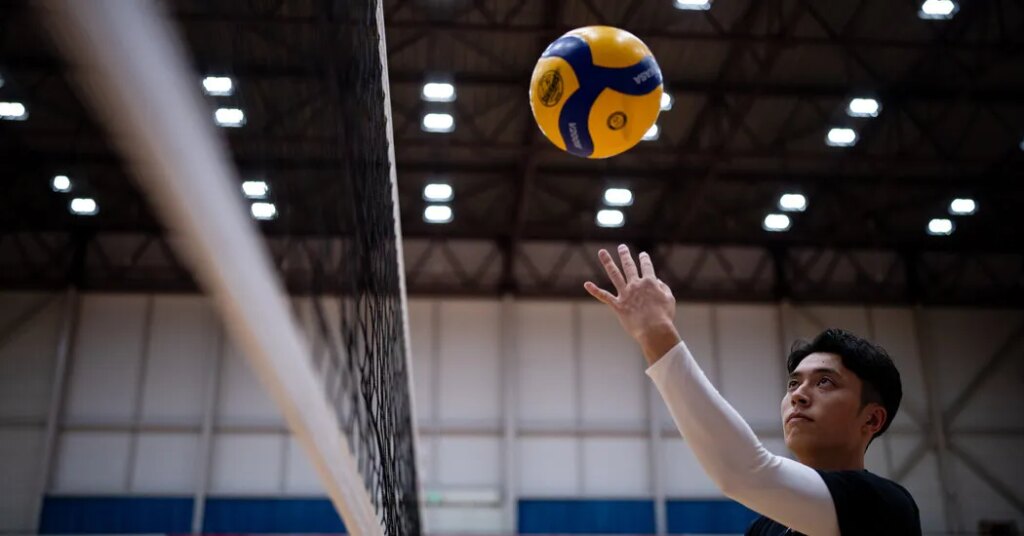
Rui Takahashi was nervous.
For years the professional volleyball player had lived with a secret: He is gay. In Japan, where gay men and lesbians often struggle to be accepted, he worried that coming out could end his career.
But now, after months of conversations with his family, friends and managers, Mr. Takahashi, 26, had resolved to speak up. On a quiet September night, he broadcast a message for his fans on a radio program.
“I would like to share something with you all today,” he said. “I want to let you know that I am a sexual minority — specifically I am gay. Ever since I was a teenager, I have struggled with this. I am 26 years old now, and for a long time — since I was young — I viewed this part of myself in a very negative light.”
The next morning, Mr. Takahashi avoided looking at his phone, worried he might be criticized for opening up about his sexual orientation. But when he did look, he was surprised to see a flood of rainbow and heart emojis and comments like “Proud of you” and “Cheering you on!”
“I didn’t know how things would turn out, and I thought about the worst-case scenario — that I might even have to quit playing volleyball,” he said in a recent courtside interview after practice with his team, the Suntory Sunbirds, at their training center in Osaka.
Mr. Takahashi is one of only a few professional athletes in Japan who have come out in recent years; the news media has described him as the first male athlete to do so. In Japan, volleyball has a wide following, particularly among women, and some games receive heavy television coverage. Star athletes like Mr. Takahashi are often treated as pop idols, garnering millions of fans online and endorsement deals.
Mr. Takahashi’s decision caused a stir in Japan, where gay, lesbian, bisexual, transgender and queer people often face intense pressure to conceal their sexuality. Many fans have praised his courage, while some conservative commentators have said he should have kept his personal life private.
Japan is the only Group of 7 country that has not legalized same-sex unions, and sexuality is rarely discussed in depth in schools, business, government and the news media. Japan ranks second to last in gay and transgender rights among the nearly 40 wealthy nations in the Organization for Economic Cooperation and Development, according to a 2020 study. Only a small number of pop stars and other celebrities have come out in recent years.
In the sports world, with lucrative player contracts, sponsorships and fan followings hanging in the balance, the situation is especially uncompromising. Japan has never had an openly gay man or lesbian athlete on its national teams, even as participation by L.G.B.T.Q. athletes in the Olympic Games has reached record levels.
Nanae Takizawa, a former volleyball player, came out as a lesbian in 2017 after she had retired from sports, one of the first Japanese athletes to do so.
In an interview, Ms. Takizawa, 39, praised Mr. Takahashi, saying he could help people who felt trapped because of strict societal expectations.
“I hope he will make a positive impact not just on the sports community,” she said, “but on all of Japan.”
At the Sunbirds’ opening game in late October, the first since he had come out, Mr. Takahashi stepped nervously onto the court. “It took a little bit of courage,” he said.
He was not sure what it would feel like to face his fans again. But he was almost immediately greeted with roaring applause. When he scored an ace, his fans cheered again, even louder than usual.
“Not a single person turned away from me,” Mr. Takahashi said. “Rather, I felt that the fans who had been supporting me up until then were supporting me even more.”
Mr. Takahashi was born in Kyoto. His father, a baseball fan, named him Rui after a Japanese baseball term that translates as “base running.” His brother, Ran, who is now a star volleyball player for LKPS Lublin in Poland, got his name from the Japanese phrase for “home run.” (The two brothers are close and run a YouTube channel together, chronicling their adventures shopping for clothing in Kyoto, eating Wagyu beef and visiting hot spring towns.)
Rui fell in love with volleyball when he was about 8, inspired by Megumi Kurihara, a player for Japan’s national team. As he watched the intrepid Ms. Kurihara, who was known as Princess Meg, on television one day, he recalled thinking, “This is my life.” He and his brother started practicing immediately at nearby parks and gyms and joined the elementary school team.
Volleyball became a “very precious thing,” Mr. Takahashi said. It helped him escape some of the questions about his sexuality that began to emerge as a teenager.
“I was able to forget everything when I was playing,” he said.
Mr. Takahashi set aside his questioning, hoping that by 20, his attraction to men would simply vanish.
“When I was in my teens, I told myself I was going to take this to the grave,” he said. “I used to think, ‘Man, I wish this would just be cured when I wake up in the morning.’”
But after graduating from Nihon University in Tokyo in 2022 and joining the Sunbirds, he couldn’t shake a nagging feeling. In 2024, when he had his first relationship with a man, he decided to come out to his brother, Ran, and a cousin. Ran responded with a simple phrase: “omoshiroi,” or “interesting,” Mr. Takahashi recounted.
He spent the next two years having in-depth conversations with his family and friends about his sexuality and his career.
At one point, he reached out to Ms. Takizawa, who had come out almost a decade earlier, sending her a message on Instagram saying he felt he was in her “exact same situation.” They met in a Tokyo restaurant, where she reassured him that he would thrive after coming out.
“Slowly,” Mr. Takahashi said, “my negative feelings were transformed into positive ones.”
Mr. Takahashi began to feel a sense of urgency and he vowed to come out before he turned 30.
“Time is the one thing that never comes back, and I really hated the thought of losing more of it,” he said. “Once I felt I wanted to speak out, I just wanted to say it right away.”
Still, he worried that his decision could create trouble for his brother, who played for the Sunbirds before starting a global career. And he was not sure how his coaches, sponsors, teammates and fans would take the news.
But on Sept. 29, he went forward with his announcement.
Ms. Takizawa messaged him almost immediately: “You finally said it!” she told him. His brother reposted his announcement, saying “Rui is Rui  .” His decision received global attention. Douglas Souza, a prominent Brazilian volleyball player who is gay, wrote in a social media post: “Different countries, different cultures, but the same sport and some of the same battles. You are not alone.”
Mr. Takahashi’s teammates rallied behind him. Over dinner one night at a favorite yakitori restaurant in Osaka, Mr. Takahashi invited his fellow players to ask him anything, hoping to eliminate any awkwardness. They asked when he first realized he was gay and how he approached the decision to come out.
During a lighter moment, Taishi Onodera, the captain of the Suntory Sunbirds, asked Mr. Takahashi what type of men he liked — the adorable type or handsome type?
Mr. Onodera said he had come to better understand the difficulties Mr. Takahashi faced in coming out. Mr. Onodera said he initially worried that Mr. Takahashi could be affected by any online criticism of his decision. But he found that he was undeterred and full of energy.
“I realized he must have been carrying a lot inside himself, and it couldn’t have been easy,” he said. “But if Rui himself feels relieved and lighter by making it public, then that’s a good thing. Nothing changes between us — we will keep playing volleyball together as teammates just like always.”
Mr. Takahashi has continued to be a force on the court. He is currently single, though he said he now feels “I’m in a place where I can accept and embrace love openly.”
He said he does not plan to use his platform to push for greater L.G.B.T.Q. rights in Japan, but hopes he can inspire others. Friends have started opening up to him about their own personal struggles, not just related to sexuality.
“First and foremost, I just want to show people my authentic self,” he said. “From here on, I want to enjoy my life even more.”
The post A Japanese Volleyball Player Breaks a Taboo appeared first on New York Times.