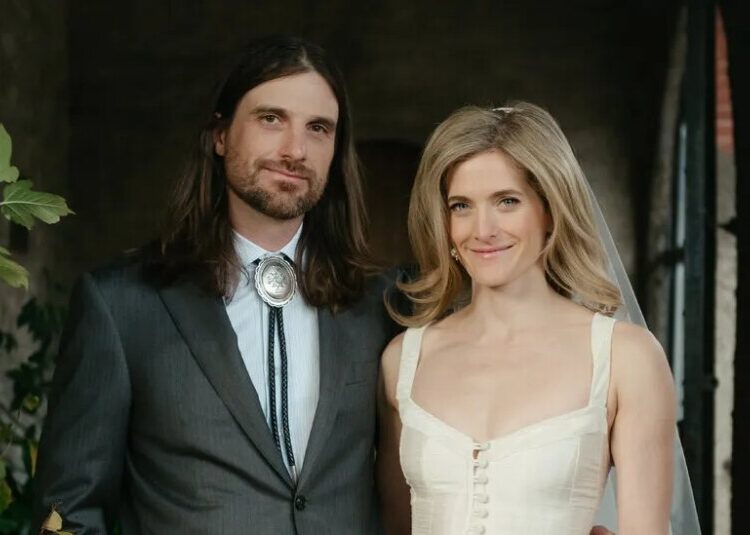
Janice Ewurama Gyede Aduhene had left her glasses at home the night she met Michel Ohene Manor Kwarteng at Aria, a lounge bar in Accra, Ghana, two years ago.
“I was sipping my champagne, and I couldn’t really see him,” Aduhene said. “I could just see teeth. But I thought he was cute just from the teeth.”
After Aduhene’s friend told Kwarteng that Aduhene was interested in him, he came over to chat. The two talked about their work, pulling up the Instagram accounts for their respective businesses to show each other what they did.
“She was somebody who could understand me deeply, straight from the first conversation,” Kwarteng said.
Soon they were holding hands, which Aduhene said was unusual for her, as she is not a touchy person. By the end of that evening on Dec. 16, 2024, the two had exchanged phone numbers, and a couple of days later, Kwarteng invited Aduhene on a first date.
Kwarteng, 35, was born and raised in Saint-Denis, a suburb of Paris. Growing up, he often visited Accra (his mother is from Konongo and his father is from Bodomasi), during his summer vacations. He has a two-year postsecondary diploma in communication and a master’s degree in global communication strategy and brand identity from CESACOM in Paris. In 2023, Kwarteng moved to Accra permanently. There, he works as the director at Lika Health, a pharmaceutical products distributor, and as the chief executive at Femino Health Clinic, a private gynecological medical center in Accra.
Aduhene, 29, was born in London and moved to Accra with her family when she was about a year old. At 15, she relocated to Bloomfield Hills, Mich., to attend a boarding school. She studied at the University of South Florida in Tampa, then transferred to Boston University, where she received a bachelor’s degree in electrical engineering. After working for a few years as an electrical engineer, she received an M.B.A. from Carnegie Mellon University. In April 2024, Aduhene decided to pivot to fashion and opened a resort wear company called Nysama.
When Aduhene arrived at Kanvas, a global fusion restaurant in Accra, for their date on Dec. 27, Kwarteng opened her car door and offered his hand as she stepped out.
“I thought that was so gentle and caring,” Aduhene said.
Over dinner, Aduhene learned that Kwarteng has an identical twin, grew up in France and was a rapper in his youth. For years, Aduhene said she’d had premonitions about the man she would marry, and the details Kwarteng shared that evening aligned with what she had imagined.
“I knew from the first date he would be my husband,” she said.
At the time, Aduhene was several months into running the clothing line. Having sold only about 10 items in six months, she was feeling “really down about the business,” she said.
As she and Kwarteng began dating, she opened up to him about her insecurities about the brand, including her fear that she would always be an engineer first and fashion designer second.
“He made me feel that it’s OK to want what I want,” Aduhene said. “I started feeling who I was in that space, and like I could take up space. He saw my talent and my strength.”
Kwarteng offered to help refine her brand presentation. Together with his twin, Richard Kwarteng, he helped Aduhene revamp the Instagram account, find the right photographers to shoot her products and define Nysama’s identity.
“We were advertising clothes and not a universe,” Aduhene said. “Putting the clothes by the beach created the feeling of luster. That’s what really started taking things off the ground for us.”
Aduhene inspired Kwarteng, too. She told Kwarteng about some of the challenges she had observed in women’s health care in Ghana. Kwarteng became interested in health care after surviving a serious car accident in 2012 and a difficult recovery in his 20s. After learning about Aduhene’s experiences, he decided to start Famano Health, a line of health care products for women as part of Lika Health, in 2025.
Binge more Vows columns here and read all our wedding, relationship and divorce coverage here.
“We’re always discussing ideas and bouncing them off each other,” Aduhene said.
As their relationship progressed, Aduhene stayed at Kwarteng’s apartment more often, though couples in Ghana are discouraged from living together before marriage.
“He would even say, ‘Go back home,’” Aduhene said. “I would always be like, ‘No, I want to stay.’ One day, I just stayed, and we stopped speaking about it.”
Once they were living together, Aduhene and Kwarteng discovered their shared love of interior design.
“We spend a lot of time together discovering artists, doing research on this stone or that leather, getting the details right,” Kwarteng said.
In the time they’ve known each other, Kwarteng has bought several apartments to rent out on Airbnb, and Aduhene has helped him decorate them. “Our system is that he chooses the huge things, like the rugs, the couches, the paint color, and I do the finishing touches,” she said. “Everything that makes it feel like a home.”
In the fall of 2025, Aduhene and Kwarteng were in Paris for Ashantis Gala, an event that Kwarteng and his brother organize every two years to celebrate African culture and traditions. The day after the gala, Oct. 5, Kwarteng took Aduhene to lunch at one of his favorite restaurants, Monsieur Bleu. During the meal, he went outside to secretly grab the engagement ring and flowers his brother was holding.
Back at the table, Kwarteng bent on one knee and asked Aduhene to marry him. Afterward, a friend photographed them at several locations around Paris, and Kwarteng and Aduhene celebrated with a dinner at Mūn Paris, an Asian fusion restaurant.
On Nov. 10, Aduhene and Kwarteng were married by Michael Kwabena Gyamfi, the deputy director of administration at Accra Metropolitan Assembly, where the marriage took place, with Kwarteng’s brother and his mother, Doris Asare Kwarteng, and Aduhene’s mother, Grace Aduhene, and her father, Kojo Aduhene, as witnesses.
“It was short, it was sweet, we legalized it,” Aduhene said.
A few days later, on Nov. 14, Aduhene and Kwarteng celebrated their union with about 400 guests at Aduhene’s parents’ house in Accra. The day started with a traditional ceremony in the early afternoon, following the customs of the Ashanti, an ethnic group in Ghana to which Kwarteng belongs. (Aduhene is part of the Fante group.)
“Michel entered with lots of drumming and dancing,” Aduhene said. “The dance style is called Adowa.”
As part of the ceremony, Kwarteng’s family brought gifts, and Aduhene’s father asked her whether her family should accept them.
“He has to ask three times,” Kwarteng said. “After the third time, we consider that the family has accepted the gifts, and now we are bonded and have become one family.”
After the Ashanti ceremony, a Catholic priest prayed over the wedding rings before Kwarteng and Aduhene exchanged them.
Following the ceremony, the guests moved on to a cocktail party, dinner and reception in different parts of the house.
“There are so many countries between the two of us, so for the wedding, it was important to not just focus on the Ghanaian culture but find a way to fuse different cultures we’ve experienced,” Aduhene said.
The dinner menu featured a mix of European and Ghanaian dishes, including jollof rice, goat soup, battered hake and squid, and niçoise salad. During the reception, the performers included a Ghanaian gospel choir and a popular Ghanaian Afrobeats musician named King Promise.
“He brought us out to the song of his we both love, called ‘See What We’ve Done,’” Aduhene said. “It was really lovely.”
The after-party took place on the roof of the house, where guests could snack on kebabs, a popular late-night food in Ghana, and fried yams and potatoes served with local pepper sauces. One bar served drinks like mojitos, while the other offered Ghanaian drinks, like a cocktail with herbs, spices, ginger and akpeteshie, a local liquor, and Coco Roco, a hibiscus slushie.
By the time the party wrapped up at 1:30 a.m., the bride and groom, who had started their days at 5 a.m., were exhausted.
“It was nearly 24 hours of being awake and alert,” Aduhene said, “but it was awesome.”
On This Day
Where Accra, Ghana
When Nov. 14, 2026
Make It Couture As a fashion designer, Aduhene knew she wanted to design and make her own dress. The process took about a year and involved artisans in Ghana and India. “The dress was centered on a bloom theme,” she said. “There was a beautiful flower bodice with intricate embroidery.”
Symbolic Cloths Kwarteng wore a kente, a traditional West African cloth, that took about four months to make by hand. The cloth incorporated two symbols: two crossed swords that stand for courage and four hearts joined at the center, a nod to the unification of the families.
Ethereal Tunes During the cocktail hour, a singer performed atop a platform inside the pool as a quartet played in the background. It looked like she was “floating in the swimming pool,” Aduhene said. Later, the couple stood on the same platform to cut the cake. “All our friends and family were cheering us on,” Aduhene said. “It felt like a scene out of a movie.”
The post Her Vision Was Blurry, but Their Connection Was Clear appeared first on New York Times.