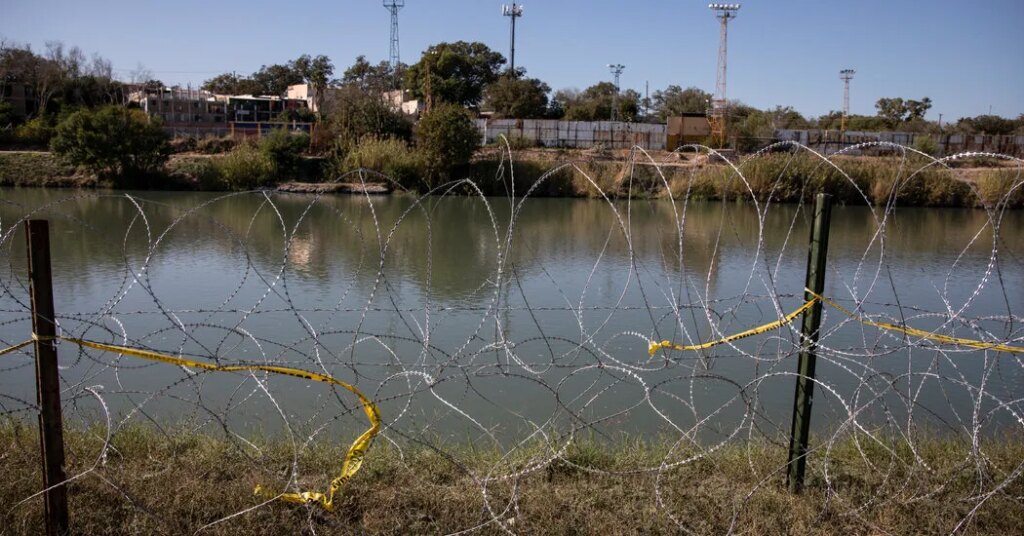
For three years, the federal government has been locked in a lawsuit with the State of Texas over whether federal agents can legally remove razor wire the state erected along a section of the southern border to discourage border crossings.
The lawsuit began under the Biden administration, when Republican state officials sued, claiming that border patrol agents were routinely cutting through concertina wire that the state had strung along a section of the border near Eagle Pass, Tex.
On Wednesday, the two sides alerted a federal judge that they wished to dismiss the case, after they reached an unusual legal settlement to end the dispute. The Trump administration has agreed with Texas’ outgoing state Republican leaders that both sides will be barred from removing razor wire along the Del Rio sector of the border — between Laredo and Big Bend, Tex. — for the next 30 years.
The extraordinary arrangement comes less than two months before Texas’ Republican governor, Greg Abbott, and attorney general, Ken Paxton, will be replaced by Democrats who won the November election.
It was the latest example of a legal tactic that the Trump administration has used repeatedly, in which the administration has reached settlements with friendly adversaries, with both sides agreeing to limit the government’s powers far beyond their time in office, locking in shared political goals.
Democrats decisively swept into nearly every statewide office in Texas during the midterm elections. But the settlement, signed on Nov. 19, would bar “all successors” to the officials named in the document from removing concertina-wire barriers, except in narrow circumstances.
That would include future senior officials in the Justice Department and the Homeland Security Department no matter who wins the presidency in future elections, as well as Gina Hinojosa, Texas’ incoming Democratic governor, and Nathan Johnson, who will become attorney general. It also applied to subcontractors and “all those in active concert and participation” with the government.
Spokesmen for Ms. Hinojosa and Mr. Johnson declined to comment this week. But Tom Jawetz, a former deputy general counsel at the Homeland Security Department, said Mr. Abbott and Mr. Paxton “simply gave away the state’s ability to decide what to do with all of this concertina wire that it owns.”
Mr. Jawetz, who served under President Joseph R. Biden, said he worried the agreement would make it harder for Border Patrol agents to save people drowning in the river.
“There is no reasonable justification for tying Texas’ hands to mitigate those dangers or to otherwise decide to remove its own razor wire,” he said.
The Justice Department, Mr. Abbott and Mr. Paxton did not respond to requests for comment.
Mr. Paxton’s office sued the federal government in 2023, claiming that border patrol agents under former Mr. Biden had unlawfully cut Texas’ concertina wire. The state alleged that immigration agents were working “to encourage and assist thousands of aliens to illegally cross the Rio Grande and enter Texas” by destroying the barriers.
The lawsuit followed a power struggle between the state and the federal government amid a wave of immigration, in which thousands of people crossed the Rio Grande and arrived in Eagle Pass over the span of several days. The Homeland Security Department argued that agents handling the surge needed the authority to cut the wire to gain access to the riverbank, particularly to process crowds and respond to emergencies.
A number of migrants drowned while crossing in the weeks before the lawsuit was filed, and border patrol agents rescued dozens of people as the surge grew.
Judge Alia Moses, a Federal District Court judge in the Western District of Texas, sided with the Biden administration. While she harshly criticized the Biden administration’s immigration policy as chaotic, and “dysfunctional and flawed” she nonetheless found that immigration officials handling border enforcement had not broken the law by cutting through the state’s concertina wire.
The decision was initially reversed by the Court of Appeals for the Fifth Circuit in December 2023, largely barring the federal government from removing the wire. But the next month, the Supreme Court sided with the Biden administration on an emergency basis, agreeing in a 5-4 vote that the federal government could keep cutting the wire as litigation over the issue proceeded.
The federal government has been barred from removing the wire since November 2024, after a three-judge panel of the Fifth Circuit again sided with Texas by a 2-1 vote.
In the joint filing on Wednesday, the Justice Department and attorneys for Mr. Paxton and Mr. Abbott asked Judge Moses to dismiss the case, in light of the settlement agreement.
Under the agreement, both sides agreed the wire could still be cut or removed in some limited circumstances, including to “administer emergency aid” to help someone facing “imminent death.” But it will otherwise bar not only the federal government but also all future state officials from cutting, removing or interfering with dozens of miles of concertina wire the state laid during Mr. Abbott’s tenure.
The only apparent exception under the agreement would be if Texas officials removed existing wire with the “prior written consent” of the Homeland Security Department.
Judge Moses, an appointee of former President George W. Bush, now has 60 days to decide whether to accept the settlement and dismiss the case. If she does, the court would be assigned to enforce the settlement. If Judge Moses declines to dismiss the case or to maintain jurisdiction, the agreement would be void.
The settlement was signed on the Trump administration’s side by Stanley Woodward Jr., the third most senior official at the Justice Department. It came after months of legal jockeying by Mr. Abbott and Mr. Paxton over which of them should sign on behalf of the state.
In a filing in August, lawyers for Mr. Abbott moved to intervene in the case, arguing that only the governor could “bind Texas in agreements with the United States.” Mr. Paxton’s office resisted the change, indicating that the attorney general’s office had the power to ink the deal.
“The only reason that this settlement has not been finally memorialized and the case resolved has been the efforts of the general counsel of the governor to involve himself in a case in which the governor is not party,” Mr. Paxton’s office wrote in a filing in September.
Ultimately attorneys for both men signed on to the final document.
The agreement mirrored several others in which the Trump administration signed binding settlements with ideological allies in Texas and Florida. While some legal experts have criticized the arrangements as collusive, Republican-appointed judges have approved such agreements and agreed they could be enforced by the courts, if either the federal government or the state strays from the terms of the settlement in the future.
In February, the Trump administration entered into a consent decree with Florida, in which the Department of Homeland Security gave up one of its authorities to admit immigrants for 15 years.
Last year, Mr. Paxton also settled with the Trump administration to invalidate a Texas law that allowed undocumented migrants to pay in-state tuition at public universities. The settlement meant the law, which had been adopted on a bipartisan basis, was dissolved, even though the Texas legislature had tried and failed to repeal it.
The post Border Barrier Cannot be Removed for Decades, Texas Republicans and D.O.J. Agree appeared first on New York Times.