My mum was the first in her family to attend university. Her grandfather had been a farmer, her father a carpenter. She became an engineer. Education, she always told me, had given her wings.
This postwar experience of education being an engine of social mobility was common for members of her generation. It has been a central tenet of the social contract in countries around the world: If you study hard, you and your children will be better off. But that promise no longer holds in the same way. Today, my colleague Amanda Taub writes about what has gone wrong, and why this moment is so volatile as a result.
A degree? It’s not what it used to be.
By Amanda Taub
In many ways, France and India could hardly be more different. But the monumental protests that have shaken both countries this fall have one striking similarity. They have been led by students who have revolted in response to the failed promises of education.
In India, students took to the streets after the government abruptly canceled the results of a medical-school admissions exam because test questions had been leaked online, forcing everyone to take the test again. Young people across the country saw the scandal as emblematic of a broken education system.
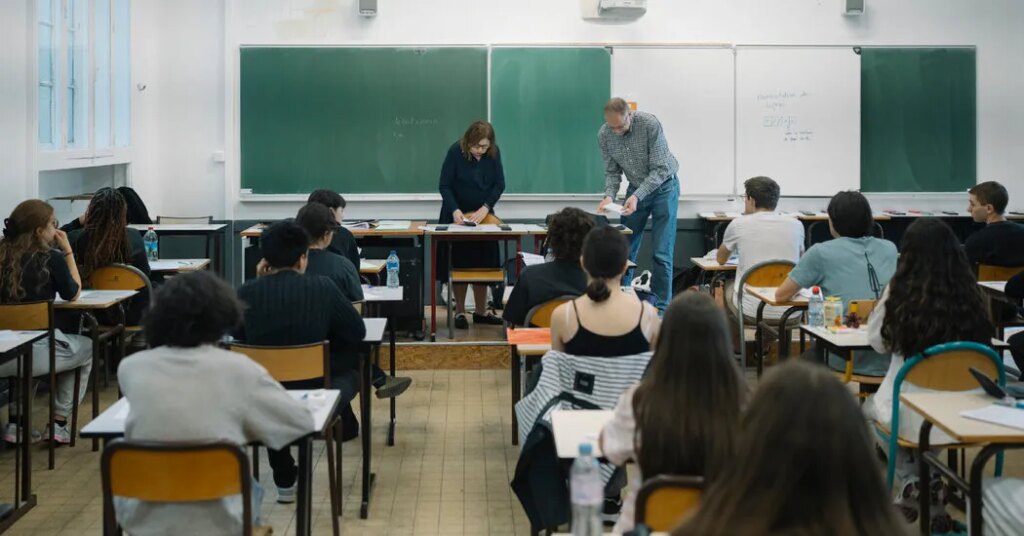
In France, students in poor suburbs outside Paris began protesting the decrepit physical condition of their schools, an opaque university admissions system and absent teachers. Soon, the demonstrations spread across the country and, in some cities, spiraled into rioting.
Different as the countries may be, the unrest has a shared source of outrage: the breakdown of a foundational social contract that one could call the meritocratic bargain.
It’s a promise at the core of many countries’ political compacts. Though specifics vary, the central proposition is that a fair society rewards merit, and that educational achievements are a good measure of merit because education is open to all and leads to the acquisition of valuable skills. Therefore, education should be a route to social and economic advancement.
The value of this system is not just that it selects for those with high ability, but also that it offers a justification for the resulting socioeconomic hierarchy — including who ends up at the bottom.
In many places around the world, that system has proved to be remarkably effective, in large part because education has translated relatively straightforwardly into economic mobility. But increasingly, many who work hard at higher education are finding that the rewards are no longer there at the end.
A deal with costs
The resulting discontent is not limited to France and India.
Young Americans voted in droves in the recent midterm elections for Democratic candidates who tapped into their frustration over being saddled with college debt and stuck in low-paying jobs. Serbian student protests grew into a political movement that led to the ouster of Aleksandar Vucic, the country’s longtime nationalist strongman, in an election last month. Last week saw yet more protests by young people across Europe.
It’s all a reminder that the meritocratic bargain as we understand it today, in which university education is a stepping stone to middle-class careers, can’t be taken for granted.
England didn’t introduce free, universal secondary education until 1944. In the U.S., it took the G.I. Bill during World War II to open broader access to college. And India introduced the first national college entrance exam only in the 1960s.
For individuals, this access to education promised more money, more status or both. For governments, it was a way to convince people to buy into society as currently structured, by promising the potential for advancement.
But that proposition comes at a cost. In India, South Korea, the U.S. and elsewhere, education-based meritocracy places significant burdens on young people and their families, whether through years of grueling study or tens of thousands of dollars in debt.
That sacrifice helps explain why, just as the meritocratic bargain can be a source of social cohesion, its breakdown can also become a trigger for social explosion.
It has happened before. In 1905, for instance, China abolished the national civil service exam that had for 1,300 years been a way to recruit elites. The shattered expectations of frustrated, aspiring commoners drove them to join revolutionary uprisings that eventually overthrew the imperial dynasty in 1911. Disillusioned scholars also flocked to revolutionary organizations in search of alternative routes to advancement.
Uncertainty ahead
This is not to say that France’s unrest signals another imminent revolution. But the frustrations of today’s young people are fueled by factors unlikely to go away soon.
High youth unemployment rates, paired with skyrocketing costs of living, have put the traditional milestones of independent adulthood out of reach for many young people.
And the biggest blow to the meritocratic bargain may be yet to come, as many fear that A.I. could do for knowledge work what a meteor strike once did for the dinosaurs.
Even if A.I. does not eliminate professionals like lawyers, scientists and doctors, it may radically reshape those fields.
Some professions may adapt, and educational structures may also develop to match skills and meritocratic selection to the demands of a new economy. But such disruptive change is likely to sow even more confusion about how young people can set themselves up for success.
That development has the potential to further challenge not only the distribution of economic rewards, but the political bargain on which modern societies have been built.
Historically, such moments have been explosive — even revolutionary.
MORE TOP NEWS
A new batch of U.S. tariffs
The Trump administration yesterday unveiled a slate of new tariffs targeting imports from China, Japan, E.U. countries and other trading partners. Some imports from China are facing a 20 percent tax that could be raised as high as 40 percent.
The administration plans to enforce the new tariffs under a trade law that allows the U.S. government to investigate unfair trade practices abroad and impose tariffs in response to its findings. The administration is invoking the law as it tries to resuscitate the tariffs that the Supreme Court has invalidated.
OTHER NEWS
-
Gadi Eisenkot, the Israeli opposition leader, appears to be making progress toward ousting Prime Minister Benjamin Netanyahu and forming a new government.
-
North Korea ordered the Swiss diplomatic mission in Pyongyang to close after Switzerland imposed sanctions on a camp accused of hosting Ukrainian children.
-
Three people died and nearly two dozen others remained trapped inside an illegal gold mine in Indonesia after a heavy rainfall flooded its shaft.
-
People in Iowa were waiting for the all-clear to go outside after the U.S. Army detonated tons of degraded chemicals at an ammunition plant.
-
A South African court threw out a report that formed the basis of a parliament inquiry to impeach President Cyril Ramaphosa.
-
My colleague Julian Barnes, who covers national security, explains in the video below how the Nvidia scandal fit into a Chinese spy campaign.
-
Two men were charged with breaking into a country home of Prince William and his wife, Catherine, Princess of Wales.
-
Some members of Haitian families trying to leave the U.S. for Canada are being denied entry, turned back and detained by U.S. authorities.
-
In a blow to China, the Solomon Islands signed a treaty with Australia that would preclude the establishment of foreign military bases there.
WHAT ELSE IS HAPPENING
-
Newly unveiled images show what happened when a NASA spacecraft struck an asteroid in 2022 and changed its orbit.
TOP OF THE WORLD
The most clicked link in your newsletter yesterday was about 100 notable books of 2026.
THE WORLD QUIZ
This question comes from a recent edition of the newsletter. Click an answer to see if you’re right.
A mathematician at Anthropic said he had solved a complex math problem with the use of A.I. What is the name of the problem?
OLD-SCHOOL SCHOOL OF THE DAY
International Butler Academy
This school in the Netherlands offers an eight-week, $14,000 program for entry into the gilded world of service. At a time when the rich are getting richer, the academy is betting that demand for butlers will only increase. No prior butling experience is required.
MORNING READ
Ukraine’s special operations forces are waging war on the airwaves, with a network of radio stations that play Russian rock, pop and punk. They also appeal to soldiers to quit the fight.
The operation rests on the quantity of Russian antiwar songs. Russian artists have long used songs to question and critique the country’s wars, like the early 1980s anthem “Don’t Shoot” by DDT, inspired by the Soviet-Afghan war. Undermining Russian soldiers’ “desire to fight,” one radio D.J. said, is the main goal. Listen to the songs.
AROUND THE WORLD
Thanksgiving dinner, marshmallows and all
It’s Thanksgiving today, an American celebration of family, friends and food. Many Americans abroad are hosting Thanksgiving feasts, and that means adapting the traditional meal to a local setting.
In France, an American art dealer serves foie gras and wine alongside turkey and mac and cheese. My colleague Francesca Regalado once faced questions when she served marshmallows on mashed sweet potatoes at a Thanksgiving dinner in Bangkok. “Why would you do this?” a British friend asked. Read more about the joys and challenges of expat Thanksgiving.
RECOMMENDATIONS
Discover: Palestinian women are using embroidery to tell their stories and support their families back home.
Explore: Check out Sydney’s most exciting neighborhoods.
Wear: This Scottish designer creates jewelry inspired by artifacts found on land that has been in her family since the 1500s.
Communicate: Here’s what to learn about aging parents before there’s a crisis.
RECIPE
What if shawarma and chili had a baby? That’s basically what this hearty and deeply warming dish is, and it comes together in 30 minutes. Top it with sumac-marinated onions for a tangy kick.
TIME TO PLAY
Here are today’s Spelling Bee, Mini Crossword, Wordle and Sudoku. Find all our games here.
That’s it for today. See you tomorrow! — Katrin
Amanda Taub was our guest writer today.
We welcome your feedback. Send us your suggestions at [email protected].
The post Study Hard, Get Ahead? appeared first on New York Times.