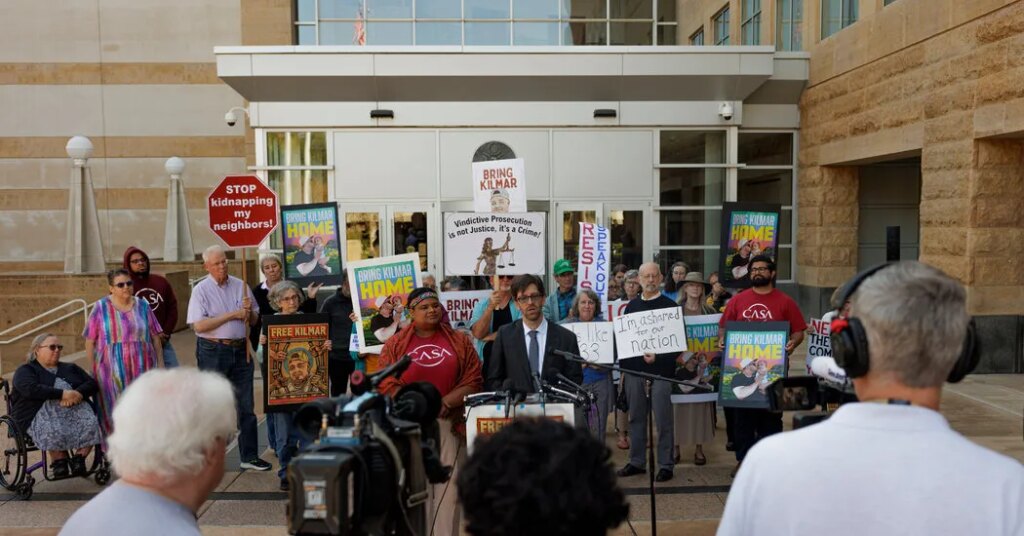
Kilmar Armando Abrego Garcia, a Salvadoran immigrant who fought attempts to deport him for almost two years, arrived in Spain on Wednesday morning, putting an apparent end to a saga that became a symbol of the Trump administration’s mass deportation efforts.
“I am leaving happy,” Mr. Abrego Garcia said in a statement released through We Are CASA, an advocacy group based in Maryland, as he voluntarily left for Madrid on Tuesday. “I am leaving with my freedom.”
He emerged from the airport terminal in Madrid at around 1:30 p.m. (7:30 a.m. Eastern) on Wednesday to a scrum of reporters waiting for him. He raised his fist as he wordlessly got into a blue minivan parked at the airport.
Despite “every obstacle they put in my way, and every attempt to shame me, justice prevailed under this administration in a way that many people never thought was possible,” Mr. Abrego Garcia said in the statement on Tuesday.
Mr. Abrego Garcia’s ordeal began when federal agents grabbed him off a Maryland street in March 2025 and, days later, wrongfully deported him to a Salvadoran prison in a clear-cut violation of a court order that barred him from being sent there.
But even after courts forced the authorities to return him to the United States, he still faced the prospect that the administration might decide his fate for him and deport him to Liberia.
Instead, his lawyers said on Tuesday, Mr. Abrego Garcia was leaving “on his terms.” The Department of Homeland Security said in a statement late Tuesday that he had left the United States.
“We are delighted to announce that Kilmar Abrego Garcia has self-deported from the United States to Spain,” Markwayne Mullin, the homeland security secretary, said in the statement.
Simon Sandoval-Moshenberg, one of the lawyers representing Mr. Abrego Garcia, said in response that a “retaliatory deportation campaign has now come to an end.”
As Mr. Abrego Garcia fought his expulsion at every level of the U.S. legal system, including the Supreme Court, he became a symbol of resistance to President Trump’s aggressive — and, at times, error-prone — deportation agenda.
When the justices ordered the Trump administration to facilitate Mr. Abrego Garcia’s return to the United States, the Justice Department brought him back from El Salvador, but only as part of an effort to indict him on charges of taking part in a human smuggling conspiracy.
A federal judge ultimately determined that those charges were a vindictive abuse of prosecutorial power and that the effort to pursue a criminal case against Mr. Abrego Garcia was essentially a way to comply with the Supreme Court’s instructions while also saving face.
His lawyers took note of his long ordeal in a statement issued earlier on Tuesday night.
“After a protracted fight, Abrego Garcia, on his terms, boarded a flight tonight to Spain,” the lawyers said.
“We will always admire his remarkable courage in staring down and defeating a vindictive prosecution instigated by the highest reaches of the Justice Department,” they added.
The Justice Department did not respond to a message seeking comment.
Immigration and Customs Enforcement agents met Mr. Abrego Garcia at the airport to remove his ankle monitor, We Are CASA said. He traveled from Washington to Madrid on a commercial flight with his wife, Jennifer; his brother; Mr. Sandoval-Moshenberg; and representatives from the advocacy group, according to Murray Osorio, the law firm representing Mr. Abrego Garcia.
He plans to hold speaking engagements in several countries while he is abroad, with Madrid as his first stop, according to Mr. Sandoval-Moshenberg.
“This is a temporary departure,” he said in a separate statement, adding that Mr. Abrego Garcia “has many options to return to the United States” as the husband of a U.S. citizen and the father of another.
Mr. Sandoval-Moshenberg added that he hoped the next U.S. administration would “prioritize reunifying this family” and bringing Mr. Abrego Garcia back to Maryland.
Mr. Abrego Garcia’s tribulations, which unfolded in three separate cases heard by multiple sets of judges, presented a major test of Mr. Trump’s demand for the mass deportation of illegal immigrants. It was also a flashpoint pitting Mr. Trump’s expansive view of executive power against the fundamental tenets of judicial review and the rule of law.
“The government is asserting a right to stash away residents of this country in foreign prisons without the semblance of due process that is the foundation of our constitutional order,” one conservative jurist, J. Harvie Wilkinson III, wrote in April 2025 in a ruling affirming the order to facilitate Mr. Abrego Garcia’s return to the United States.
For months, the court battle over Mr. Abrego Garcia’s wrongful deportation was marked by an extraordinary level of obstinance by the Justice Department, which over and over dragged its feet in complying with court orders. Making the department’s stonewalling even more unusual was that officials admitted that the administration had erred in sending Mr. Abrego Garcia to the Salvadoran prison, but repeatedly refused to fix its own mistake.
The first judge to hear the case, Paula Xinis, of Federal District Court in Maryland, became so frustrated that at one point she opened a contempt investigation into the department lawyers handling the matter, accusing them of shattering the traditional bonds of the trust that the government has long enjoyed in court.
“This has been the process from Day 1,” Judge Xinis said during a hearing in July 2025. “You have taken the presumption of regularity and you’ve destroyed it in my view.”
Outside the courtroom, Mr. Trump and some of his most senior aides treated Mr. Abrego Garcia’s case less as a legal proceeding and more, at times, as an opportunity to demonize a man who had very publicly fought his expulsion. The president and members of his cabinet often assailed Mr. Abrego Garcia as a terrorist and a member of the violent street gang MS-13 even though judges repeatedly questioned the evidence that lay behind those accusations.
Mr. Trump personally accused him of belonging to MS-13, citing an image in which the gang’s name had been superimposed above a series of tattoos on Mr. Abrego Garcia’s knuckles. Turning the case into a White House spectacle at one point, Mr. Trump held a news conference in the Oval Office at which President Nayib Bukele of El Salvador said he would never let Mr. Abrego Garcia leave his country, saying that to do so would be akin to sending “a terrorist into the United States.”
All the while, Mr. Abrego Garcia languished in a prison known as CECOT, which was designed to hold terrorism suspects. He claimed that he was beaten, deprived of sleep and psychologically tortured during nearly three months in custody there.
His ordeal continued even after he was brought back from El Salvador to face charges in Nashville of having acted as a driver for a smuggling ring that transported illegal immigrants across the country.
Those charges were dismissed in their entirety in May by Judge Waverly D. Crenshaw Jr., who determined that the case had only been brought to punish Mr. Abrego Garcia for having challenged the efforts to deport him. In his ruling, Judge Crenshaw singled out Attorney General Todd Blanche for criticism, saying that prosecutors had reawakened a dormant investigation into Mr. Abrego Garcia at his request and that of his top deputies.
Even as it sought to prosecute Mr. Abrego Garcia in Nashville, the Justice Department didn’t give up on its efforts in Maryland to deport him, a double-tracked approach that seemed at times to confuse both Judge Crenshaw and Judge Xinis, who oversaw the parallel cases.
Moreover, the department had trouble settling on a country that it wanted to deport him to, and, more important, that would receive him. Officials floated plans to send Mr. Abrego Garcia to Uganda, Ghana and the small African nation of Eswatini, but failed in the end to get permission from the governments of those countries to take him.
Ultimately, they tried to deport Mr. Abrego Garcia to Liberia, but his lawyers fought that move in court, saying that their client would willingly deport himself to Costa Rica if the government allowed it. That case ended in an impasse — that is, until Mr. Abrego Garcia agreed to fly to Spain on Tuesday night.
The post Abrego Garcia Arrives in Spain After Voluntarily Leaving U.S. appeared first on New York Times.