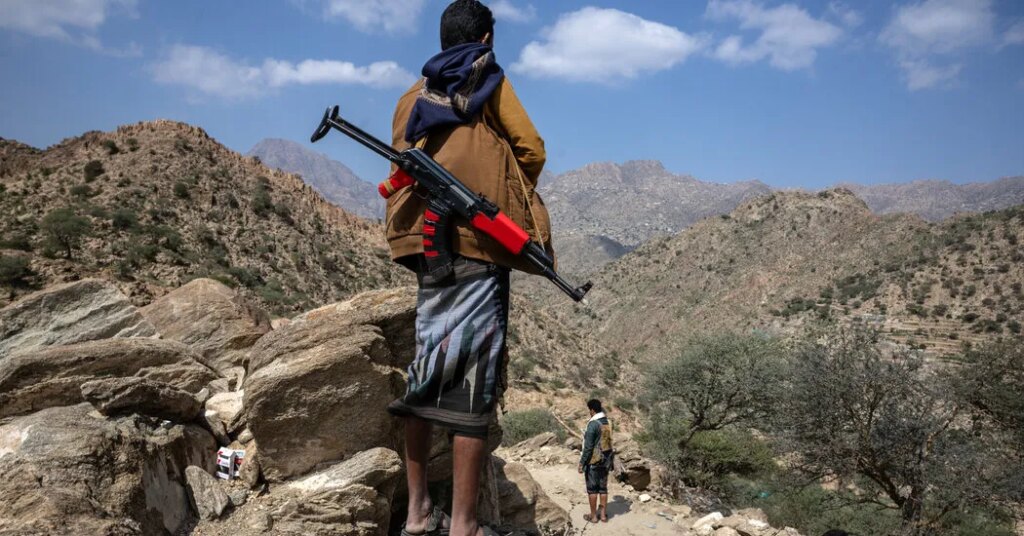
Since Yemen’s civil war reignited this year, pitting the country’s beleaguered government against the Iran-backed Houthi militia, the Houthis have maintained the upper hand at every turn.
Even after the Yemeni government declared a major counteroffensive last month — aided by Saudi warplanes dropping bombs across the country — the Houthi fighters have continued to gain ground.
They have done so by exploiting internal divisions among the government’s forces and racking up win after win, analysts say.
Yemen’s devastating war has had global reverberations. If the Houthis continue to expand their control, the result could be an Iran-backed pariah state beside the Red Sea, a vital international trade route.
The toll of the fighting is starkly apparent in the Yemeni government’s provisional capital, Aden, where tens of thousands of people have sought refuge. On a recent morning at the Aboud Military Hospital, the wounded arrived in a steady stream.
Patients with bandaged limbs and shrapnel wounds were wheeled into wards, one after another. Lanky soldiers, many groaning in pain, crowded the corridors, where doctors and nurses rushed past, struggling to cope with shortages of medical supplies and beds.
“The last two months have been the worst in recent years,” said Aref Al-Da’eri, head of the hospital’s medical services department. “We expect more injured people and more bad news to come.”
The Yemeni government and the Houthis have been at war, on and off, for more than a decade, since the militia seized the official capital, Sanaa, and entrenched its power in the country’s north. A truce was agreed in 2022, but it began to unravel after the United States and Israel attacked Iran, the Houthis’ primary ally.
Since the fighting resumed, the Houthis have gained control of Yemen’s entire Red Sea coast, including territory overlooking the Bab al-Mandab Strait, through which roughly 10 percent of global shipping passes. The Houthis seized territory beside the strait in a lightning advance in September, giving Iran and its allies the ability to menace shipping passing through maritime choke points on both sides of the Arabian Peninsula.
Houthi forces have also surrounded and besieged the major city of Taiz and advanced within a few dozen kilometers of Aden.
“The government was overconfident, and it had underestimated what the Houthis have been planning,” said Baraa Shiban, a specialist on Yemen and the Gulf at the Royal United Services Institute, a research organization based in London. He said the government’s aim now was, as much as possible, to contain the Houthi’s advance.
Since August, when the civil war reignited, more than 2,200 people have been killed and nearly 350,000 displaced, according to the World Health Organization.
A Saudi-led military coalition has carried out a fierce bombing campaign in Houthi-held territory that has killed hundreds of civilians, according to Houthi officials. In turn, the Yemeni government has accused the Houthis of shelling and firing missiles at civilian targets.
In addition to backing the Yemeni government’s fight against the Houthis, Saudi Arabia is mired in its own, parallel battle with the militia. Saudi Arabia is fending off near-daily Houthi missile and drone attacks against the kingdom, including on its energy facilities, airports and the financial district in the capital, Riyadh. A Houthi strike on a Riyadh skyscraper on Tuesday injured 11 people, the Saudi authorities said.
Col. Majed al-Nuzaili, a Yemeni military spokesman, said at a news conference on Tuesday that the Yemeni government was not in as bad a position is at might seem from the outside.
“The situation is not where it should be, but not as dire as reported,” he said. “Our priority is clear: hold Aden, guard the strait, bring an end to the siege of Taiz, keep pressure on every front.”
Still, it is unclear where the government and its Saudi allies go from here, analysts say. Their predicament lies in the fact that the Houthis have turned years of grinding war to their benefit, honing their skills as a unified and effective combat force.
And, at the same time, the Yemeni government forces have all but disintegrated into a motley coalition of warlords that has proved ill-equipped to hold the Houthis back.
In a statement to The New York Times, the Yemeni government said that it has worked to resolve the internal problems that had contributed to its recent losses and is now pushing back forcefully against the Houthis. “Every unit now operates under one command and one joint operations room, with clearly defined sectors,” the government said.
Ultimately, the statement added, the government’s goals are to retake the Red Sea coast, “restore the institutions of the state” and end the Houthis’ decade-old coup.
Analysts say those goals are unrealistic, for now.
“Government forces are trying to regroup and put a plan together to halt additional Houthis gains and even push back, but their fundamental weakness and internal fragmentation remains,” said April Alley, a Yemen expert and senior fellow at The Washington Institute. “In fact, infighting among their ranks has worsened.”
A contentious retreat last week by government-allied troops near the Red Sea was a case in point.
Those troops had been battling the Houthis for weeks in an effort to reclaim the territory, but on Nov. 15, the Saudi-led military coalition, which oversees operations in Yemen, announced that they were pulling forces back to protect Aden, citing recent battlefield developments and threats against the city.
The same day, Saleh Idris al-Awaji, a local youth leader of a tribe whose members were fighting alongside the government forces, criticized the decision in a statement on social media, saying that the tribe’s fighters had wanted to stay and hold out against the Houthis. He said the order to withdraw was “imposed on us without our knowledge or consultation.”
As a result, he added, there was confusion and mistrust on the battlefield, and that enabled the Houthis to enter his tribe’s territory.
The order sparked a heated dispute between Yemeni and Saudi officers, according to a Yemeni military official briefed on the issue, who spoke on the condition of anonymity because he wasn’t authorized to talk to the media.
Some Yemeni officers argued that they should hold their ground, he said, while some fighters refused to leave, pulling out only after the Houthis bore down on them.
During the Yemeni government news conference on Tuesday, Col. al-Nuzaili did not directly answer a question from a Times reporter about the dispute over the withdrawal, saying only that it was “a decision made by our commanders.”
Soon after the retreat, Saudi Arabia replaced the Saudi general leading operations in Yemen — an apparent acknowledgment of the campaign’s shortcomings.
Saudi Arabia’s Center for International Communication, which handles media queries, did not respond to a request for comment.
The war in Yemen is threatening to turn into another quagmire for the kingdom, which previously led a disastrous bombing campaign against the Houthis in 2015 to try to restore the government to power. The campaign contributed to the deaths of hundreds of thousands of people from violence, hunger and disease.
Newspapers and pundits in Saudi Arabia have begun to openly criticize the Yemeni government in recent weeks, putting distance between the kingdom’s goals in Yemen and the state of ground operations.
Ali Shihabi, a commentator close to the kingdom’s leadership, wrote in the Saudi newspaper Arab News recently that it was important for the kingdom to strengthen the Yemeni government’s position but that Saudi Arabia’s security “cannot depend on resolving every Yemeni division.” He warned that the war could drag on for six months, or longer.
In Aden, people are fearful that the Houthis could advance on the city, as they did a decade ago, before the Saudi-led coalition drove them back.
Official Houthi media have recently reported that the militia has no intention of pushing into Aden. However, the militia’s officials have repeatedly said that they intend to “liberate” all of Yemen from the government fighters, whom they describe as Saudi mercenaries.
Since August, Aden has absorbed more than 70,000 people who have fled the renewed fighting, the government said in its statement.
At Al-Firdaws displacement camp, west of the city, families live with little access to adequate food, medicine or clean water.
“The Houthis have destroyed our lives,” said Rabia Ali, 35, who fled with her five children from Dhubab, a town near the Bab al-Mandab Strait.
Like many of the families at the camp, she said she and her family are hoping for assistance, but their greatest wish is to return home.
Saeed Al-Batati contributed reporting from al-Mukalla, Yemen and Mohammed Ali Kalfood from Hudaydah, Yemen.
The post How an Iranian Ally Gained the Upper Hand in Yemen’s War appeared first on New York Times.