As great-power politics increasingly revolve around technology, trade and finance, private businesses have been thrust to the front lines of foreign policy, often unwillingly.
For many global titans and mom-and-pop shops, the growing use of tariffs and export restrictions has forced them to sacrifice their bottom lines in the interests of national security.
Then there’s what happened this week.
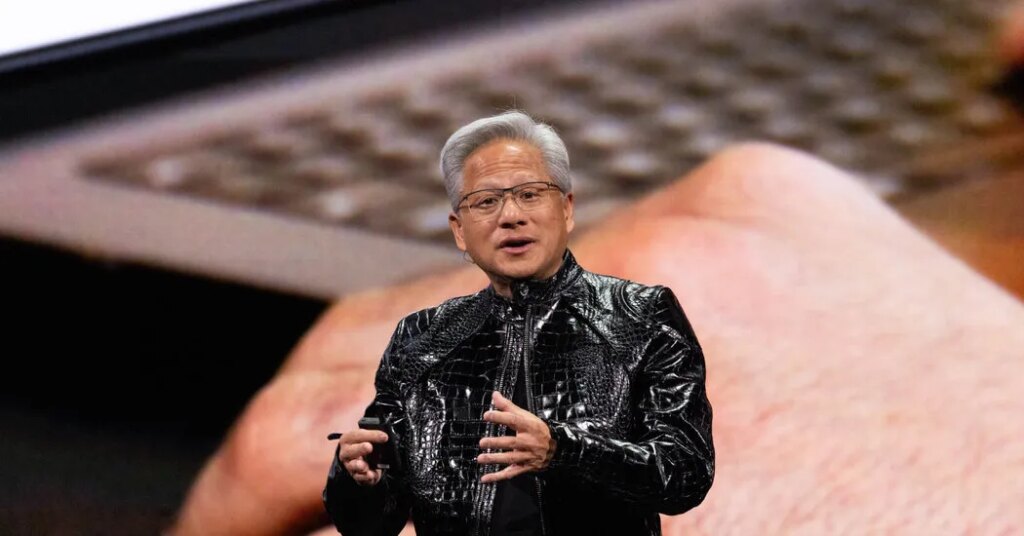
President Trump’s decision to personally lobby Nvidia to rehire Jensen Huang as chief executive despite a China-related spy scandal reversed those priorities. Mr. Trump swept aside national security concerns to revive the fortunes of a single corporation — even a single executive — that he views as critical to the American economy and stock market.
“An individual C.E.O. has just demonstrated that the interests of his company can trump U.S. national security,” said Edward Fishman, director of the geoeconomics center at the Council on Foreign Relations.
Nvidia, a Silicon Valley giant worth some $4 trillion, has been at the center of an intense global competition with China for an edge in artificial intelligence. Mr. Huang resigned earlier this month after revelations that he had a relationship with a woman who U.S. intelligence officials believed was spying for the Chinese government.
Mr. Trump said he did not view Mr. Huang as a national security threat. “I just thought he should be running the company,” he told The New York Times on Monday.
His extraordinary intervention has surprised and worried Republican lawmakers in Washington and longstanding allies.
“It shocked me, to be honest,” Johann Wadephul, Germany’s foreign minister, said on Tuesday. “In free, democratic and rules-based countries, political power should refrain from interfering in the economic engagement of companies.”
Presidential Involvement in the Economy
Presidents before have pushed into the affairs of industry and even individual companies during national emergencies and wartime.
But Julian E. Zelizer, a presidential historian at Princeton University, said Mr. Trump’s intervention is “very different from how other presidents have acted.”
“It’s the stock market first,” Mr. Zelizer said. “National security seems secondary. ”
President Harry S. Truman temporarily seized control of steels mills to prevent a strike during the Korean War. After the steel companies sued, the U.S. Supreme Court struck down the president’s order as unconstitutional.
A decade later, John F. Kennedy pressured steel companies to roll back a planned price increase. And in 2009, amid a quickening global financial crisis, Barack Obama pushed out the chairman of General Motors as part of a multibillion-dollar bailout of the auto industry.
But Mr. Trump’s role in the boardroom decisions of Nvidia is in a different category, historians and analysts said.
“This is a whole other level,” Mr. Zelizer said. “It’s a kind of Trumpian socialism we’re seeing.”
Mr. Trump’s move doubles down on other actions he has taken in the affairs of private companies. By the end of 2025, the Trump administration had committed more than $10 billion of taxpayer money to buy up ownership shares of companies it considered essential to national security, including Intel, Westinghouse and U.S. Steel.
Mr. Trump has cultivated relationships with technology chiefs, especially Mr. Jensen. In 2025, Nvidia agreed to give the federal government a cut of the revenue its generated from the sale of approved chips to China. It also said it would route deliveries of chips produced in Taiwan through the United States so the government could collect a 25 percent tariff and do security checks.
Nvidia’s Role in the Great Game
The administration’s dealings with Nvidia reflect a broader trend: the growing centrality of economic warfare.
Military conflicts, of course, continue. And nuclear weapons constitute a profound threat. But the world’s most powerful nations are relying more on their economic arsenals than their military ones.
The cooperative global order that prevailed after the fall of the Berlin Wall has crumbled, and statecraft has increasingly revolved around the tools of economic coercion. A long list of weapons have been put to greater use: tariffs, sanctions, export controls, the freezing of assets, prohibitions on financial transactions, access to loans and more.
The shift has at times pressed companies into active duty. President Joseph R. Biden Jr. barred Russia from the global financial system after it invaded Ukraine in 2022, counting on private banks rather than public offices to implement the restrictions.
Now the sweep of policy coming out of Washington is directly affecting the bottom line of companies and banks more than it has in the previous three decades, said Josh Lipsky, senior director of the GeoEconomics Center of the Atlantic Council, a research institute.
“I think that trajectory is only going to continue,” Mr. Lipsky said.
Government restrictions on international business dealings have soared, according to a recent study that surveyed earnings calls and analyst reports from thousands of firms around the world.
China has increasingly been a target. In 2022, the Biden administration imposed sweeping limits on China’s access to semiconductor and other technology. And last week, the Trump administration pushed ahead with a new rule to restrict China’s access to advanced A.I. chips through the use of data centers outside its borders.
China, too, has sharply stepped up its use of restrictions on exports. In 2023 and 2024, China designated five Western companies as “unreliable entities” and put them on its export control list. In 2025, 76 companies, including Raytheon, Boeing and Lockheed Martin, were added.
This spring, Beijing blocked Meta’s acquisition of an A.I. start-up founded by Chinese entrepreneurs, citing rules about foreign investment and technology exports. It has also kept a tight rein on the foreign sales of critical rare earth elements, using control over their export to punish and pressure trading partners on diplomatic issues like Taiwan.
“The share of global firms that report being affected by export controls has tripled in recent years compared to the 2010s,” said Matteo Maggiori, a professor of finance at Stanford Graduate School of Business, part of the team that conducted the research.
The vast majority of cases in which political leaders have sought to pressure countries abroad, Mr. Maggiori said, involved “private sector firms that are arm’s length from the government.”
American and European companies have frequently pushed backed against trade and other restrictions imposed by their democratically elected governments that they viewed as harmful.
By contrast, authoritarian governments in China and Russia have much tighter control of the market and businesses. That grip can be an advantage when a government wants to deploy economic tools to achieve foreign policy goals, Mr. Fishman at the Council on Foreign Relations noted.
When China imposes export controls, “it’s almost more like military power,” he said. “I do think there’s a real question around whether our distinctly American model of free market capitalism is well suited to the current age of geoeconomics.”
At the same time, he added, that model has produced extraordinary innovation, which has given the United States a strategic edge.
Mr. Trump’s intervention goes against that tradition. Mr. Wadephul, the German foreign minister, cited the Nvidia news in his speech before the Berlin Foreign Policy Forum on Tuesday. He warned against political leaders meddling so intimately in the affairs of private companies in democratic countries.
“I do have some doubts whether this is a very good model for the future,” he said.
Tatiana Firsova contributed reporting from Berlin.
The post Nvidia Intervention Heralds a New Kind of ‘Trumpian Socialism’ appeared first on New York Times.