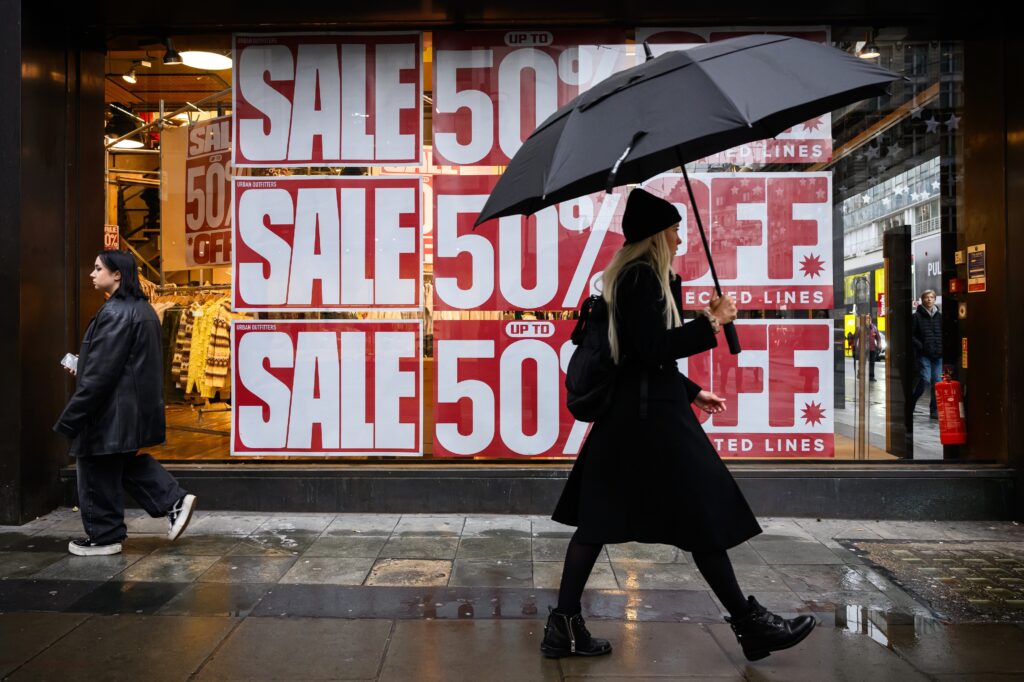
With Black Friday days away, people’s inboxes are already flooded with sale emails from nearly every retailer they’ve ever bought from. But not every discount is as good as it looks, and retailers have plenty of ways to make one seem bigger than it is.
“Retailers are very good at making us feel like we’re getting a deal before we’ve even decided whether we want the product,” said Hanna Horvath, a certified financial planner and creator of Your Brain on Money, a newsletter about the psychology behind financial decisions.
From crossed-out prices to countdown timers, here’s how those tactics work and what to check before you buy.
Strikethrough pricing
There’s a reason crossed-out price tags are everywhere. Known as strikethrough pricing, this tactic makes a discount feel like a great buy.
It’s one of the most common examples of the anchoring effect, the psychological tendency to rely too heavily on the first piece of information we receive. When a price tag shows $100 crossed out next to a discounted $60, that $100 becomes the anchor, or reference point.
“Your brain grabs that first price it sees and judges everything else against it, so you stop asking ‘is this worth $60?’ and start asking ‘how much am I saving?’” said Horvath.
It also changes how the purchase feels.
“You’re no longer spending $60, you’re ‘saving’ $40, and avoiding a loss is a much stronger motivator than getting a good price. The retailer has turned a cost into a gain without changing the number you pay,” said Kieva Hranchuk, a behavior scientist and professor at Brock University.
Limited-time deals
Another way retailers get us to spend is through limited-time deals, such as “this weekend only” sales or countdown timers. “They switch you from thinking to reacting. Scarcity and urgency set off loss aversion: We hate losing something more than we like gaining the same thing,” said Horvath.
Most of us have told ourselves we’d buy something later. A countdown timer makes that harder to do. “Most purchases don’t fail because someone definitively decided no,” Hranchuk said. “They fail because someone decided they would buy it later, and then later never comes.”
“Urgency also crowds out the pause (a.k.a. friction) you’d normally use to compare prices or check your budget, which is exactly why retailers use it,” Horvath said.
‘Up to’ discounts
Another common strategy is promoting the best deal. Signs and fliers that advertise “up to” a certain percentage off highlight the best possible discount, even when only a few items are marked down that much.
“The 60 percent is the ceiling, and it might apply to a handful of items nobody wanted,” said Horvath. “But the biggest number on the sign is the one that sticks, so it sets your expectations for the whole store.”
Hranchuk said the same logic explains why a sign that says “from $19” pulls you in when the item you actually want costs $89.
Sales can lead you to overspend
Even when you shop with a set budget, a sale can trick you into overspending.
“Sales have a funny way of making spending money feel like saving money,” said Horvath. “And sometimes we use those imaginary savings to justify buying something else! The other thing is that discounts often ‘give’ us permission to buy things we wouldn’t normally buy.”
Before you add to cart
As we enter the busiest shopping weeks of the year, here are a few simple ways to tell whether a deal is worthwhile.
Horvath suggests focusing on the price you’d pay, not the original price listed. “Would you actually buy this item if you had no idea it was discounted? That’s a much better way to decide if something is actually worth the money,” she said. She also recommends checking the price at another retailer or looking at the item’s price history, especially for larger purchases.
Hranchuk recommends deciding what you’re willing to pay before you even look at the price tag. “Once you have your own number, the sale either beats it or it doesn’t, and the crossed-out price stops mattering,” she said.
Horvath also advises having a plan. “Go into holiday sales with a list of what you actually want to buy. A discount is only valuable if it’s helping you spend less on something you were already planning to purchase,” she said.
Knowing the tricks isn’t enough on its own, Hranchuk said. “The protection isn’t in understanding the trick, it’s in changing the conditions around your decision: a list, a budget, a number you set in advance, a rule that you ‘sleep on it’ for anything over a certain amount. Change the environment, and the behavior follows.”
The post How retailers make a Black Friday sale look better than it is appeared first on Washington Post.