The Permanent Peoples’ Tribunal announced in September that Canada had committed genocide and crimes against humanity against Indigenous peoples, including forced family separations, physical abuse, burials in unmarked graves, and that some crimes continue.
The panel of seven judges pointed to a number showing how little has changed: About 165,000 Indigenous children have been removed from their parents since the residential school system ended in the late 1990s, more than the roughly 150,000 taken during the schools’ 130-year history. (Residential schools are the Canadian counterpart to the Native American boarding school system in the United States.)
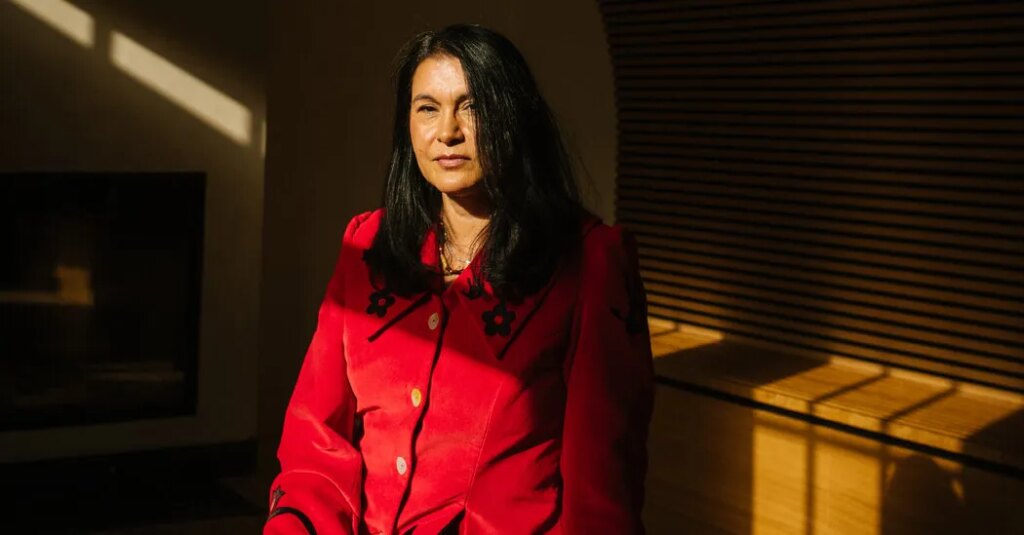
Na’kuset, the executive director of the Native Women’s Shelter of Montreal, is a survivor of a wave of removals known as the Sixties Scoop. She was born into a Cree family in Thompson, Manitoba, and placed in foster care before being adopted into a Jewish family in Montreal, part of a program in which Canadian social workers forcibly separated Indigenous children from their families.
The tribunal, founded in Italy in 1979, examines human rights violations when victims have not found justice in their home countries. Na’kuset had spent years asking lawyers and institutions how to put Canada’s treatment of Indigenous children before justice.
In 2023, when she met an Amnesty International official, she asked her, “what is the closest thing we can get to a Nuremberg trial?” The official pointed her to the tribunal, and encouraged her to write to the panel.
“We have to show the world, ‘This is what happened,’” said Na’kuset over a video interview. She spent about three years raising money from foundations and community groups, assembling a legal team, and working with a legal group that had compiled some 2,000 pieces of evidence like admissions records and journals from school staff, consulting a committee of survivors and another of elders at every step.
“During the session Na’kuset demonstrated leadership through her manaaki [care] for all participants and kaha [strength] in her desire for justice,” Valmaine Toki, a professor at the University of Waikato in New Zealand who is on the tribunal’s panel of judges and is a co-chair, said via email.
“The panel of judges were asked to respond to the indictment and judge Canada’s responsibility in international law for the crimes of genocide and crimes against humanity, finding that Canada is failing to comply with its international legal obligations,” Dr. Toki said.
The effort with the tribunal is the latest example in a string of outreach Na’kuset has been a part of to meet Indigenous needs she saw going unmet. The work, she said, means hearing stories that make you want to give up. “So we have to create hope, and we have to create those services,” she said.
Na’kuset joined the Native Women’s Shelter in 1999 as a frontline worker; it now has more than 50 employees. In 2013, she started a network of Montreal’s urban Indigenous organizations and ran it for a decade. When Raphaël André, an Innu man died in the cold during the Covid pandemic in 2021, she raised the money for a memorial tent in Cabot Square, a gathering place for Indigenous communities, that stayed open for 18 months.
Then came Resilience Montreal, which first opened in 2019 near the square after several deaths among Indigenous people on the streets. When the city offered $800,000 and asked who would run it, Na’kuset said she stepped up. In June 2026, it moved into a new building. Pandemic-era price increases pushed the renovation to $19 million, she said, paid largely by government programs. Na’kuset wanted something far from the usual shelter.
“Most homeless services, it feels like, ‘Well, just a granola bar, right? That’s all they need, and a church basement,’” she said. Her idea was different. “What if you were to create something where people come in and they are purposeful, and every single space is designed for them?” She said the architects held workshops with Mohawk and Inuit community members about what home looks like.
“As soon as they walk in, they have to feel calm,” she remembers telling them.
The result is a building featuring warm shades of wood with a plant and flower-covered wall that waters itself, so the sound of water greets people as they enter, a cedar bath and a curved room with a fireplace. On the patio, rainwater is filtered in the basement and reused for the toilets and laundry.
There are two soundproofed “Zen rooms” where someone who has been up all night, or assaulted, can come in angry and work it out with an intervention worker, and then be offered a shower, nap or meal.
Members of the unhoused community can sign up for paid work cleaning streets in the neighborhood, doing shifts in the kitchen and in the laundry.
There is a waiting list.
“Nobody has anything as beautiful as we do,” she said, “and this is for the community that nobody wants to talk to.” Resilience now runs independently; she remains its director of development and philanthropy.
Growing up, the person who gave her strength was her grandmother. “My bubbe thought I was going to do amazing things one day,” she said, “but she died before any of this happened.” Her grandmother, who died in 1998, also helped her find her biological family. Na’kuset had been renamed when she was adopted. In her early 20s, a Mi’kmaq elder she met on a film set named her Na’kuset, meaning “the sun.”
Her grandmother is also central to “Becoming Nakuset,” a 2020 CBC short documentary about her adoption and how she reclaimed her identity. After watching it, Jennifer Podemski, a creator of “Little Bird,” the 2023 drama about a First Nations woman adopted into a Jewish family in Montreal, brought her on as an adviser.
What comes next, she said, is getting this decision applied into the world. By the end of March 2027, Na’kuset hopes to hold a conference in Montreal with the tribunal’s co-chair, Frances Webber, and some of the judges so people like legal experts and policymakers can understand what the panel found.
She also wants schools to teach it. The tribunal called on Canada to expand public education about its colonial history, and Na’kuset wants it in textbooks. Her own children, she said, learned little about residential schools. “If you can read about Anne Frank, you should be able to learn about what actually happened.”
The post The Woman Who Took Canada to Court Over Genocide appeared first on New York Times.