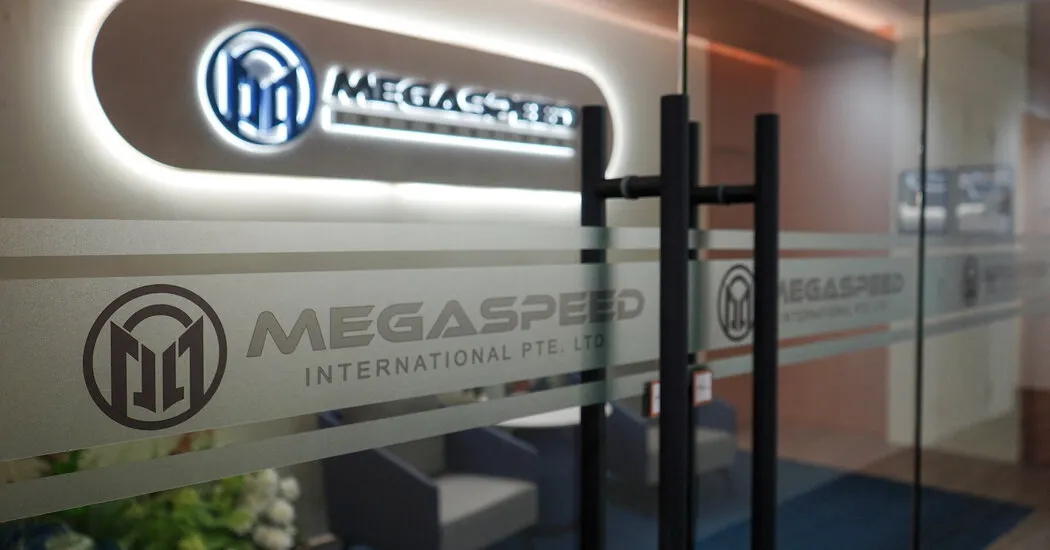
The Trump administration on Monday barred a Singaporean data center firm at the center of the Nvidia scandal from buying advanced A.I. chips, according to people familiar with the matter, who spoke on the condition of anonymity since the announcement was not yet public.
The Commerce Department on Monday added Megaspeed to the government’s entity list, a trade blacklist that will prevent companies from shipping U.S. technology, like Nvidia’s chips, to the firm without first obtaining a government license.
Megaspeed is currently under criminal investigation by the Justice Department for allegedly smuggling A.I. chips to China, in contravention of U.S. law. The firm had been established by a woman, Alice Huang, who U.S. officials believed to be a Chinese intelligence asset and who had an affair with Nvidia’s chief executive, Jensen Huang.
Mr. Huang stepped down this month after that affair and another relationship with an Nvidia employee were revealed. On Monday, Nvidia announced that it was restoring Mr. Huang as chief executive, after receiving assurances from senior U.S. officials that he did not present a national security risk.
The decision to add Megaspeed to the entity list comes after weeks of debate within the administration about whether to take such a step.
The debate had pitted officials including Treasury Secretary Scott Bessent, who favored quicker action on the Megaspeed entity listing and other A.I. chip regulations, against Commerce Secretary Howard Lutnick, whose department oversees the technology export rules. The decision to add Megaspeed to the entity list was reported earlier by Semafor.
In an interview this month, Mr. Bessent blamed Mr. Lutnick’s department for slow-walking the measure, saying that Treasury officials had pushed for weeks to add the company but that the Commerce Department “has the pen.”
Mr. Bessent said that the Treasury, Defense and State Departments and the U.S. trade representative had all been in favor of putting Megaspeed on the entity list for months.
Unlike many other recent entity listings, critics point out, Monday’s action bans only exports from the United States to Megaspeed, not from other countries. Most A.I. chips are made in Taiwan and would not be affected by the rule. The Commerce Department put out other regulations last week that will limit the ability of firms like Megaspeed to gain access to A.I. chips, but the listing on Monday seems more symbolic than effective.
How strictly to enforce the entity listing will now be up to the Commerce Department. Mr. Lutnick has so far recommended more surgical action on restricting technology sales overseas, drawing accusations from others in the administration and in Congress that his department had become too cozy with Nvidia and Mr. Huang.
Last Monday, his department issued sweeping regulations that cut down on China’s access to A.I. data centers around the world. But as it did so, it took the unusual step of saying it acted at the direction of the Treasury Department.
Mr. Lutnick had taken more aggressive action on export controls last year, including overseeing a significant expansion of the entity list. But that provoked a harsh response from China and forced Trump officials to the negotiating table with Beijing.
Since then, the department has been more reserved with its technology controls. It has been over a year since it added any companies to the entity list, the longest such stretch in 18 years. Adding Megaspeed to the list will break that streak.
Officials at the Commerce Department began looking into Megaspeed in 2024, after the formerly unknown firm began buying billions of dollars of advanced A.I. chips and shipping them from California to Malaysia.
U.S. rules ban Chinese companies from directly buying A.I. chips. But Megaspeed and other companies have been able to sidestep those rules by re-registering under Singaporean ownership. U.S. officials also became concerned that the firm was illegally smuggling A.I. chips into China.
A Commerce Department official visited one of the company’s data centers in Malaysia in late 2024, and found the server equipment to be packed up in boxes rather than installed, arousing suspicions about smuggling.
American and Singaporean officials met with Ms. Huang in Singapore to inquire about the company’s purchases in June of last year. Singaporean officials also detained Ms. Huang for questioning.
The Commerce Department’s work on the case was suddenly halted soon after, following an unusual interaction between Nvidia’s general counsel and a top department official.
After Singaporean officials detained Ms. Huang, Nvidia’s general counsel, Tim Teter, reached out in August to Jeff Kessler, a Commerce Department official appointed by President Trump, to ask about the detention and the case.
Mr. Teter then reached out to agents working on the Megaspeed case for information, saying that Mr. Kessler had given Nvidia permission to make the inquiries.
The incident raised questions of what Mr. Kessler and Mr. Teter had discussed, and whether those interactions could become the subject of legal proceedings. Bloomberg reported earlier that Ms. Huang’s detention was the cause of Mr. Teter’s outreach.
Commerce Department officials were subsequently told not to work on or speak about the case. In a statement this month, Singaporean officials said they had continued their work on Megaspeed, but had received limited information or assistance about the company.
Critics say the delay in imposing sanctions on Megaspeed allowed the company to continue purchasing hundreds of millions of dollars of technology. Trade data obtained from ImportGenius, a trade data platform, shows that between July 2025 and February 2026, Megaspeed’s Malaysian subsidiary received more than $800 million of shipments containing controlled Nvidia chips.
The post U.S. Imposes Sanctions on Singaporean Firm at Center of Nvidia Scandal appeared first on New York Times.