The collapse of United Nations climate talks in Turkey inflicted a deep wound on the global effort to keep the planet from overheating, leaving it unclear how, or even whether, it can be healed.
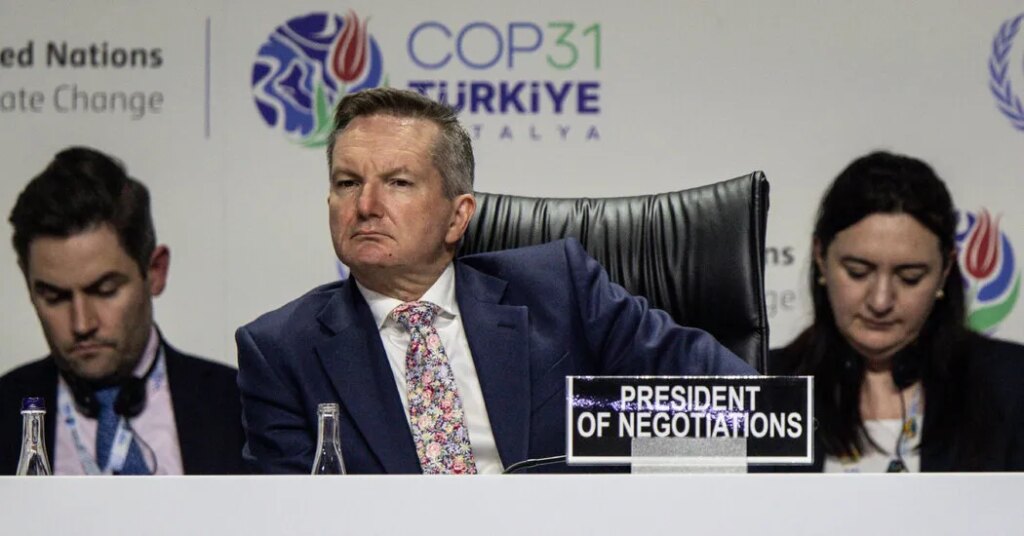
After 12 days of meetings and nearly 50 hours of overtime, the talks broke down in deadlock after Saudi Arabia and Russia, leading a group of oil and gas exporting nations, refused to allow a final declaration with any mention of transitioning away from the fossil fuels that are dangerously heating the planet.
Roughly 90 countries — including the European Union and small island states — walked away rather than sign what they viewed as an empty deal.
“This is one of the darkest hours in the history of climate negotiations,” said Mark Watts, the executive director of C40 Cities, a coalition of nearly 100 mayors around the world working on climate change.
Designed to give every country a voice, the rules of the U.N. climate body require consensus among nearly 200 countries in order to approve an agreement. In practice, that enables a small group of countries, or even a single nation, to derail a deal.
“It is clearly imperfect,” Wopke Hoekstra, the European Union’s commissioner for climate change, said on Sunday as talks broke down.
The collapse in Turkey comes at a particularly challenging moment for international cooperation. During the same weekend, a U.N. conference on regulating lethal autonomous weapons ended in an impasse, with countries unable to agree to ban or limit the use of the technology.
And as negotiations stalled over climate, President Trump and the leaders of China and Russia agreed to “increase the production and supply” of petroleum to bring down the cost of fuel that has soared because of the war in Iran.
Now, governments, investors and climate advocates are increasingly looking past the U.N. negotiating halls toward smaller diplomatic alliances, trade rules and market forces to see what can still move forward before global temperatures are expected to shatter another record in 2027.
A push for smaller, faster pacts
Increasingly, leaders are arguing that the future of climate action may lie outside the United Nations.
This year, 57 countries attended the first conference on transitioning away from fossil fuels in Santa Marta, Colombia. Another meeting is planned for next year, co-hosted by Ireland and Tuvalu. European leaders said they intended to work with that bloc and other groups committed to bolstering clean energy and protecting vulnerable countries.
Local action will also take on more importance, from approving wind farms to installing electric vehicle charging stations and expanding incentives for rooftop solar.
Al Gore, the former vice president, called on the United Nations to find ways to “empower” mayors, governors, businesses and others that are acting faster than national governments.
Some leaders and activists are turning to legal action. States like New York and Vermont have tried to require fossil fuel companies to pay for the effects of climate change based on their historic greenhouse gas emissions, though those efforts are facing legal challenges. Some activists say they are considering taking more climate cases to the International Court of Justice.
Economics, not politics
Even if the world’s political process staggers, economics can help push along some climate progress. The plummeting prices of solar panels and wind energy have given them a cost advantage over fossil fuels in most parts of the world.
“In an era of cheaper clean energy solutions, geopolitical competition and energy insecurity, new mechanisms come to matter even more than U.N. negotiations,” said Jason Bordoff, the founding director of the Center on Global Energy Policy at Columbia University.
He called the U.N. climate body “built for a different era.”
Still, markets alone cannot solve every part of the crisis. Marshaling the trillions of dollars that poorer countries need to recover from intensifying disasters requires political will and international cooperation that remain in short supply. That’s especially true as long as the United States, the world’s wealthiest country and largest emitter in history, remains on the sidelines.
What happens at COP32 next year?
The breakdown leaves a cloud over the next global climate summit, to be held in Ethiopia. It would be the first time in 16 years the talks have been held in sub-Saharan Africa, and it will fall to one of the world’s poorest and most vulnerable nations to restore credibility in the system.
Many of the political forces that derailed the talks this year are not expected to disappear. The United States has no plans to return to the negotiating table during the Trump administration.
“The United States is focused on common sense, not climate nonsense,” Taylor Rogers, a White House spokeswoman, said in a statement about the climate talks.
There’s also deep uncertainty within the United Nations. António Guterres, the secretary general, has been an advocate for a transition to solar, wind and other renewable energy. But he is stepping down next month after two terms. In January, the United Nations is expected to elect a new leader, and it remains to be seen whether climate change will be a priority for Mr. Guterres’s successor.
Yet there may also be some positive developments. Ethiopia will manage next year’s negotiations on its own with support from the United Nations, which many said should avoid the friction that came with two countries, Turkey and Australia, trying to share the gavel under an awkward co-presidency.
Jennifer Morgan, a veteran of U.N. talks and Germany’s former lead negotiator, called the management of Chris Bowen, Australia’s climate minister, and his Turkish partner, Murat Kurum, “unprecedentedly poor.”
In the meantime, diplomats from vulnerable countries said they were working with the incoming Ethiopian hosts to make sure their voices are heard next year even as others work to reform the overall system. With no other global forum available, they said they had no choice.
“The process needs serious fixing, but it is still the only place where the smallest island nation sits at the same table as the biggest polluter,” said Harjeet Singh, a climate activist at the talks. “We can’t walk away from it.”
Mr. Hoekstra said nations remain committed to “do whatever we can” to fix the U.N. climate body, adding, “Even though, let’s admit, that will be hard.”
The post The U.N. Climate Talks Broke Down. Now What? appeared first on New York Times.