If someone asked which shift or flip was most surprising in this year’s blue tsunami, you might be hard-pressed to choose. Kansas elected its first Democratic senator in nearly a century. Republicans lost every statewide race in Texas. With Democrats winning in South Carolina and Mississippi, conventional wisdom about what counts as a battleground went completely out the window.
And then there’s Utah.
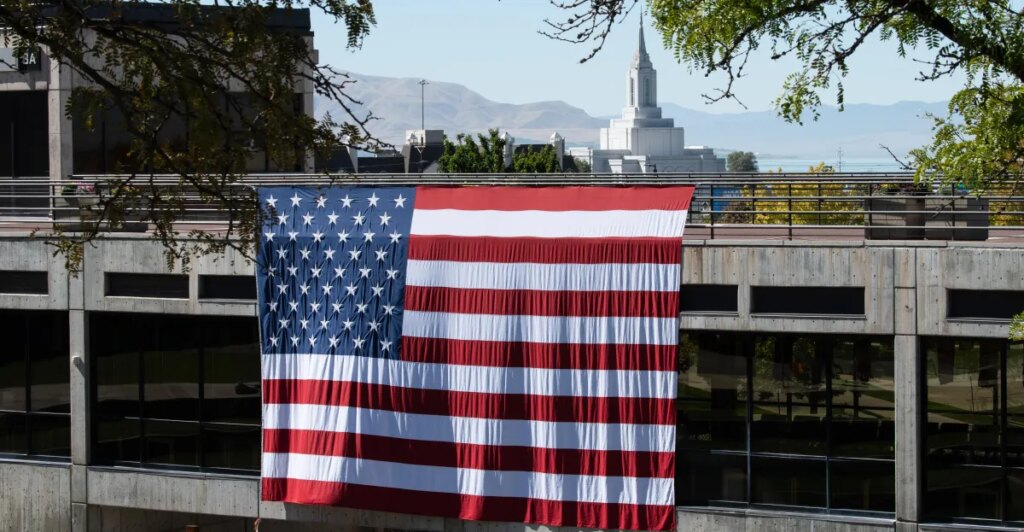
A state that last voted for a Democratic presidential candidate in 1964; a bastion of cultural conservatism and business-friendly politics; the home of Mitt Romney and the Mormon church. And now…although a handful of votes are still waiting to be counted, it looks like, for the first time in decades, more votes were cast for Democrats than Republicans in Utah this cycle.
Is this just another high spot for a fluke blue wave — or a pivot in American political history?
For Democrats, the results have led to some improbable dreams about “Blutah,” a middle-of-the-nation state that, like Colorado, could be swinging from a GOP stronghold into a Democratic opportunity. It’s not yet clear how likely that is; there was no galvanizing statewide race on the Utah ballot this year, and registered Republicans still dramatically outnumber Democrats. The 2026 results could just be a phenomenon of a blue-wave midterm year, where the absence of a presidential contest left more Republican-friendly voters at home.
But the Utah results didn’t come out of nowhere. There have been signs throughout the last decade of simmering discontent with the Trump-era Republican Party — some of which are specific to Utah, and some of which connect to trends that extend far beyond its borders. What happened in the midterms may be a preview of a future political coalition that was hard to imagine at the start of the Trump era.
The state as a whole has changed dramatically in the last 15 years, experiencing a population boom, racial diversification, and an influx of both wealthier, college-educated residents as well as those looking for a more affordable state in which to live. At the same time, the makeup and ideological views of Mormons — members of the Church of Jesus Christ of Latter-day Saints, the state’s most influential institution — have also changed during the Trump era.
Those two shifting electorates foreshadow both a reordering of state politics and a broader trend in American society: that youth, racial diversity, and secularization may continue to turn uncontested or unchanging territory into competitive battlegrounds in the future.
MAGA and Mormonism have never fully gotten along
It’s impossible to talk about Utah politics without talking about Mormons, the most influential segment of the Utah electorate. Though their share of the state population has declined over the last decade, they still make up anywhere from 40 percent to 60 percent of the state, depending on how you measure Mormon identity. Nationally, Mormons make up about 2 percent of the population, one of the five largest Christian denominations in the US. And they’ve tended to back Republicans by lopsided margins that rival only white evangelical Christians.
Despite their conservative streak and history, Mormons have had an uneasy relationship with the MAGA-era GOP, and the results suggest that may now be getting worse. Though officially nonpartisan, Mormon leaders have pushed for social justice initiatives that contrast with the Trump agenda, and were early critics of the president’s immigration campaign promises back in 2016 (when a Church-backed newspaper called on President Donald Trump to leave the race after the Access Hollywood scandal). Some have questioned his commitment to conservative social politics. The most prominent Mormons involved in politics — Romney, Gov. Spencer Cox, independent Evan McMullin, and current Sen. John Curtis — have staked out territory as Trump skeptics or antidotes.
Though it seems long ago, Trump came in last place during the state’s 2016 Republican presidential primary, winning just 14 percent of the vote, while McMullin ran as an independent during the general election and siphoned votes from Trump. Trump support has remained very soft in Utah. And those tensions bubbled to the surface again in 2022, when Sen. Mike Lee faced a surprisingly competitive challenge from McMullin. Romney, at the time Lee’s Republican colleague in the Senate, pointedly refused to endorse him, while church leadership was reportedly frustrated with Lee’s MAGA turn. (Lee’s coming reelection fight may turn out to be the next big test of “Blutah.”)
Beyond the personal gripes Mormon voters and leaders may have had with Trump, their alienation from the Trump-era GOP has some deeper causes. Immigration politics have always been a sticking point for this global church. Young Mormons famously must go on evangelizing missions as part of their faith formation; those assignments place them in diverse and heterogeneous places, especially abroad, and color the experiences of older church and political leaders. The church has expanded rapidly outside of the US, with new temples being constructed in Africa and Latin America.
The anti-immigrant turn of the Trump-era GOP fits poorly with this cosmopolitan worldview. Church leadership has spent the last decade projecting a moderate voice on immigration while trying not to antagonize the administration, occasionally speaking about enforcement policies domestically. That mismatch doesn’t necessarily make Mormons into natural Democrats, but it does make them a bad fit for MAGA Republicanism.
The post-pandemic GOP’s embrace of Christian nationalist rhetoric and ideology has also tested its bonds with Mormonism. In June, Pete Hegseth’s Pentagon temporarily branded Mormonism a non-Christian religion. The attacks by various segments of MAGA on Muslims and Jews, and the broader movement on the right to chip away at the separation of church and state, all sit badly with a church whose own roots are in a refugee community that suffered official persecution.
“LDS members are very sensitive to attacks on religious minorities because they themselves are a religious minority,” Dave Campbell, a longtime religion and politics scholar at the University of Notre Dame and expert in Mormon politics, told me. “They see themselves as under attack when they hear other minority religions being attacked.”
The Mormon electorate is changing, too
The religious, social, and cultural differences between the church and MAGA are also being driven by a broader generational divide between younger LDS members and older ones, Campbell told me. Younger LDS voters are simply less likely to identify with the GOP, vote for Republican candidates, agree with the church’s conservative social teachings, and be personally devout, he said. They are more racially diverse, are more comfortable with same-sex relationships, and less strict on abortion politics, Campbell said.
“These are young people who are generally more liberal, not just religiously, but also politically,” Campbell told me.
The data show that younger Mormons are less likely to identify with the Republican Party than those older than 40, according to the religion and politics scholar Ryan Burge. An overwhelming majority of the oldest Mormons, 77 percent, identify with the GOP, but among Mormons under 30 that share shrinks to 40 percent. In the past three presidential elections, younger LDS voters have been less likely to back Trump than older LDS voters — a split also reflected in early 2026 results.
That consistently lower support for the GOP from younger Mormons suggests a couple of things, Campbell told me. One is that they’re a clear target for Democrats trying to build a new coalition: The GOP will have a hard time recovering reputationally with these voters, he said. The other is that LDS voters used to be pretty distinct as a voting bloc. They now seem… well… pretty much like the average American.
“LDS folks, and certainly church leaders, often speak of church members as being distinctive. The term that’s often used is that they are a peculiar people,” Campbell said. But now, looking at the 2026 results, he said: “They were reacting the way the rest of the country was, in spite of the peculiarity that they like to tell themselves they have.”
Utah’s electorate as a whole is transforming
At the same time as Utah’s LDS population has experienced all this change, the non-Mormon electorate has also gone through tumult, becoming younger, more racially diverse, better educated, and more secular — the kinds of ingredients necessary for a state-level political realignment.
Utah’s population has nearly doubled over the last two decades, driven by a combination of natural birth and a steady rate of in-migration from non-Mormons, who have diversified urban and suburban parts of the state.
A lot of that change was already underway before the coronavirus pandemic — Utah led the nation as the state with the fastest rate of growth from 2010 to 2020. But post-pandemic migration into the state, especially from California, has taken on a bigger role in the state’s growth, primarily by residents looking for a more affordable place to live. Those new residents also tend to be more racially diverse: though still very white (about three-quarters of the population), that share has declined by 10 points since 2000. Cities like Provo and Salt Lake City suburbs of West Valley City and Taylorsville have seen dramatic growth in the Latino population, while a quarter of the state’s growth as a whole in that decade was driven by Latino residents. These are exactly the regions that have seen shifts away from the MAGA GOP — and where Democrats have been improving their vote totals from 2012 to 2022.
Adding to this picture is one other noticeable trend that makes Mormons look similar to other religious groups: religious disaffiliation and secularization are rising. The state is growing more secular, and those who leave the LDS faith in particular seem to be much more critical or antipathetic to the religion they just left. The result: former Mormons tend to be much more politically liberal than those who remain, and they shift more than those who leave other Christian churches.
“When they leave the LDS church, they typically leave religion altogether,” Campbell told me. “It’s also the case that they are quite far to the left politically…so not only would they be Democrats, but often they would be on the left wing of the Democratic Party — the DSA type.”
This rising coalition of disaffiliated Mormons, moderate Mormons, liberal college-educated voters, and nonwhite voters were who made Lee’s 2022 Senate victory such a close contest. And the 2026 results are only adding to the sense that Utah is genuinely in play.
Quin Monson, a longtime scholar of Mormonism and politics at Brigham Young University, told me that while the 2026 Democratic overperformance was primarily driven by MAGA Republicans staying home and more Democratic voters turning out, there are still clear data points that non-MAGA Republicans and Mormon voters decided to change their votes this time around.
In data he analyzed from BYU’s Utah Voter Poll, and shared first with Vox, he found that about two-fifths of the Democratic vote came as a result of Republicans, LDS voters, and independents crossing the political aisle to cast votes for Democrats. The result: Democratic support among LDS voters more than doubled from 13 percent to 28 percent.
He noted that this isn’t necessarily the start of a massive realignment toward Democrats — but it does suggest the trend of moderate LDS voters, and young voters in particular, having weaker loyalty to the GOP.
Looking ahead to the quest to beat the Trump-friendly Lee for a Senate seat in 2028, Democrats are already scouring the state for the next Adam Hamilton – the type of candidate who could bring disaffected religious moderates into a coalition against an unpopular Republican incumbent.
“There’s no question in my mind that the most effective way to appeal to Utahns is going to be with a Democrat who is going to make [religious] Utahns feel comfortable,” Brian King, the Utah state Democratic Party chair, told me. “I think if James Talarico is in Utah and ran the kind of race that he ran, or Adam Hamilton was in Utah and ran the kind of race that he ran, it would be resonating for Mormons as well as non-Mormons,” King said.
This all suggests that the dream of Blutah might be tantalizingly close; Monson said he imagines “there’s a pretty good chance that Utah will elect a Democrat statewide in the next 15 years,” even if it doesn’t happen in 2028.
But perhaps more importantly for those watching from outside, the Utah vote shows a few things: that the national trends that have made more parts of the US more competitive in election seasons — diversification, assimilation, secularization, education polarization, urbanization, and affordability politics — are strong enough to move a reliably red state closer to purple. We just went through an election cycle that pitted some of these factors against strong partisanship and polarization, only to see the latter fall. That march seems likely to continue.
And they also tell a story of American religion, and how the most peculiar people can come to experience the same kinds of shifts that other minority groups have experienced as they enter the mainstream. American Mormonism, like other Christian faith traditions, is going through a period of transformation. Strains of Christian nationalist sentiment are entering the church at the same time as its younger cohort seems less inclined to follow in older generations’ footsteps. Blutah is exciting — but its advance is about a lot more than winning the popular vote.
The post Democrats’ tantalizing dream of a Blue Utah appeared first on Vox.