In today’s edition … House Democrats will have a 21st-century record majority … I want to know about your Thanksgiving plans … but first …
Who is ready for some presidential debates?
It’s still 2026. But get ready for the 2028 presidential race to start soon.
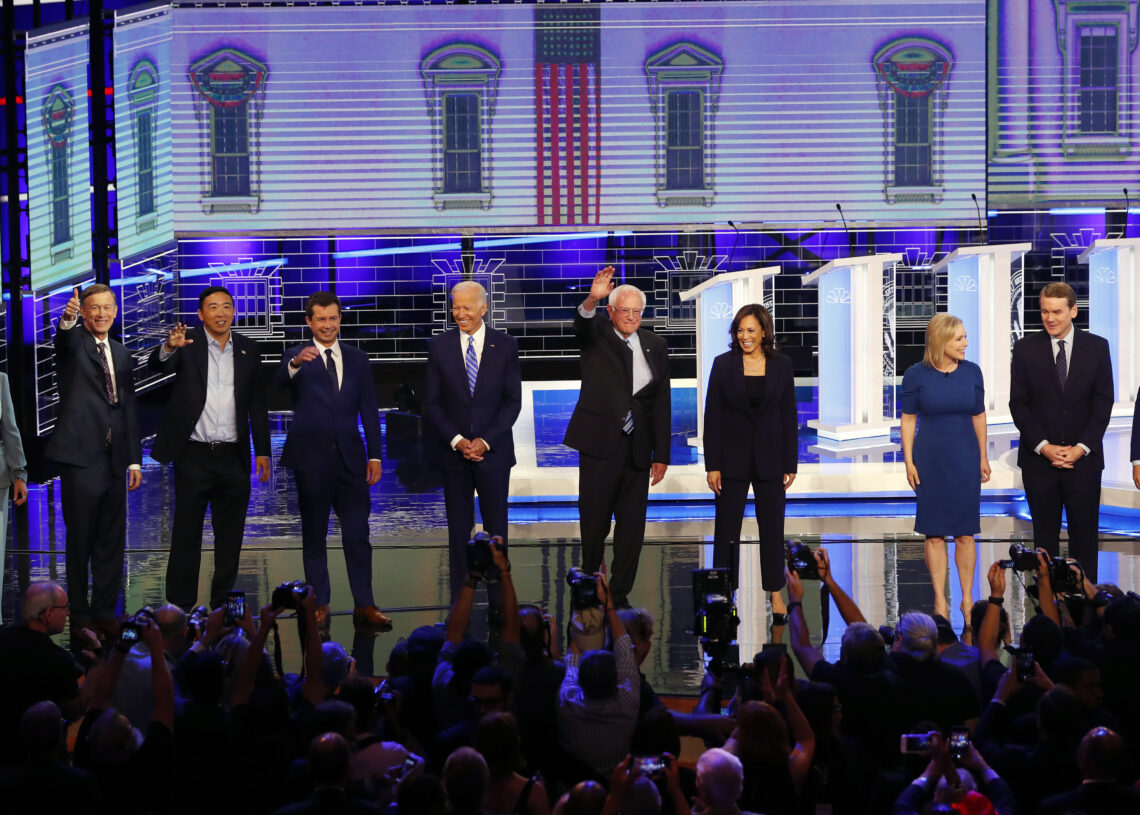
I reported with Isaac Arnsdorf this morning that the Democratic National Committee announced plans for a dozen presidential primary debates beginning in June, along with new rules requiring potential candidates to denounce unlimited outside spending on their behalf.
“Democrats are on offense after our historic victories in the midterms, and the DNC is keeping our foot on the gas as we head into the 2028 cycle,” Democratic National Committee Chair Ken Martin said in a statement.
The announcement sets the terms for what could be a crowded 2028 contest. As we report, political operations for likely candidates, including Gov. Josh Shapiro (Pennsylvania), Rep. Ro Khanna (California), Gov. Andy Beshear (Kentucky) and Gov. Wes Moore (Maryland), have begun interviewing potential staff, according to people familiar with the discussions who spoke on the condition of anonymity to share those private conversations. And Gov. Gavin Newsom (California) has told reporters he will decide whether to run in January.
“I don’t think anyone wants politics over Thanksgiving and Christmas, so I’ll probably take time with my family and then make a decision,” Khanna told me earlier this month.
Here are the broad strokes of the Democratic committee’s announcement:
- The schedule, with five debates next year and seven more in 2028, resembles the one Democrats used in the 2020 cycle, when roughly two dozen candidates competed for the nomination.
- The party is seeking to limit unchecked outside spending in the primary by requiring debate participants, for the first time, to denounce spending on their behalf by super PACs, which can accept unlimited donations, and nonprofits that don’t disclose their donors. It’s a complex process — the committee released a website that explains its details — that could be tough to navigate for both the committee and the campaigns. A committee spokesperson said the plan received support from a range of Democrats, from Reps. Greg Casar (Texas) and Jason Crow (Colorado) to Sens. Andy Kim (New Jersey) and Elizabeth Warren (Massachusetts), as well as Sen. Bernie Sanders (I-Vermont), who caucuses with Democrats.
- The DNC will base debate eligibility on polls and grassroots fundraising. Early debates may be held over two consecutive nights, with candidates randomly assigned to groups of 10, as in 2020. The committee plans to announce additional criteria in January.
We learned while reporting this piece that the committee considered starting debates as early as April or May, a timeline supported by some campaigns and television networks, according to four people involved in the discussions who spoke on the condition of anonymity because such conversations were private. Martin has told some Democrats he wanted to begin the debates in May — which would have been the earliest kickoff since 2007 — but at least three potential campaigns objected to that early timeline. A committee spokesperson said the committee considered a variety of options but ultimately landed on June with Martin’s support.
We documented in this newsletter on Friday how the 2028 nominating process may take a little longer to get moving as Democrats take the time to bask in their massive midterm victories before turning their attention to yet another election.
And this Democratic debate rollout feels like another data point in this trend. If Democrats hadn’t won as big earlier this month, the committee may have been more inclined to put an early debate on the calendar to jump-start the White House primary. Instead, Democrats in the House and Senate will effectively get a full six months to own the party’s messaging before the 2028 debates begin.
You can read our story on the planned debates here.
Want this in your inbox?
Start your day with The Washington Post’s flagship political newsletter. Sign up here.
From across the newsroom
- How Nvidia fought for years in Washington to sell its prized chips to China, from Ian Duncan.
- Trump keeps losing in court. Here’s how he gets what he wants anyway, from Justin Jouvenal.
- The remarkable recovery of a National Guardsman shot near the White House, from Brady Dennis.
- A lifelong brawler is coming to Congress. Does he have a next act? from Anna Liss-Roy.
- The district Alabama remade — and the congressman who held on, from Robert Samuels.
- GOP set to block Trump Pentagon picks as other military moves face headwinds, from Noah Robertson and Michael Birnbaum.
What I’m watching
It’s official: House Democrats will begin next year with the largest majority of the 21st century, a resounding victory for the party and a dramatic loss for Republicans.
The record was set on Sunday when the Associated Press called Chuck Hubbard’s race in North Carolina, defeating longtime Republican Rep. Virginia Foxx, chairwoman of the House Rules Committee.
As my colleague Mariana Alfaro wrote on Sunday, Hubbard’s win brings the total House Democratic count to 258, with four races still uncalled — one in Tennessee, one in Minnesota and two in Louisiana. Republicans so far have claimed 173 seats.
The record also cements the conclusion that this was unquestionably a wave election for Democrats, one that surpassed even the most upbeat Democratic predictions earlier this year.
Now what will Democrats do with this House majority? The size of the Democratic bloc in the House gives Hakeem Jeffries, who will likely become House speaker, a lot of leeway to pursue a slate of priorities, with affordability probably the party’s focus from the outset.
But I am going to be watching closely whether Democrats actually take on ethics reform, given so many of the elections won this cycle were defined by a focus on corruption in Washington.
“I want to make sure that we’re working on an anti-corruption platform from day one and putting things on the table even though they’re uncomfortable for members that have been there a while,” Paige Cognetti, the newly elected House Democrat from northeast Pennsylvania, told me after her win. The Scranton mayor defeated Republican Rep. Rob Bresnahan with a corruption-focused campaign.
Cognetti told me she wants Congress to consider implementing term limits, a ban on corporate PAC money, a ban on stock trading by members of Congress, and a rule that members of Congress are not paid if they do not pass a budget.
“It’s very important that we show the American people that we understand that the wins on Tuesday night are not a mandate for Democrats. They are a directive from the American people to go push the corruption out of the system, lower costs and move our country forward,” she said.
In your local paper
Louisiana Illuminator: Sen. John Kennedy, a Louisiana Republican considering a 2028 presidential run, told NBC News yesterday that he’s unlikely to seek the presidency, saying he would only enter the race “if I really get fed up.”
Maryland Matters: Sens. Angela Alsobrooks and Chris Van Hollen, Maryland’s two Democratic senators, reportedly remain cordial, despite Alsobrooks supporting Sen. Chuck Schumer over Van Hollen for majority leader. But the break has roiled Maryland politics, with Alsobrooks facing protests over her decision.
The Seattle Times: Seattle airport officials are outraged at the arrest of a father and daughter at the airport this weekend. Video of the arrest went viral.
From you
Many of you are very excited to spend Thanksgiving cooking, eating and, yes, watching sports.
“At least for Thanksgiving Day, as a Bills fan, I’m thinking Bills vs Chiefs Day, though I should be thinking, life for me is not a burden, and I’m grateful. Still, we seem to accommodate smack-talk about sports better than political or religious talk,” wrote John Perryman.
“One of my earliest Thanksgiving memories: I am in the kitchen watching my grandmother preparing dinner. It’s warm. There’s the smell of turkey and pumpkin. Then, from the living room, I hear my grandfather shout, ‘Go, Griese, Go!’ My five-year-old brain thinks ‘Greasy?’ The Miami Dolphins were playing, and Bob Griese was the quarterback. The memory makes me smile every year. It’s really not Thanksgiving without the sound of football in the background,” added Lori Michalec.
And Bonita Migliore added, “I have no problem watching sports during the holidays. As a child I watched my dad live on the couch watching sports incessantly for years during the holidays. If you don’t like watching sports, then don’t watch them.”
Not everyone is excited.
“You make an assumption that everyone likes sports. I disagree, and could not care less about overpaid people who play a ‘game’ while there are many more important things to be concerned about,” wrote Rich Kunkel.
And Doug Lynch added: “For what it’s worth, I pretty much ignore all the televised sports. I find it annoying that you can’t get away from them during the holidays.”
Send a reply
I’ll keep it simple today: How do you celebrate Thanksgiving? Family? Friends? Food? Unique traditions? I want to hear them. Let me and your fellow Early Brief readers know at [email protected].
Thanks for reading. You can follow me on X at @merica.
The post Who is ready for some presidential debates? appeared first on Washington Post.